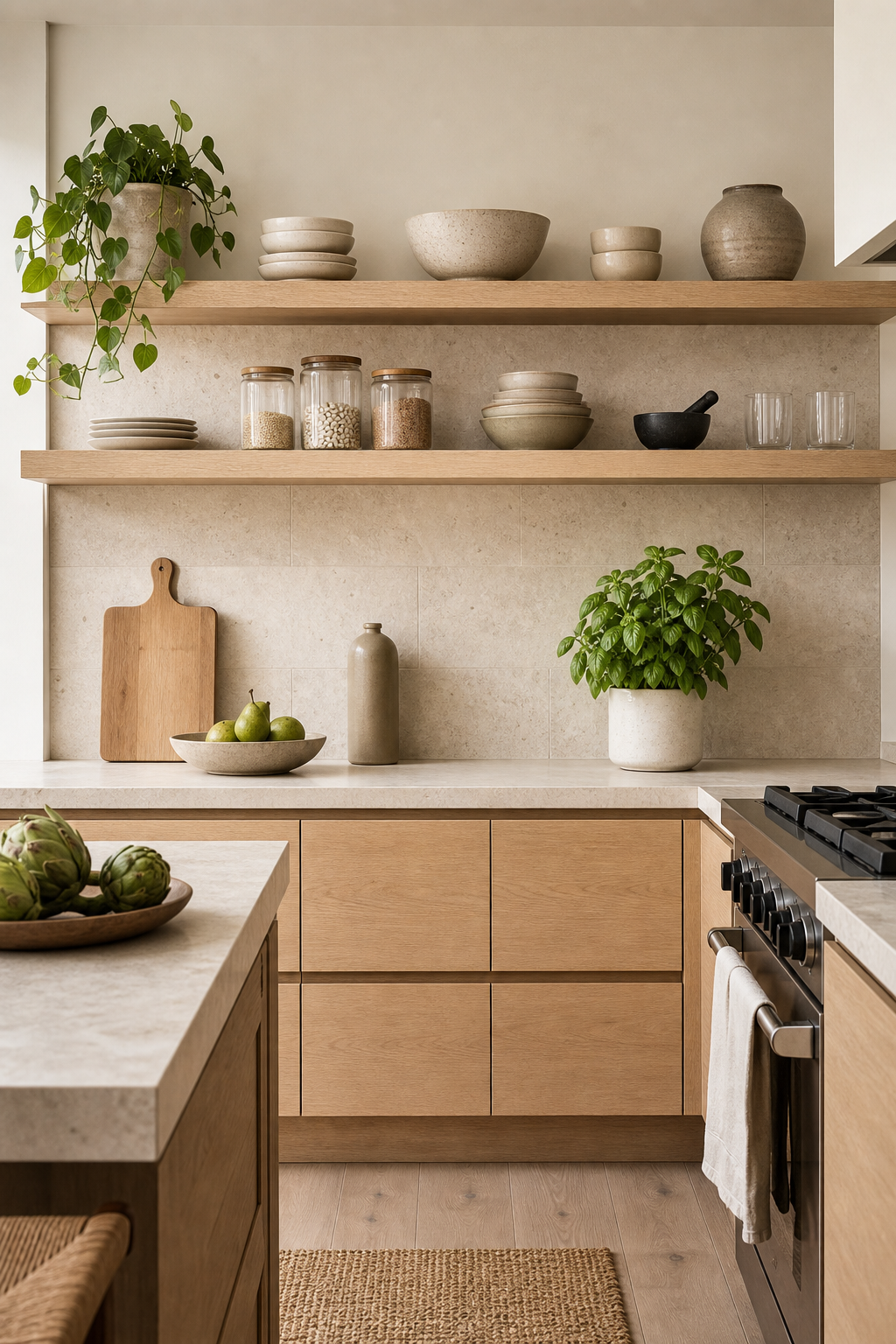

Two continuous shelves define this kitchen more strongly than any single accessory. They stretch across the pale tiled wall, holding dishes, vessels, glassware, jars, and plants in low clusters. Their length gives the display architectural weight, while the generous gaps between objects keep the working wall from resembling crowded pantry storage.
The open arrangement succeeds because it is supported by a calm base. Warm wood-toned lower cabinets run beneath a pale counter; the range occupies the right; and the foreground island edge remains largely clear. Storage is visible, but it stays within a disciplined horizontal zone above the primary preparation surface.
Two Shelf Lines Organize Objects by Height
The lower shelf holds frequently legible pieces such as stacked plates, bowls, and glasses, while the upper line accommodates jars, taller vessels, and trailing foliage. This is a visible hierarchy rather than an assumption about daily use: shorter objects sit closer to the counter, and taller silhouettes have more open wall around them above.
Both shelves maintain a consistent thickness and warm tone, creating two strong lines against the pale rectangular tiles. Their repetition is enough to make mixed objects feel related. Extra brackets or decorative trim would introduce another rhythm where the dishes and tile joints already provide considerable detail.
Pale Tile Makes the Display Easy to Read
Small light-toned tiles cover the wall from counter to above the highest shelf. Their regular joints create a fine grid behind irregular bowls, stems, and jars. Because the background remains close in value, shadows beneath each shelf supply most of the depth rather than a dramatic color contrast.
The exact tile composition cannot be established from the image. Its design role is clearer: it gives the open display a washable-looking, continuous visual field and reflects side light into the spaces between objects. Naming a specific stone or ceramic finish would add certainty the photograph does not support.
Edited Groupings Preserve Useful Counter Space
Objects are gathered into short sequences rather than spread evenly from end to end. A stack of bowls may sit beside glasses, then yield to a visible stretch of wall before the next vessel. Those intervals prevent the shelves from turning into one uninterrupted band of small items.
Most of the counter below remains open, with accessories kept close to the backsplash. This separation protects a real working depth at the front edge. Open shelving is more convincing when it does not require the countertop to become a second display shelf merely to complete the composition.
Plants Soften the Long Horizontal Edges
Greenery appears near shelf ends and in a few upper positions. Fine leaves break the rigid shelf lines and connect them to the more organic shapes of bowls and vessels. The plants remain small enough that they do not cover the dishes or create a curtain across the tile.
A larger plant sits near the outer counter, giving the lower elevation a related but separate vertical accent. Concentrating foliage at edges keeps the central working zone legible. The visible strategy is placement and scale, not a claim about species or care requirements.
Warm Lower Cabinets Ground the Open Upper Wall
Flat wood-toned cabinet fronts form a continuous base beneath the pale counter. Their larger, quieter surfaces balance the fragmented display above. If upper cabinetry had matched that full mass, the wall would feel enclosed; if the base were equally open, the many small objects would lack a stable visual foundation.
The Range Marks a Functional End Point
A dark range occupies the right side and creates a clear stop to the shelf composition. Its stronger outline prevents the two long boards from appearing to drift indefinitely across the wall. The island edge in the foreground provides another horizontal layer but remains low enough that the display stays visible from the room.
To adapt this arrangement, establish one uninterrupted shelf span, reserve clear counter depth below, and edit objects into groups with actual gaps. Choose shelf depth from the largest visible dish rather than from decorative ambition. The room feels organic because useful pieces, grain, plants, and tile are allowed to remain distinct.
The woven textile on the floor runs parallel to the lower cabinet line and introduces texture below the smooth counter. Its narrow position preserves exposed flooring at the island edge, so the working route remains visually distinct from the display wall.