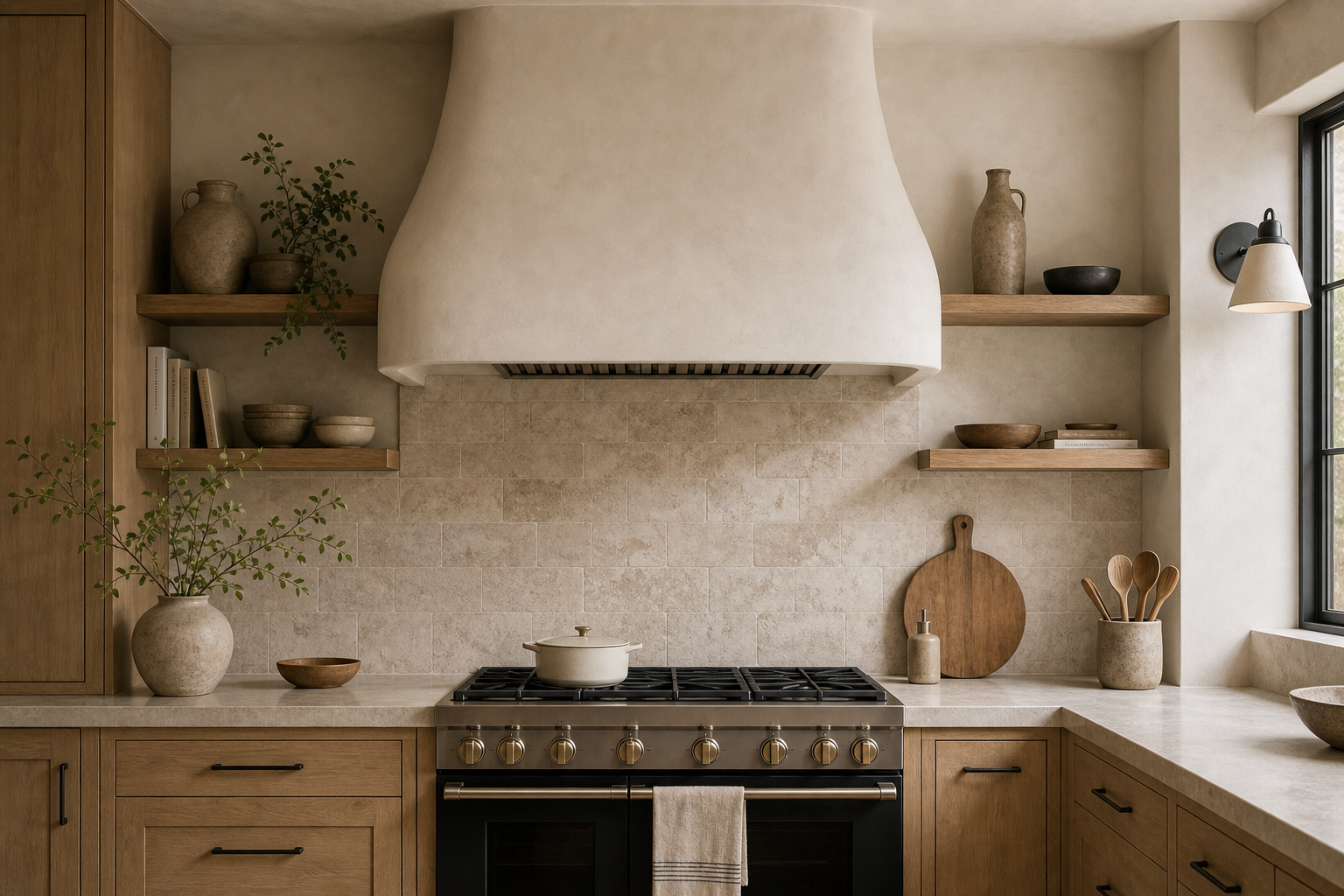

The range hood is shaped as a broad architectural volume rather than a conventional appliance cover. Its pale textured body widens gently from ceiling to a curved lower edge, centering the black range while leaving timber shelves visible on both sides. The oversized form gives the cooking wall a calm focal point without relying on color contrast or ornamental trim.
Everything around it is lower and more linear. A pale rectangular backsplash stops beneath the hood and shelves, timber-toned counters run across the wall, and warm flat-front cabinets create a grounded base. Pottery, books, boards, utensils, and branches occupy the edges, allowing the central hood-and-range axis to remain visually clear.
The Hood Uses Curvature to Establish Hierarchy
The hood begins as a narrower ceiling connection and expands into a wide bell-like body above the range. Rounded transitions eliminate the hard box profile common to wall-mounted hoods. Its lower edge projects enough to cast a shadow over the dark vent opening, making the volume legible against the similarly pale wall.
Exact construction and finish composition cannot be confirmed. The defensible design lesson is massing: a continuous light-toned shell can become the wall's dominant form when its width, taper, and projection are coordinated with the appliance below.
The Range Gives the Pale Volume a Dark Base
A broad black-and-metal range sits directly below the hood, with its center aligned to the hood's deepest curve. Dark grates and oven fronts create a firm rectangular counterpoint to the soft pale shape. A light pot and striped towel break up the appliance without hiding its width.
The contrast is concentrated in one functional zone. Black pulls repeat across the lower cabinetry, and a black-framed window and wall light appear at the right, but no other large dark block competes with the range.
The Backsplash Creates a Textured Middle Layer
Warm pale rectangular units fill the wall between counter and hood, with subtle tonal variation visible across their faces. The backsplash extends behind both shelf zones and meets the hood at a clean central boundary. Its smaller scale gives the broad hood a textured field without challenging its silhouette.
Material type should not be guessed beyond the visible tile-like surface. What matters is the relationship: quiet joints introduce detail at eye level while hood and cabinetry remain larger, simpler forms.
Open Shelves Balance Both Sides of the Hood
Two timber-toned shelves sit on each side at matching heights. Upper shelves hold large vessels, bowls, and trailing greenery; lower shelves carry books, smaller bowls, and a shallow vessel. Their aligned edges create horizontal balance around the curved center.
The displays are not mirrored object for object. Varying silhouettes keep the wall relaxed while shelf positions preserve order. Empty backsplash between pieces prevents the side zones from becoming dense visual cabinets.
Cabinetry Maintains a Continuous Working Base
Warm timber-toned drawers and doors run beneath pale counters on both sides of the range. Broad framed fronts and long black pulls produce a steady lower rhythm. A tall cabinet at the left terminates the elevation, while the counter turns toward the window on the right.
Only exterior fronts are visible, so interior storage should not be described. Their contribution is compositional: one continuous furniture-toned base supports the pale upper architecture and prevents the range from standing alone.
The Side Window Adds Directional Daylight
A tall black-framed window brightens the right counter and reveals the backsplash's uneven tone. A small wall light occupies the return beside it, but remains secondary to daylight. Branches, a round board, wooden utensils, and one dark bowl gain clear silhouettes in this brighter zone.
The window's dark frame also balances the appliance mass across the wall. That distant repetition keeps contrast distributed without introducing another focal object next to the hood.
Organic Character Comes from Shape and Texture
Curved hood, rounded pottery, open branches, timber grain, and softly varied pale surfaces counter the strict range and cabinet lines. The palette stays within warm white, sand, brown, and black, so texture carries more information than color.
For a similar kitchen, size the hood from the range, preserve balanced shelf zones, and let one dark appliance ground the pale form. Keep surrounding display below the hood's strongest curve. The wall feels resolved because one sculptural volume is supported by disciplined horizontal layers.