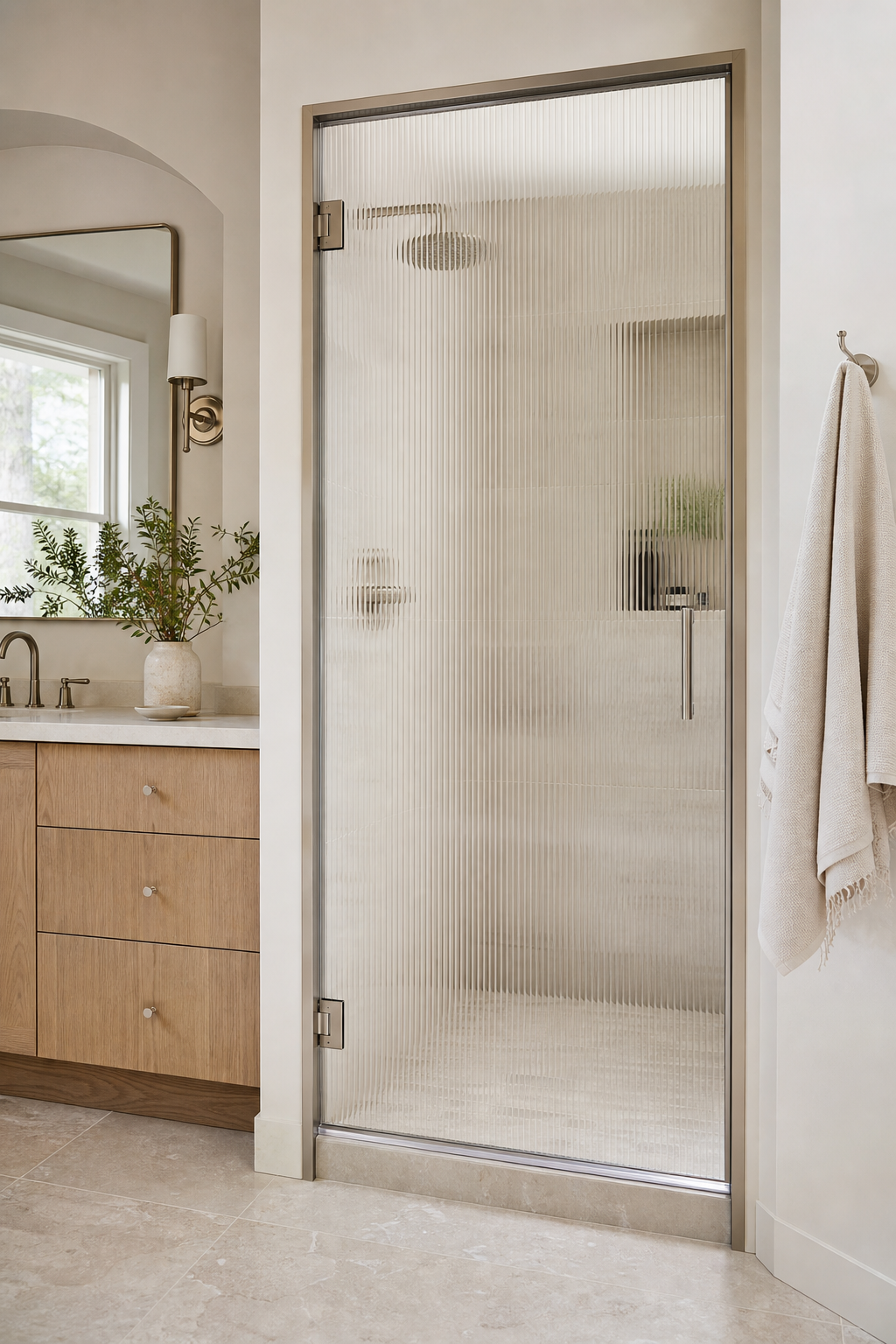

The shower door is more than an enclosure in this compact bathroom: its full-height fluting turns incoming light into a fine vertical rhythm. A slim dark perimeter gives that translucent plane a decisive edge, while the shower beyond remains softly obscured. Pale tile, a timber-toned vanity, a broad mirror, and one towel occupy quieter supporting roles. The room succeeds because privacy is added without sacrificing visual depth.
Fluting Makes Privacy Part of the Elevation
The shower door is the largest vertical surface in the composition, and its ribbed texture immediately catches light. That makes it the main design feature rather than just a functional enclosure. A clear glass door would have exposed the shower more directly. The fluted glass gives the bathroom privacy while keeping the shower zone luminous.
Closely spaced ribs run from top to bottom, bending reflections without turning the panel opaque. The earlier reeded-glass enclosure analysis examines a broader enclosure; this image is distinguished by one dark-framed door plane and its narrow visual footprint.
The Dark Perimeter Gives Soft Glass a Clear Edge
The narrow vertical lines stretch the shower door visually upward. They also blur the objects behind the glass, so the wall feels layered instead of flat. This is especially useful in a transitional bathroom, where texture often has to do the work that pattern would otherwise handle.
The frame is thin beside the wide textured field, so contrast defines the door without dividing it into several heavy sections. The handle repeats that dark line at hand height and supplies the only strong horizontal interruption.
A Full-Height Panel Preserves the Room's Vertical Scale
The brushed slim dark frame outlines the door without making it feel heavy. It gives the textured glass a clean edge and helps the shower opening feel precise. The hinges and handle are visible but restrained, which keeps attention on the glass surface.
Pale Shower Surfaces Remain Legible Through Texture
The pale tile behind the door stays quiet, allowing the fluted texture to remain the stronger feature. Its soft tone also prevents the bathroom from feeling cold. Because the tile and floor sit in the same muted color family, the shower reads as part of the room rather than a separate enclosure.
Through the glass, the shower reads as a pale volume rather than a catalogue of fixtures. That controlled ambiguity is useful in a small room: the enclosure retains depth while routine bathing details do not dominate the view.
The Vanity Establishes a Warmer Parallel Plane
The timber-toned vanity on the left brings warmth to the bathroom and balances the cooler glass and metal. Its simple drawer fronts suit the transitional mix of classic and contemporary details. The mirror and sconce above the vanity also give the shower door a useful visual neighbor, so the wall does not feel empty beside the glass.
Daylight Reveals Rather Than Flattens the Ribbing
The towel hook on the right wall adds a practical vertical note without competing with the shower door. The soft towel texture balances the harder glass and stone. Keeping this side wall quiet is important because the fluted glass already provides enough visual rhythm.
Light arrives from the vanity side and changes across each rib. No exact glazing specification or metal alloy can be confirmed, but the photograph clearly demonstrates how directional daylight gives the surface its dimensional quality.
The Towel Wall Avoids a Second Focal Point
Start by deciding how much privacy the shower needs. Fluted glass is most useful when the bathroom should stay bright but the shower interior should feel softened. Use a slim frame, simple handle and quiet surrounding tile. The glass texture should be the detail, not one detail among many competing finishes.
Choosing an Enclosure That Still Feels Open
I would avoid patterned tile directly beside this door. The vertical glass texture is already the strongest surface movement in the room. I would also avoid heavy black framing here. A darker frame would make the shower feel more industrial and less transitional.
Set the door's width, hinge clearance, and handle position before introducing decorative objects. A thick grid, patterned shower tile, or dark vanity would compete with the single finely textured plane that makes this bathroom memorable.
The door frame meets the pale floor with a narrow dark vertical rather than a broad curb. That precise termination lets the fluted plane appear continuous while the shower boundary remains unmistakable.