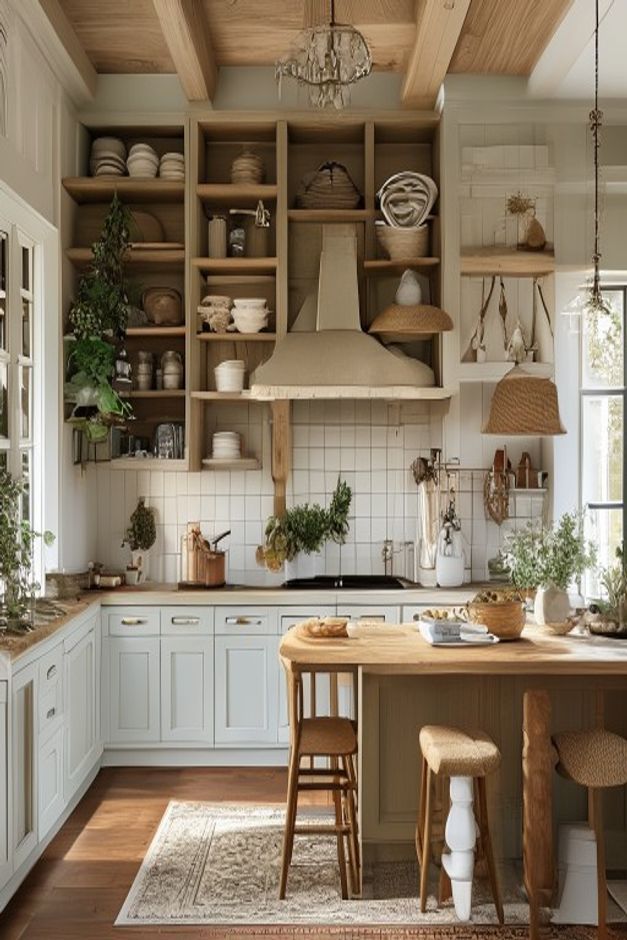
What gives this kitchen credibility is the decision to make storage part of the cooking wall's architecture. Open wood shelves rise around a sculptural hood, filling the space between the pale base cabinets and exposed ceiling beams. Crockery, baskets, plants, and tools are visible, yet the central range zone remains easy to identify.
The room does not chase perfect uniformity. Cabinet fronts are orderly, while the shelf contents vary in height and texture. A wood-topped island occupies the foreground with mismatched-looking stools, adding the informal layer that keeps the tall storage elevation from feeling like a showroom display.
The Hood Creates a Pause Within the Shelf Grid
A broad plaster-like hood interrupts the open shelving at the center. Its sloping form differs from the rectangular cubbies, giving the eye a clear destination above the cooking area. Without that solid shape, the wall would dissolve into a collection of small objects and lose its functional hierarchy.
Square pale tiles behind the range make a calm, washable-looking field beneath the hood. The regular joints provide fine scale while the shelves and beams operate at a larger scale. This layered geometry lets practical surfaces contribute to the country character without relying on decorative signage or motifs.
Shelf Depth Appears Matched to Everyday Objects
Plates, bowls, jars, and baskets sit close to the front edge rather than disappearing into deep recesses. That shallow proportion makes the contents readable and likely easier to reach. It also limits the shadow cast onto the work surface below, an important point on a busy preparation wall.
The arrangement uses clusters instead of a continuous line of crockery. Some bays hold stacked white pieces; others contain a plant, a dark vessel, or open space. The breathing room is not wasted capacity. It is what keeps a large open-storage area from reading as visual clutter.
Pale Base Cabinets Stabilize a Busy Upper Wall
The lower run is composed of quiet paneled doors and drawers in a soft off-white finish. Their repeated widths form a steady base under the varied shelves. Small warm-metal pulls add definition without introducing a dark line across every cabinet front.
A wood worktop bridges the pale joinery and the shelving above. The related cottage kitchen backsplash wall illustrates another way tile can organize a traditional cooking elevation, but here the backsplash deliberately recedes behind the hood and stored objects.
The Island Adds Work Space Without Blocking the Range
The island is narrow enough to preserve a visible aisle to the L-shaped base cabinets. Its thick wood top introduces a broad horizontal plane in front of the highly vertical shelf wall. A rounded support at one corner and varied stools make the freestanding piece feel accumulated rather than factory-matched.
Objects on the top remain low, so the sightline to the range is not obstructed. This is a practical styling decision. Tall displays in the center would divide the room and make conversation across the island awkward, while the modest arrangement allows the surface to continue functioning as a work area.
Ceiling Beams Complete the Warm Material Sequence
Light wood beams and boards carry the shelf color overhead, linking the cabinetry wall to the entire room. Their spacing runs across the view and gives the compact kitchen a stronger sense of width. A small glass fixture hangs between them without concealing the timber.
Plants soften several shelf edges and gather near the window, where their placement makes visual sense. They are accents, not the organizing idea. The lasting lesson is to coordinate the hood, shelf dimensions, worktop, and ceiling structure first; loose objects can then express daily life within a disciplined framework.
The Range Wall Keeps Tools Where They Are Seen
Utensils hang near the range, while jars and small vessels sit along the backsplash-level worktop. Their positions make sense for cooking and give the shelf composition a functional lower register. The wall appears active because objects are grouped near the task that uses them.
This practical layer distinguishes the room from a purely decorative country kitchen. Editing is still necessary, but usefulness is not hidden. The most convincing open storage combines visible routine with enough clear counter area to prepare food safely. Here, the sink and range remain visually accessible beneath the busier shelves.