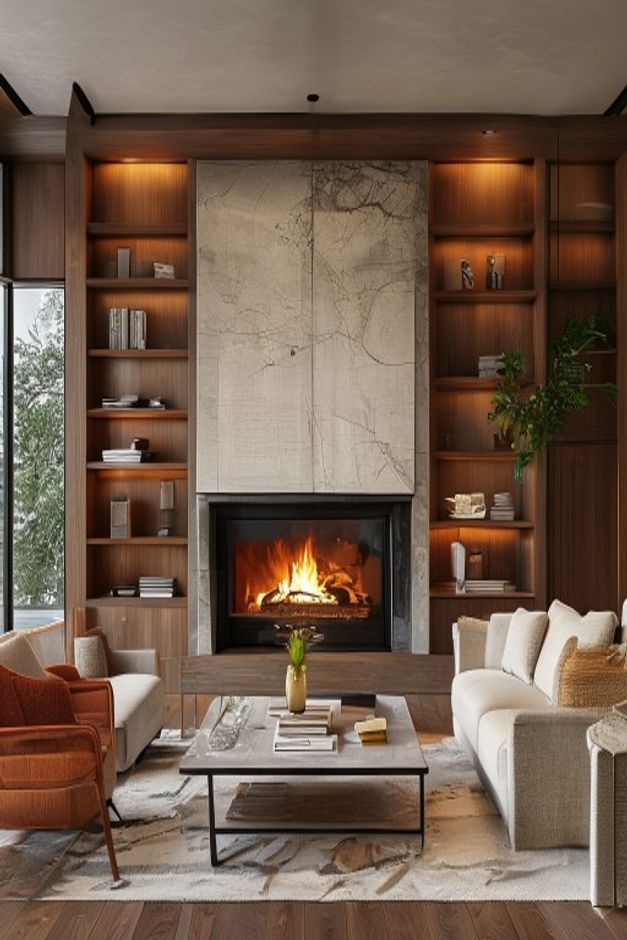

The fireplace wall succeeds because it is designed as a complete elevation rather than a firebox with furniture placed beside it. A tall pale surround occupies the center, while dark warm-wood shelving rises on both sides. The strong central mass and the finer shelf grid give the wall both monumentality and human scale.
Low sofas and an rust-colored lounge chair gather around a rectangular coffee table in the foreground. Their restrained height leaves the entire fireplace composition visible. Daylight from the left and concealed shelf lighting on the right reveal the wood grain, preventing the deep-toned built-ins from becoming a flat backdrop.
The Pale Chimney Breast Holds the Center
Large light-toned panels run from the firebox nearly to the ceiling. Fine irregular markings give the surface character, but the broad slabs remain visually calmer than the bookshelves. The dark opening sits low within this tall field, making the flames appear grounded and the room above them feel higher.
A narrow dark line separates the firebox from the pale surround, sharpening the transition without decorative molding. The simplicity suits the mid-century language of the furnishings. Adding a mantel crowded with objects would interrupt the uninterrupted vertical plane that currently gives the wall authority.
Wood Shelving Creates Depth on Both Sides
The flanking shelves are recessed into a continuous timber wall. Their varied bay widths accommodate books, small vessels, and a plant while preserving plenty of shadow. Those recesses make the central surround project visually even if the actual wall depths are modest.
Integrated warm light appears beneath several shelves, creating horizontal bands inside the darker wood. The effect can be compared with these modern organic living room built-ins, though the present wall uses stronger symmetry and a taller central stone-like plane.
The Furniture Stays Below the Architectural Datum
Cream seating on both sides has low backs and broad horizontal cushions. The rust lounge chair introduces a warmer accent without exceeding the visual height of the sofa arms. This keeps the furniture grouped in a lower register and allows the shelving to remain continuous above it.
The arrangement faces the fire while leaving angled views between seats. It supports conversation rather than lining every piece toward a single screen. Open space at the center is occupied by one coffee table, and the surrounding rug defines the group without extending into the window edge.
A Fine-Framed Table Echoes the Firebox
The coffee table uses a pale rectangular top over a thin dark frame. Its outline repeats the black firebox without matching its visual weight. The lower shelf adds a second horizontal plane and keeps books off the main surface, preserving a clear line through the seating area.
The tabletop objects are concentrated in a narrow central strip. A small vase rises enough to relate to the fire, while glassware and books remain low. That disciplined composition lets the table participate in the room's axis without becoming an ornamental centerpiece unrelated to daily use.
Window Light and Shelf Light Divide the Day
A tall glazed opening on the left introduces cool daylight and a view of trees. On the opposite side, warm shelf illumination gives the built-ins depth. The wall therefore changes across the day: exterior light shapes one edge, while concealed interior light protects the darker wood when daylight fades.
The key design principle is contrast under control. Pale and dark surfaces, cool and warm light, solid center and recessed sides all work in pairs. Because their boundaries are clear, the room can support rich material variation without losing the calm order established by the fireplace.
One Rust Chair Prevents a Neutral Seating Monotony
The rust-colored lounge chair on the left is the only large saturated object in the seating group. Its warm tone intensifies the wood shelving and fire without covering a broad wall surface. A matching chair on the other side would make the accent feel formulaic.
Cream sofas absorb more daylight and keep the lower composition bright. The single darker seat therefore acts as punctuation within the neutral arrangement. Its slim frame preserves a view toward the window and the illuminated shelves behind it. The accent also picks up the orange tones of the flames without mimicking them exactly. That is sufficient here.