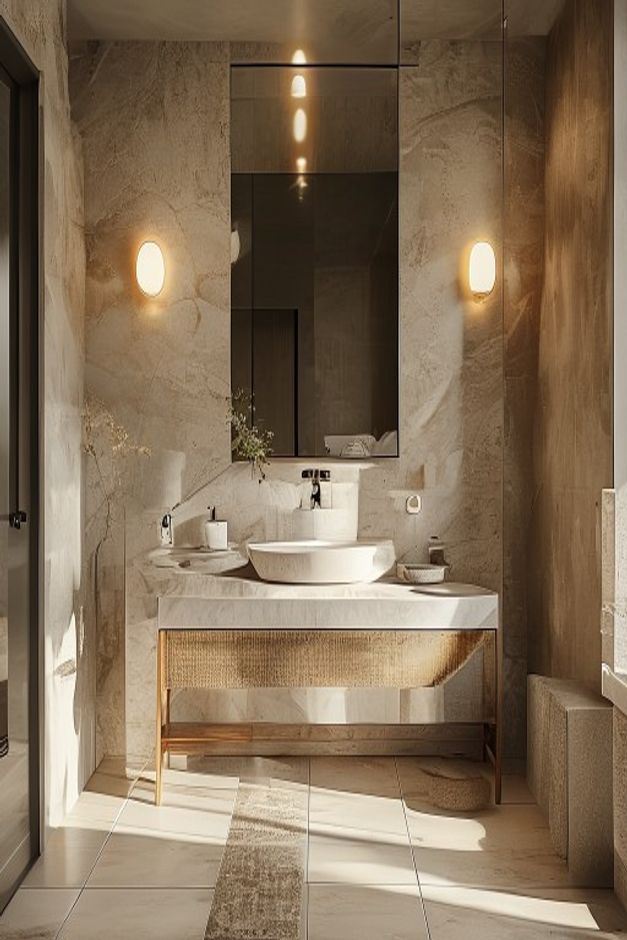

One white vessel sink sits at the center of a slim furniture-style console, and every surrounding decision reinforces that single point. The tall mirror rises directly behind it, two oval sconces hold the sides, and sunlight crosses the floor toward the vanity. The room's character comes from this precise vertical stack rather than from a large quantity of cabinetry.
Pale mottled wall surfaces wrap the basin zone, while a warmer timber-toned plane appears on the right. The console adds another texture through its woven-looking front and narrow frame. These surfaces are close in value, yet their different reactions to light give the compact bathroom enough depth.
One Vessel Sink Holds the Center of the Console
The broad white basin has a rounded rectangular outline and rises clearly above the counter. A dark faucet is aligned behind it, creating the strongest small contrast on the vanity wall. Low soap vessels and a tray remain to the sides, so the rim can be read as a complete, uncluttered form.
The Woven Front Lightens a Furniture-Like Frame
The console stands on slender legs rather than meeting the floor with a solid plinth. Its woven-looking front introduces a fine horizontal texture beneath the smooth basin, while an open lower area allows the floor to continue behind the frame. The piece feels more like movable furniture than a heavy cabinet block.
That visual lightness is especially useful in this narrow view. A deep base with continuous doors would close the wall from side to side and reduce the bright floor area. Here, the vanity supplies a useful top and a defined front without occupying more visual volume than the sink requires.
A Tall Mirror Uses the Wall Above the Basin
The mirror is markedly taller than it is wide and nearly reaches the ceiling. Its dark reflection creates an apparent recess between the pale wall fields. By extending the vanity composition upward, it offsets the console's low, horizontal proportions and makes the wall feel less confined.
Paired Oval Sconces Reveal the Mottled Surface
Two softly glowing oval fixtures sit at equal heights outside the mirror. Their curved outlines repeat the vessel sink without copying its scale. Warm halos graze the wall and reveal cloudy tonal changes that a central ceiling light would flatten.
Small ceiling spots appear as secondary points above. They support general visibility, but the side fixtures give the vanity its human scale. The relationship between directional light and pale wall texture is also visible in this warm neutral bathroom tile wall analysis.
Sunlight Draws a Diagonal Route Across the Floor
Bright bands enter from outside the frame and cross the square floor tiles toward the vanity. The light makes the open area beneath the console visible and emphasizes the walking strip in front of the sink. A narrow runner occupies the center without covering the entire floor pattern.
A Timber-Toned Side Plane Warms One Edge
The right wall is distinctly warmer and more uniform than the pale textured surface behind the mirror. Concentrating this tone on one side prevents the room from becoming a timber box. It also gives the vanity frame a related material neighbor without requiring an exact match.
A low block or bench-like form sits against that wall, outside the main approach to the basin. Its simple mass balances the slender console legs. No storage mechanism can be confirmed, so its contribution is read through placement, scale, and color rather than an assumed function.
The Open Approach Is the Bathroom’s Quiet Luxury
The most valuable empty space lies directly before the sink. Accessories stay on the counter perimeter, the vanity lifts from the floor, and the side block remains beyond the route. This gives one person a generous standing position and allows sunlight to remain part of the design instead of being hidden by added furniture.
Square floor tiles make this open strip measurable to the eye. Their joints continue beneath the console and toward the doorway at left, showing that no freestanding piece interrupts the approach. The narrow runner softens only the center line; exposed tile still frames it on both sides and keeps the vanity visually connected to the wider room. The effect feels spacious without excess.