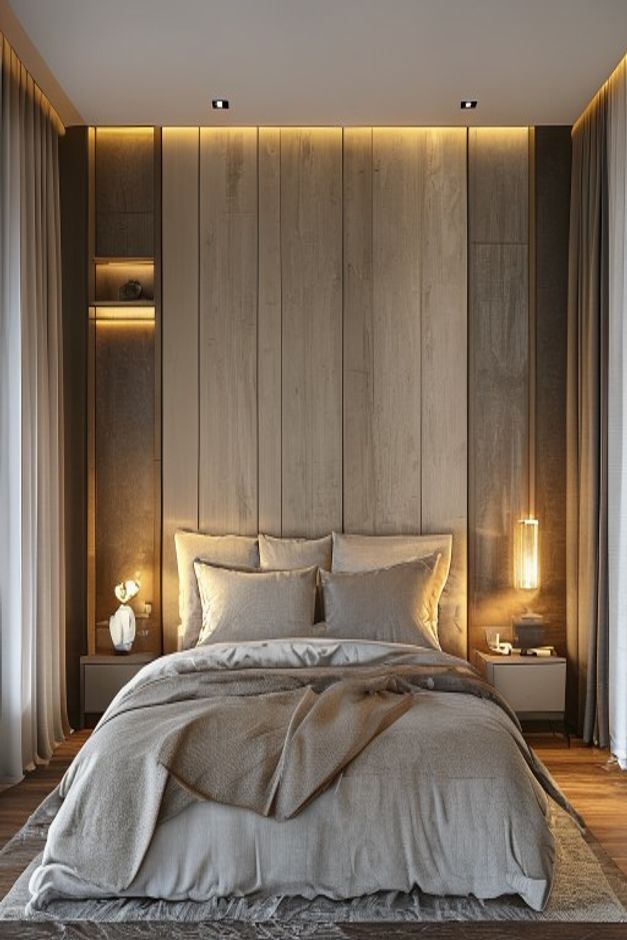

This bedroom derives its sense of luxury from continuity. Tall, light wood-toned panels run from floor to ceiling behind the bed, creating a wall that is more architectural than decorative. The upholstered headboard sits within that field rather than covering it, so the vertical rhythm remains visible above and beside the pillows.
Warm concealed light traces the top of the wall and returns within a small niche on the left. Curtains frame both edges, making the bed wall appear like a complete inset composition. The palette stays close to gray, taupe, and pale timber, allowing proportion and shadow to carry more weight than contrast.
Full-Height Panels Give the Bed a Taller Presence
The narrow panel divisions extend well above the headboard and align the bed with the room's full height. Their grain is visible but subdued, which keeps the wall from behaving like a bold striped pattern. The result makes the sleeping zone feel taller without enlarging the furniture itself.
Dark vertical reveals sharpen several joints and separate the main panel field from the side strips. These fine lines provide precision at a scale that suits the restrained interior. Wide battens or heavy molding would make the same wall more conventional and reduce the quiet effect.
The Upholstered Headboard Softens the Lower Center
A pale padded headboard with gently curved upper corners occupies the lower middle of the wall. Its soft edge interrupts the strict vertical lines exactly where the occupant makes contact. Matching neutral pillows expand that cushioned zone without disguising the paneling behind it.
This balance between fabric and hard wall treatment is explored differently in the published feature on warm neutral upholstered headboards and vertical paneling. Here, the wood-toned surface rises much higher and the textile element remains deliberately compact.
Integrated Light Reveals the Wall in Layers
A slim luminous line runs along the ceiling edge, washing the upper panels from above. On the left, two small recessed shelves glow from within; on the right, a narrow bedside fixture produces a vertical pool of light. Each source explains a different depth in the wall.
The illumination remains warm and localized rather than flattening the elevation. Ceiling downlights provide small accents but do not erase the shadows between panels. That hierarchy is central to the room's quiet character: the architecture remains readable after dark without turning the wall into a theatrical display.
Curtains Finish the Composition at Both Edges
Floor-length curtains descend on the left and right, forming soft side borders around the paneled wall. Their folds repeat the vertical direction in a looser material. Because the fabric is close in tone to the bedding, the window treatments frame the center without creating separate focal points.
The asymmetry of the bedside furniture is subtle. A darker nightstand anchors the left, while a pale drawer unit and slim light occupy the right. The curtains hold those differences within a larger balanced frame, demonstrating that a bedroom can feel composed without duplicating every object.
Layered Gray Textiles Keep the Floor Plane Calm
The duvet, blanket, pillows, and rug stay within a narrow family of warm grays. Their varied weave and drape prevent monotony, while the absence of strong print protects the wall's fine panel rhythm. A small border of warm flooring remains visible around the rug and nightstands.
Adding patterned bedding or more wall art would weaken the measured hierarchy already in place. The room's most transferable idea is to assign expression to one continuous architectural surface, then let upholstery, curtains, and floor textiles adjust comfort through texture rather than additional color.
A Small Lit Niche Breaks the Wall's Strict Repetition
Two shallow illuminated shelves interrupt the left panel strip above the nightstand. Their horizontal openings create a compact counter-rhythm within the many tall joints. A few small objects occupy the recesses, allowing light and depth to remain more prominent than display.
No matching niche appears on the right, which keeps the wall from becoming mechanically symmetrical. The bed still holds the center, but this controlled imbalance gives the elevation a bespoke quality. It feels designed around use rather than copied from a repeated module. The right-hand vertical light supplies enough visual weight to answer the niche without duplicating its form.