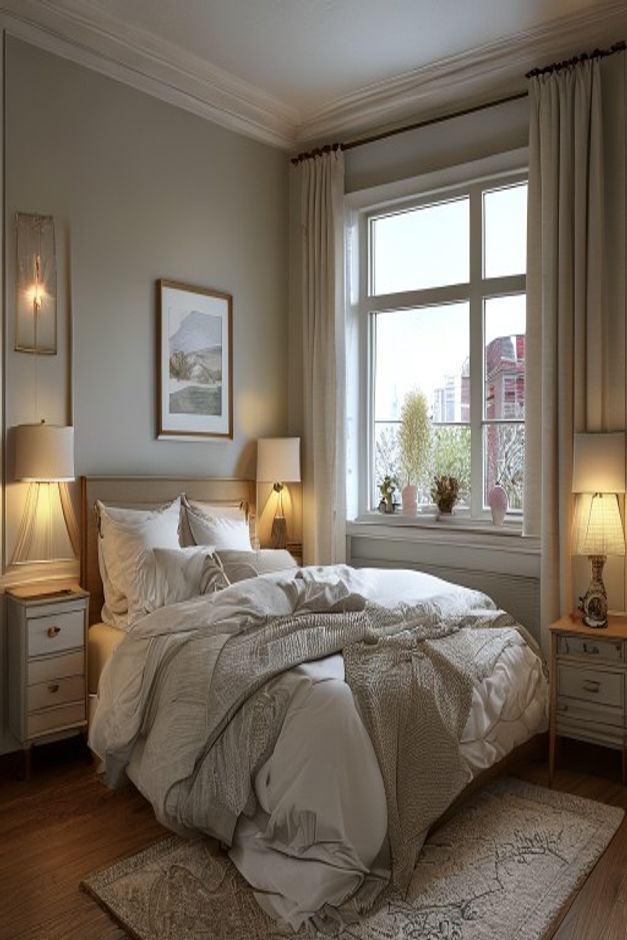

This compact bedroom is shaped by a window that occupies the corner beside the bed rather than the wall behind it. The tall white frame, deep sill, and long curtains create a bright side elevation, while the headboard remains on a solid taupe wall. The plan gains both a dependable place for the bed and an unobstructed source of daylight.
Vintage character comes through familiar proportions: narrow painted nightstands, warm shaded lamps, layered crown molding, a simple framed landscape, and a low upholstered headboard. These pieces do not form a matched suite. Their slight differences make the room feel assembled over time while the bed stays visually balanced.
The Window Sits Beside the Bed, Not Behind It
The mattress runs parallel to the glazing and finishes close to the deep sill. This orientation lets light travel across the duvet without placing pillows against the window. It also reserves the uninterrupted left wall for the headboard and keeps the operable panes visually accessible.
A Deep Sill Becomes Part of the View
The sill projects far enough to hold several small vessels and a plant. Their low profiles emphasize the thickness of the window recess without blocking the exterior scene. The objects appear as a narrow foreground to the city and trees rather than a crowded display shelf.
A radiator-like panel sits below the opening and shares its width. The bed does not cover this lower wall completely, allowing the window assembly to read from molding to sill and base. That visible continuity gives the corner more architectural presence than a standard opening behind curtains.
Curtain Panels Meet the Crown Molding
Cream curtains hang from a dark rod positioned just beneath the layered ceiling trim. Their full drop connects the high molding to the floor, and the open center leaves the white window grid exposed. The contrast between dark rod, pale fabric, and taupe wall is restrained but precise.
Two Narrow Nightstands Recover Symmetry
Painted nightstands flank the headboard even though the room itself is asymmetrical. Both are narrow enough to preserve bedside access, and each supports a shaded lamp. Their drawer details differ slightly, which softens the formal effect of the paired placement.
The right table stands closer to the curtain and carries the more decorative lamp base; the left sits under a slim wall sconce. Equal widths and similar shade heights matter more than exact furniture matching. This is how the bed gains composure without denying the window's off-center position.
Three Lamps Produce an Uneven but Useful Glow
Two table lamps illuminate the pillow zone from low positions, while a narrow wall fixture adds a higher point on the left. The result is not perfectly mirrored, yet the bed receives balanced warmth. The vertical sconce also fills an otherwise empty strip of wall without requiring another picture.
Loose White Bedding Softens the Tight Footprint
Generous white pillows and a rumpled duvet make the bed feel full, but their light color prevents the large textile mass from closing the room. A gray knitted throw lies diagonally across the lower half, introducing coarse texture and a directional line toward the window.
The low upholstered headboard remains deliberately plain beneath these layers. A related approach to warm neutral upholstered bedroom headboards uses stronger wall treatment; here, window scale and traditional trim already provide enough architecture.
One Landscape Print Holds the Solid Wall
A single framed landscape hangs above the left half of the bed. Its muted image and light mat suit the taupe wall, while the slim wood frame echoes the floor. Keeping the artwork modest leaves clear wall around it and avoids competing with the much larger view through the window.
The Rug Stops Before the Window Corner
A small pale rug emerges from beneath the foot of the bed and ends well before the sill. Its subtle border marks a soft landing without covering the warm wood floor around the window. This exposed perimeter makes the tight room easier to read and preserves a narrow route along the lower edge.
Adding a bench would consume that open patch and crowd the bed toward the glass. The photograph instead relies on the bed, two compact tables, and the window itself. That limited furniture set is what allows vintage detail to feel comfortable rather than congested.