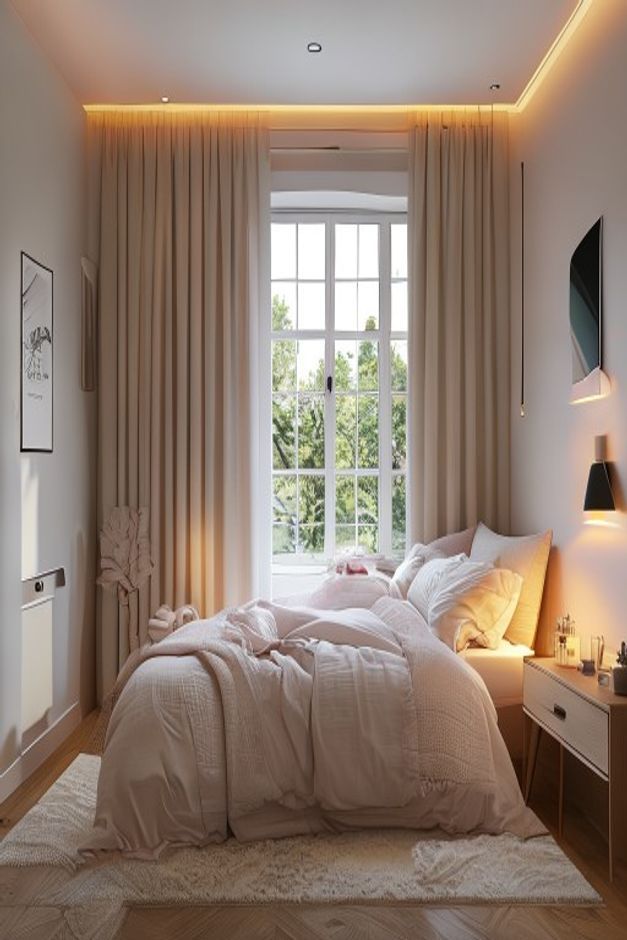

A tall multi-pane window closes the far end of this narrow bedroom, turning daylight into the room's main destination. The bed runs toward it rather than across the opening, and pale curtains descend from a concealed high track. This orientation makes the window feel taller and gives the small floor plan a strong sense of depth.
Artificial light follows the perimeter. A warm cove line turns along the ceiling, compact fixtures gather beside the pillows, and recessed spots remain almost invisible overhead. The layers are useful because they illuminate different surfaces without introducing a large hanging object above the bed.
The palette is close to white, blush, and oatmeal, so changing light supplies most of the contrast. Soft bedding occupies much of the room, yet the bright end wall and a slim left-hand passage prevent the textiles from feeling visually heavy.
Curtains Build a Full-Height End Wall
The curtain panels begin above the window frame and fall to the floor on both sides. Their narrow folds cover the solid wall strips, making the opening appear broader than the glass alone. Because the fabric is close to the wall color, it frames the view without creating a dark theatrical border.
The center remains fully open, revealing white mullions and greenery beyond. This is a practical balance for a small bedroom: enough fabric to control glare and privacy, but no decorative overlap that reduces daylight. The stack of each curtain stays tight against the side wall.
A soft ceiling glow meets the curtain line at the top and makes the hidden track feel intentional. Homeowners using a similar treatment can see how warm neutral bedroom linen curtains gain presence when their full drop, rather than a printed pattern, supplies the detail.
Bed Placement Borrows Light From the Window
The bed sits close to the right wall and extends lengthwise toward the glazing. This avoids dividing the room into two unusably narrow side paths. Daylight reaches the duvet from the foot and left side, bringing definition to the many pale folds.
The head area remains supported by a shallow nightstand rather than a broad furniture run. A small lamp and a few bottles fit on its top. Their scale accepts the limited bedside width and leaves the mattress as the dominant object along this wall.
Edge Lighting Traces the Room’s Longest Lines
The concealed strip at the ceiling follows the right wall and turns across the window end. Its continuous path visually lengthens the room, while small recessed points add general illumination without breaking that line into decorative clusters.
Near the pillow, a dark wall fixture directs a warmer pool onto the bedding. A slender suspended element drops nearby, contributing a vertical accent where floor area is unavailable. These lights operate at different heights and do not pretend to be one matching set.
Exact lamp temperature cannot be read from a photograph, but the visible effect is clearly warmer than the daylight. That contrast makes the bedroom usable after dusk while preserving the cool brightness of the window as a daytime feature.
Wall-Mounted Pieces Protect the Left Passage
The left wall carries a slim framed drawing and a shallow white panel rather than deep furniture. Both stay close to the surface, allowing the open strip beside the bed to function as the principal route. Their vertical proportions echo the window without crowding it.
On the right, a dark curved artwork hangs above the bed and remains similarly shallow. Visual interest is therefore moved onto the walls, where it does not compete with circulation. A bench or chest at the foot would occupy the only point where the passage widens.
A Blush Cast Comes From Light and Textile Layers
The bedding includes ivory, pale pink, and soft beige layers, but no strong printed motif is visible. Amber light at the head and ceiling warms those fabrics, while window light cools them near the foot. The color story changes across one bed instead of relying on several accent objects.
A light rug extends beyond the mattress and softens the floor at the foot. Its irregular edge and subtle texture complement the rumpled duvet. Keeping these lower surfaces pale allows the window grid, curtain folds, and small dark fixtures to remain readable in the narrow scene.