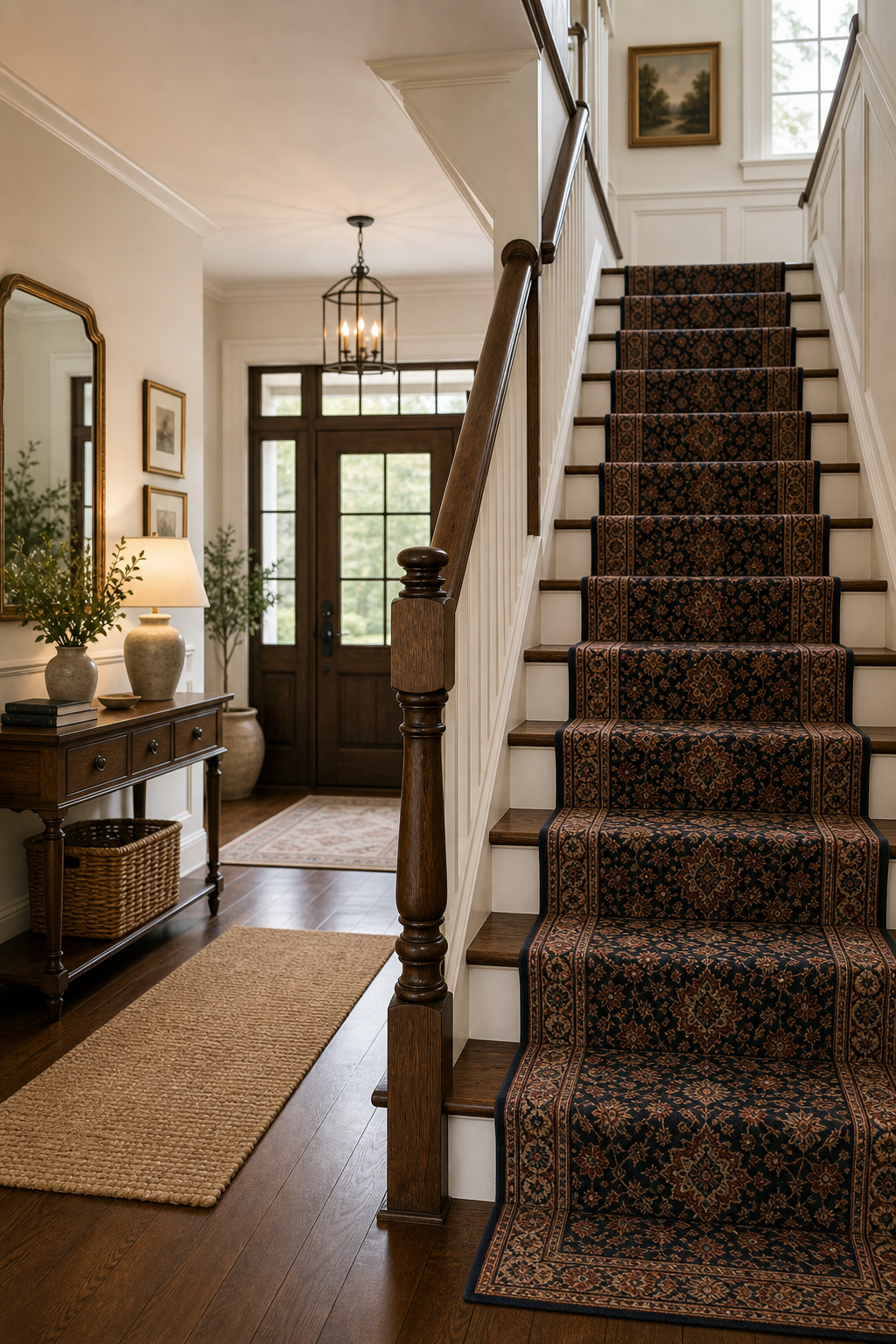

The dark floral runner makes the staircase the entryway's primary route and strongest pattern. Rust, muted gold, and blue motifs repeat within a deep ground, climbing from the first tread to the upper landing. Narrow exposed timber edges frame the textile and connect it to the dark handrail, newel, floor, and front door.
Everything beside the stairs is quieter. White risers and paneling brighten the structure, while a slim console, tall mirror, lantern, and small artwork furnish the hall without challenging the runner. Pattern is concentrated where movement occurs, so the eye understands circulation immediately.
The Runner Establishes an Unbroken Upward Rhythm
Each tread carries the same central field and side borders, allowing the motif to turn over risers without losing continuity. The strong vertical sequence visually lengthens the stair and gives individual steps one collective identity. A series of separate mats would fragment that route.
The darkest field remains centered, while warm ornament prevents it from becoming a featureless black stripe. Exact fiber and fixing method are not visible, so evaluation should stay with pattern scale, alignment, and contrast.
Exposed Timber Edges Frame the Textile
A narrow strip of dark timber remains visible at both sides of the runner on every tread. Those consistent margins sharpen the installation and relate floor to handrail. If the textile covered the full stair width, the dark wood framework would lose much of its visual continuity.
White risers create a brighter interval between patterned horizontal planes. That alternating light-dark sequence clarifies step depth and keeps the substantial runner from making the staircase appear solid.
White Paneling Holds the Pattern in Check
Paneled stringers and upper walls surround the stairs with large pale fields. Their rectangular molding provides quiet detail at a much larger scale than the floral motifs. The contrast lets the runner remain dramatic without making the complete entry visually dense.
A landscape artwork hangs above the upper flight and occupies a contained pale bay. Its muted tones continue the traditional atmosphere while remaining secondary to the textile below.
The Turned Newel Marks the Change in Direction
A substantial timber newel stands at the foot of the stairs and carries a dark handrail upward. Its turned profile gives the runner a clear starting point and separates stair circulation from the ground-floor hall. Fine white balusters lighten the structure behind it.
The newel aligns close to the runner edge rather than its center, preserving a direct visual path up the treads. This placement makes the staircase readable from the entrance.
Hall Furniture Remains Narrow and Peripheral
A slim timber console and tall curved mirror occupy the left wall. A lamp, vase, books, and basket use vertical storage without narrowing the central route. The glazed front door and black-framed transom bring daylight behind the console area.
For a comparable hall, choose runner width from the exposed tread margin, center the motif consistently, and let surrounding paint remain quieter. Repeat the textile's darkest value in handrail and door rather than adding competing patterned furniture. One strong circulation surface is enough to give the entry character.
The Floral Pattern Is Scaled to Individual Treads
Dark ground and rust, cream, and muted green motifs repeat in units large enough to be recognized on each step. The design is not so fine that it dissolves at the stair angle, nor so oversized that every tread captures an unrelated fragment. That scale creates continuity while still allowing riser and timber edge to remain distinct.
The runner stops consistently inside both stair sides, exposing a slim timber border. This repeated margin acts like a frame and separates textile from white trim. Exact runner width cannot be calculated from the view, but equal side reveals are visibly central to the finished appearance.
The Lower Hall Provides a Calm Landing
At the foot of the stairs, pale flooring and light walls give the dense floral runner a visual release. A narrow timber console, small lamp, framed pieces, and branch vessel stay close to the side wall. None blocks the direct approach to the first tread or competes with the runner's upward movement.
A turned newel and dark handrail mark the transition from hall to stair with stronger timber shapes. Their warm tone relates to exposed tread edges and console. For a similar entry, coordinate these fixed wood lines first, then choose a patterned textile whose darkest value can hold its own against them without overwhelming the landing.