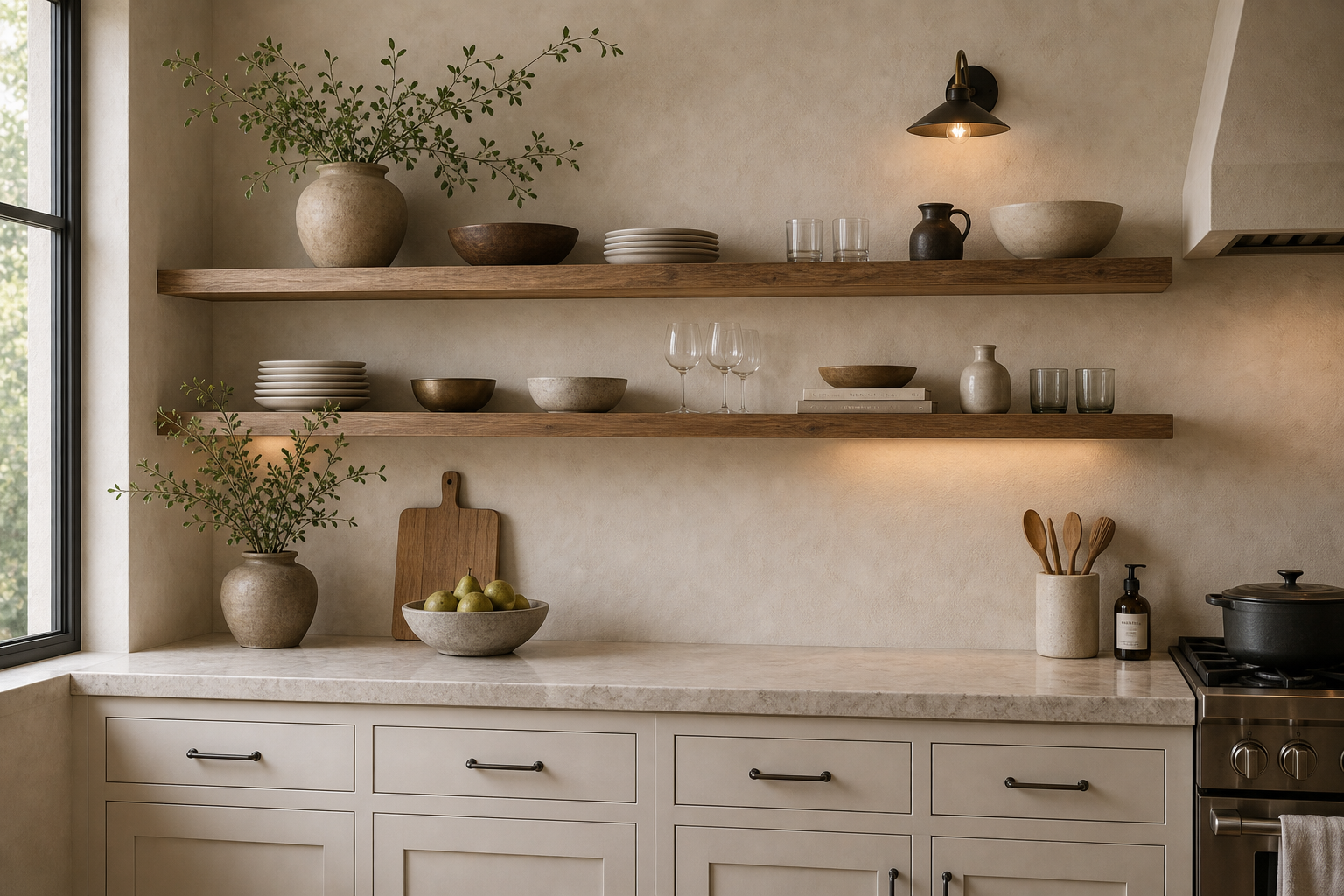

Three long shelves give this kitchen wall a deliberate rhythm. They span nearly the full work zone, align their left edges near the window, and stop cleanly before the dark range at the right. Because the shelves are thick and timber-toned, they read as architectural lines against the pale textured wall rather than as light accessory ledges.
The arrangement works from the counter upward. Wide drawer fronts form a quiet closed base, a light-toned work surface provides a visual pause, and the shelves carry progressively lighter groups of dishes and vessels. Open display is therefore balanced by concealed volume below. The photograph does not reveal drawer interiors, but it clearly shows why visible storage needs a calm foundation.
Three Horizontal Lines Organize a Broad Wall
The lowest shelf sits within easy reach above the counter and carries everyday-looking plates, bowls, glasses, and small vessels. The middle line holds a looser sequence, while the upper shelf has the most empty space. This graduated density prevents the wall from becoming top-heavy. Equal shelf thickness ties the levels together even though their contents vary.
Useful Objects Create the Strongest Styling
Stacks of pale plates, shallow bowls, clear glasses, boards, and compact bottles account for most of the display. Their low profiles let the wall remain visible between groups. A branch vessel and small plant interrupt the repeated tableware with taller organic silhouettes. The shelves feel credible because the objects belong near a work surface; nothing requires a decorative story unrelated to cooking.
Empty Gaps Are Part of the Composition
No shelf is filled from end to end. Broad spaces surround the central glassware, upper bowl, and right-hand vessel, allowing each group to remain distinct. Those intervals also expose the warm shelf surface against the pale wall. In an open kitchen display, adding one more object often has a larger visual cost than leaving a useful gap, particularly when three levels are visible at once.
The Counter Carries a Separate Working Layer
A cutting board, fruit bowl, grinder, dark bottle, and a few tools occupy the counter without directly mirroring the shelves above. The surface remains open through the middle, preserving a practical preparation area. The dark range at the right establishes a strong end stop, while the sink or other fixtures are outside the frame and should not be invented.
Daylight Makes Texture Legible
A tall black-framed window at the left washes light across the shelf fronts and the softly mottled wall. The raking angle produces thin shadows beneath each timber slab, clarifying their depth. A small dark wall light above the top shelf adds a compact downward source. Its exact output is unknown, but its position suggests that the display can remain readable when window light recedes.
Closed Drawers Prevent Visual Overload
The base cabinetry uses wide pale fronts with simple dark pulls, creating far fewer lines than the object-rich wall above. That contrast is central to the room's calm. A related cottage kitchen backsplash wall uses a more patterned vertical surface; this kitchen instead lets shelf thickness, pottery, and natural shadow provide the detail.
To maintain this balance, treat the shelves as one elevation rather than three unrelated rows. Begin with the pieces used most often at the lowest level, distribute taller forms away from one another, and preserve at least a few uninterrupted stretches. The visible success comes from proportion and editing, not from maximizing how much the wall can hold.
Shelf ends are handled with particular discipline. At the left, the slabs stop short of the deep black window frame, preserving a narrow pale reveal; at the right, they terminate before the range and its darker vertical edge. These margins keep heat, glass, and display visually distinct even though technical clearances cannot be measured from the photograph. The lowest slab also stays high enough above the counter for boards, bottles, and the tall branch vessel to stand comfortably. Good open shelving is as dependent on the space around each board as on the board itself.
The upper shelf carries only a shallow dark bowl and one small object near its center. Keeping the highest line sparsely occupied prevents the display from pressing visually toward the ceiling and gives the wall light a clear area to wash.