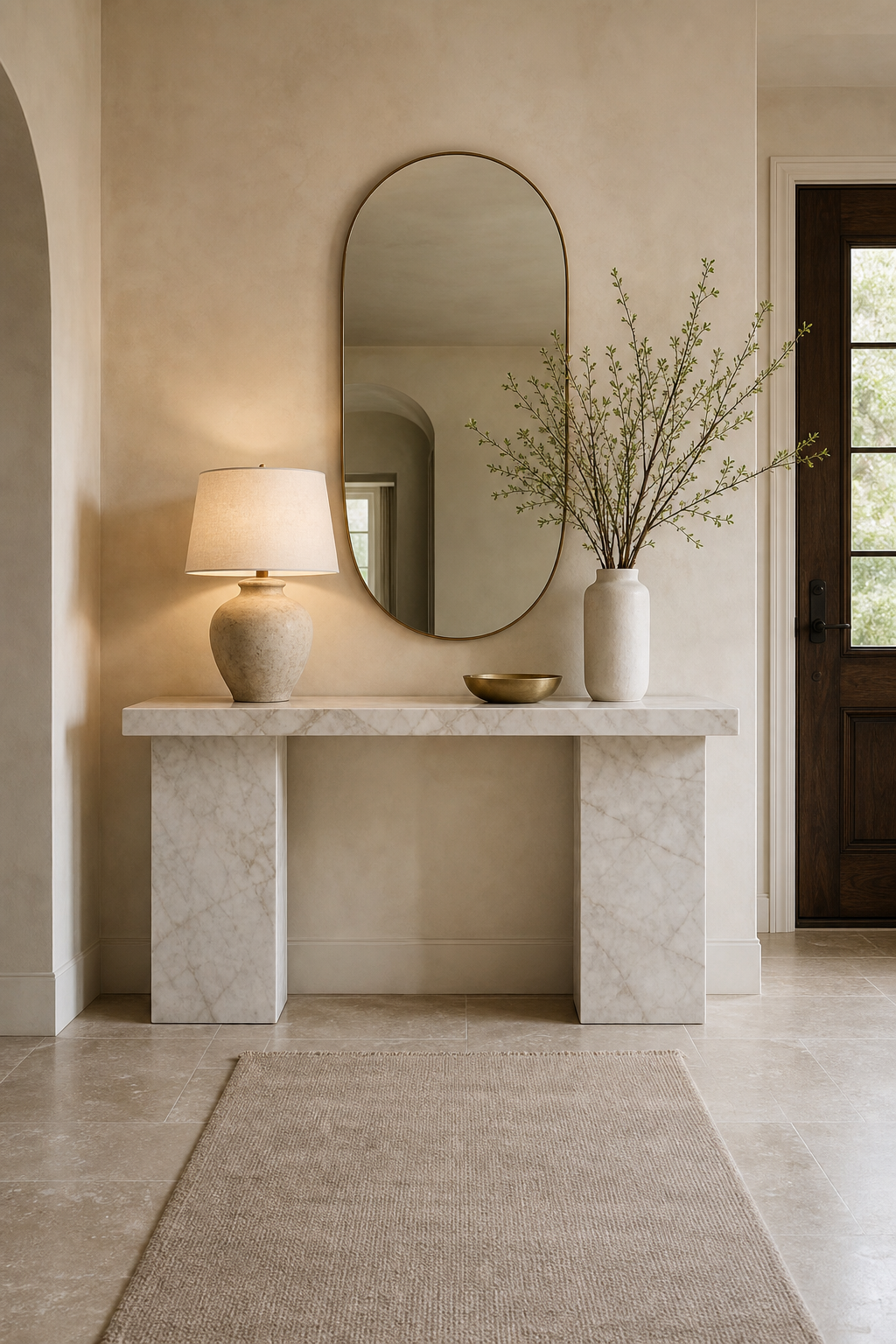

The console has the weight and clarity of a small architectural object. A thick pale veined top bridges two substantial slab legs, creating a simple portal beneath an elongated oval mirror. One lamp and a tall branch arrangement occupy opposite ends, while broad floor slabs and an arched doorway extend the same disciplined geometry into the entry. Quiet luxury here comes from scale, surface continuity, and empty space rather than a dense layer of accessories.
The Slab-Leg Console Gives Arrival a Permanent Anchor
The console has the most physical presence in the entryway because the top and legs are both rendered in pale veined pale veined surface. It reads almost like a small architectural portal rather than a light occasional table. That mass is important in a foyer. A narrow entry can feel temporary when the furniture is too delicate, but this console gives the arrival point a composed, permanent quality.
The console is narrow enough for circulation but visually dense from floor to top. Unlike a delicate open frame, its two end supports establish clear boundaries and make the wall feel deliberately occupied.
The mirror introduces a tall rounded shape directly above the rectangular console. That curve prevents the wall from becoming a stack of hard horizontal and vertical lines. Its slim warm-metal-toned edge also picks up the small bowl on the console, creating a restrained metallic note without turning the entry into a shiny display.
The Oval Mirror Introduces One Controlled Curve
The table lamp sits on the left side of the console, where its shade overlaps the warm plaster wall. It gives the entryway a softer evening function, not just a daylight view from the door. Because the lamp is rounded and ceramic, it contrasts with the crisp pale veined surface slab. That difference in shape is what keeps the surface from feeling like a showroom plinth.
The mirror stays narrower than the console and rises well above the tabletop, adding vertical reach without copying its rectangular profile. The pale-console entryway study uses a similar tonal family; this room is defined by heavier slab legs and an oval upper form.
Asymmetrical Objects Keep the Composition From Feeling Staged
The tall vase and branches lift the right side of the console composition. Without that height, the mirror would dominate alone and the tabletop would feel visually low. The branches are also light enough to avoid blocking the mirror completely. They add movement while still allowing the console wall to breathe.
The lamp remains low at the left while branches climb at the right, leaving the mirror center open. That unequal balance is more convincing than identical pairs because the console itself already supplies strong symmetry.
Broad Floor Slabs Extend the Console's Material Logic
The runner leads the eye toward the console and confirms the direction of arrival. It creates a soft path through the pale veined surface floor rather than leaving the entry as one hard surface. Its woven texture is doing practical work too. Against pale veined surface, plaster and floor tile, the textile makes the foyer feel more residential and less formal.
The Arched Opening Deepens the Arrival Sequence
The visible colors are tightly controlled: warm ivory plaster, pale veined surface, soft taupe, muted warm-metal and dark wood. The dark door gives the scheme enough contrast so the light pale veined surface does not fade into the wall. This is the difference between quiet and empty. The palette is calm, but the materials still have enough tonal range to hold attention.
The dark doorway beyond the arch creates a deep background layer beside the pale console. This contrast lengthens the visual route without requiring a runner or extra furniture, neither of which is visible in the scene.
Warm Local Light Softens the Pale Surfaces
The dark glazed door on the right and the arched opening on the left give the console wall a sense of context. The entryway is not just a vignette; it sits between actual circulation points. That matters for design credibility. The console is placed where it can greet the arrival path without blocking movement.
Editing an Entry Around One Substantial Object
Start with a console that has enough visual weight to feel intentional. A pale veined surface or pale veined surface-look piece works best when the wall behind it is simple and warm rather than heavily patterned. Then edit the surface sharply: one lamp for glow, one vessel for height and one small bowl for function. The restraint is what makes the entryway feel expensive.
Choose the console's depth from the clear walking path, then scale mirror and objects to its mass. Small scattered frames, baskets below, or multiple lamps would dilute the strength of the two slab supports.
The console top remains mostly bare between lamp and branches, so its veined surface reads as one uninterrupted bridge. Reflections in the oval mirror add depth without introducing another piece of furniture.
The floor slabs run toward the darker arched opening, extending the entry's direction beyond the console wall. Their large scale supports the console's substantial proportions.