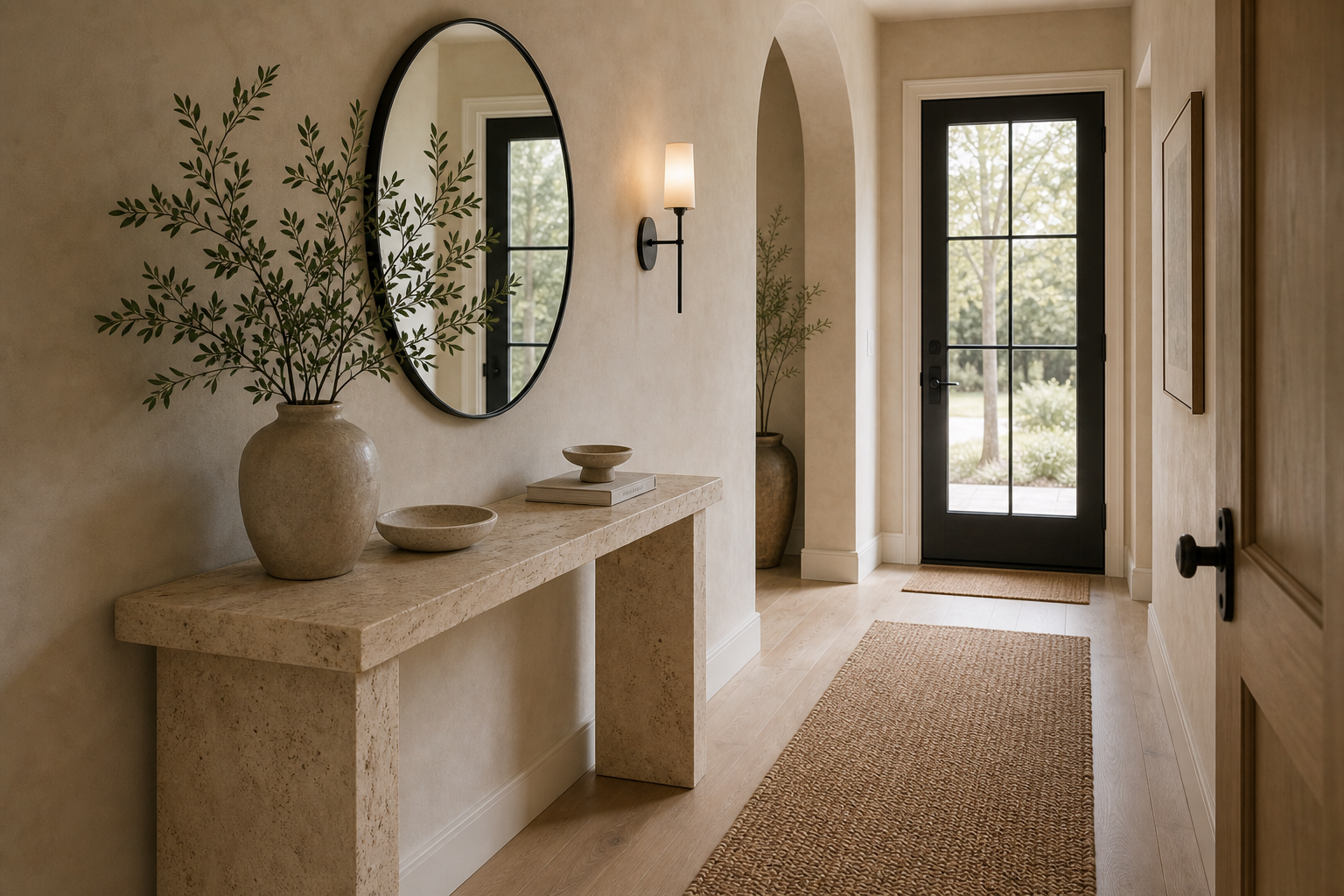

A narrow pale stone console gives this entry enough mass to hold the wall without intruding on the passage. Its thick top and slab-like supports form a grounded horizontal beneath a round dark-rimmed mirror. One large vessel sends branches upward, while a small tray and bowl remain low. The arched opening and mirror introduce related curves; a dark glazed door at the far end gives the otherwise pale hallway a firm destination.
The Stone Console Establishes a Grounded Wall Line
The console is the heaviest object in the hallway, and that is exactly why it works. Its pale stone surface gives the entry a grounded first impression. Because the table is narrow, it adds material presence without stealing the walking path.
The table is shallow relative to its length and remains tight to the wall, preserving the corridor while still presenting a substantial pale profile. Its open center exposes wall and floor, preventing the stone-like volume from reading as a solid storage block.
The round mirror offsets the console's straight slab geometry. Its black rim also relates to the door and sconce, keeping the entry visually connected. The mirror reflects the door and daylight, which helps the stone wall feel less dense.
The mirror is narrower than the console and centered over its clearest portion. Its fine dark rim echoes the distant door and nearby wall light, producing enough contrast to separate the glass from pale plaster without competing with the table's thickness.
One Branch Arrangement Supplies Vertical Scale
The woven runner draws the eye down the hallway toward the glass door. It gives the entry a clear path while adding texture underfoot. Its woven texture works with the pale stone rather than competing with it.
The Arched Opening Extends the Curved Language
The black-framed glass door gives the far end of the hallway a strong visual stop. It also repeats the mirror frame and sconce finish. That dark outline is useful because the rest of the palette is very soft.
The opening begins just beyond the console wall and frames another pale passage. Because its curved crown is taller and narrower than the mirror, the two forms relate without becoming a literal matched pair.
The ceramic vessel and branches bring vertical movement above the console. They keep the stone from feeling too static. The branches are loose and organic, which suits the plaster wall and natural runner.
The Runner Clarifies the Walking Direction
The arched opening adds depth beyond the console wall. It gives the entry a second architectural moment without competing with the stone table. Its curve also echoes the round mirror in a quieter way.
Choose a stone console with enough thickness to feel intentional, but keep the depth slim for circulation. Pair it with a round mirror, a textured runner and one tall vessel instead of many small accessories.
Choosing Console Depth for a Working Entry
I would not cover the console with clutter. The pale stone surface needs room to be seen. I would also avoid a patterned wall treatment here. The plaster and stone already create enough texture.
The integrated wardrobe in this modern entryway storage study concentrates daily belongings behind a built elevation. This hall uses a far shallower stone console and leaves storage outside the visible argument.
The runner stops before the distant door threshold and leaves pale floor visible around the console supports. Its narrow width confirms the circulation axis without turning the hall into a fully covered corridor. The vignette and pathway can therefore overlap visually while remaining physically separate.
The console's pale veining and tonal variation are visible, but the photograph cannot verify a specific stone species. Describing it simply as pale stone preserves the important design fact: one materially substantial object gives weight to an otherwise light hallway. The surrounding plaster-like surfaces remain quieter and less patterned, allowing the table to register without a strong color change.
A single wall light sits between the mirror wall and arched opening, providing a compact dark-and-warm accent at standing height. It does not form a symmetrical pair or attempt to center over the console. That slight independence keeps the hall from becoming a staged vignette and helps the eye move from furniture to arch and then to the distant glazed door in sequence.