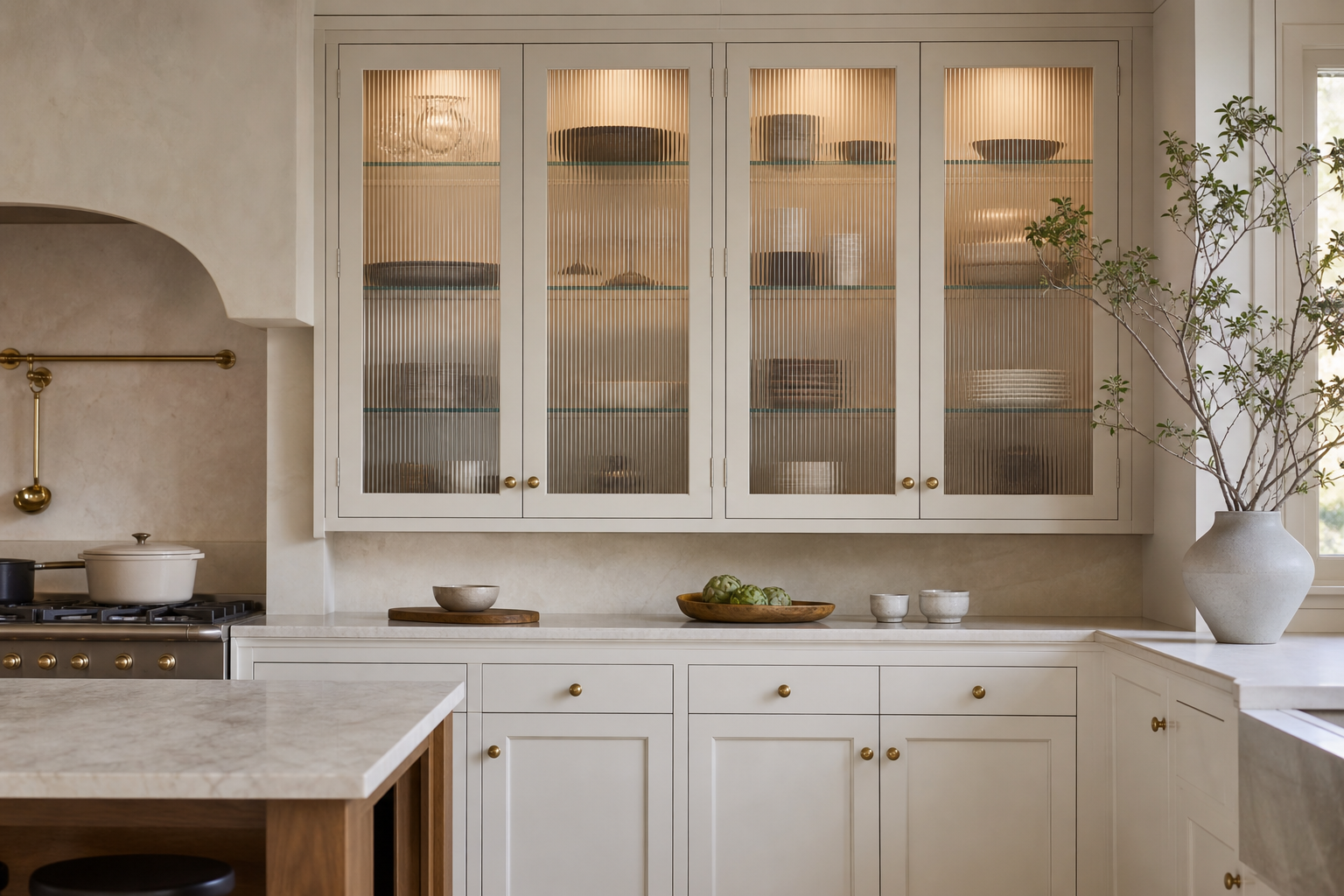

Four tall fluted-glass doors give this kitchen wall a display function without exposing every stored outline. Soft cabinet light catches the vertical ribs and turns the upper run into a warm translucent band, while pale lower cupboards, small warm-metal knobs, a pale counter, central arched range niche, timber-toned island edge, and side greenery remain more solid. The transitional balance comes from combining familiar framed cabinetry with deliberately softened glass.
Four Fluted-Glass Doors Establish the Upper Rhythm
The upper cabinets are the strongest feature because the ribbed glass catches light across the entire wall. Their vertical texture gives the kitchen movement without relying on color. Unlike clear glass, the fluted surface blurs the stored pieces behind it. That keeps the wall elegant even when the shelves hold practical dishes.
The doors share equal width and run in one uninterrupted row, making their vertical pattern more architectural than decorative. Their pale frames keep the wall bright.
The warm glow inside the cabinets makes the ribbed texture easier to read. It also turns the upper storage into a softer evening feature. This lighting works because it is contained behind the doors. The cabinet wall feels illuminated, not flashy.
The reeded-glass upper-cabinet article covers a related surface. This image is distinguished by four illuminated doors grouped as one display bank.
Interior Illumination Gives the Glass Depth
The small warm-metal knobs add warmth at the cabinet doors and lower drawers. Their scale is restrained, which lets the fluted glass remain the primary texture. A larger pull would interrupt the vertical rhythm of the glass. Here, the hardware behaves like punctuation rather than decoration.
Light reveals shelf levels and vague silhouettes without making individual stored pieces dominant. Exact lamp type and temperature cannot be confirmed from the photograph.
Warm-Metal Knobs Mark a Fine Repeated Detail
The pale counter creates a quiet horizontal base below the glass cabinets. It gives the wall a clean surface before the eye moves up to the ribbed doors. Because the counter styling is limited to bowls and a tray, the cabinet texture is not forced to compete with clutter.
Pale Lower Cabinets Stabilize the Translucent Band
The range niche on the left adds architectural depth beside the cabinet run. Its smooth plaster-like surface contrasts with the repeated cabinet doors. That contrast keeps the kitchen from becoming one continuous storage wall. The niche gives the eye a break.
Solid drawer and cupboard fronts below use broader rectangles than the ribbed glass above. This scale change prevents the full wall from becoming a field of narrow lines.
The Range Niche Creates a Solid Pause
Use fluted glass on a controlled section of upper cabinetry rather than every cabinet in the kitchen. The detail is strongest when it has a clear role. Pair it with simple painted cabinet frames, small hardware and a quiet counter surface so the glass can provide the texture.
Side Greenery Breaks the Cabinet Symmetry
Avoid styling the interior shelves with too many competing colors. Even behind ribbed glass, clutter can make the cabinet wall look restless. This kitchen stays refined because the objects behind the doors are muted and the lighting is warm.
Choosing Display Glass Around What Will Be Stored
Transitional kitchens work best when traditional detail is edited through a cleaner lens. Here, fluted glass brings texture, storage and softness together in one focused cabinet decision.
Use fluted glass where softened silhouettes are acceptable and keep interior shelf spacing disciplined. Mixing clear, opaque, and ribbed doors across the same short run would weaken the ordered four-door composition.
The cabinet lights form four softly glowing fields rather than one continuous strip, preserving each door's individual width.
Counter objects stay below the glass doors and cluster near the range niche, leaving broad preparation surfaces visually open.
Fluted glass produces soft vertical highlights that shift across each door while the cabinet frames remain sharply rectangular.
The arched niche at the left provides one curved counterform and stops before the four-door run, keeping cooking and display as separate wall events.
The cabinet bank stops at the counter line and does not continue down as a dark display tower. Separating luminous upper doors from solid pale storage below keeps the ribbed glass visually special rather than applying it to every available front.