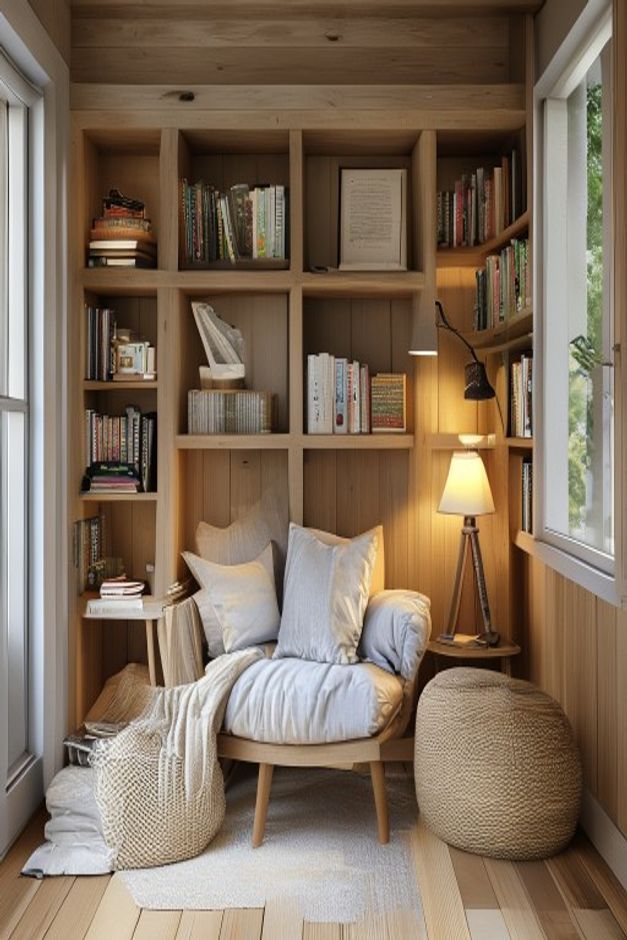

This narrow reading nook gains its identity from an unusually complete piece of joinery. Light-toned shelving covers the rear wall, turns onto the right side, and rises to meet a matching wood ceiling. The chair is not simply placed near books; it sits inside a small timber-lined room within the larger house.
Windows on both side walls prevent that enclosure from becoming oppressive. Daylight crosses the chair from two directions, while the pale upholstery, floor covering, and woven accessories keep the lower half of the alcove visually open. The result suggests coastal ease through brightness and texture rather than themed decoration.
Built-In Shelves Define Three Usable Zones
The rear storage is divided into a regular grid with taller and shorter compartments. Books occupy many bays, but a framed page and a few small objects interrupt the repetition. This distribution lets the shelving read as a working library without turning every opening into a densely packed block of color.
At chair height, the central bays remain calmer, giving the seated area a visual backrest. Side shelves continue toward the window and hold a small task light. That wraparound condition is what makes the nook feel purpose-built; a single bookcase pushed against the end wall would leave the side elevation unresolved.
Two Windows Make a Deep Alcove Feel Airy
Glazing on the left and right draws the eye beyond the tight footprint. The white window frames create a bright border around the warmer timber interior, so the wood feels sheltered rather than heavy. Exterior greenery adds a changing backdrop without occupying any shelf space.
The chair is angled just enough to receive the light while avoiding a rigid, corridor-like pose. It does not obstruct either opening. In another narrow nook, keeping the central seat clear of the window swing and preserving an outward view would be more valuable than fitting a wider chair.
A Chair, Pouf, and Basket Share the Floor Efficiently
The cushioned wood chair carries the main seating role, while a rounded woven pouf sits to its right and a soft basket rests to the left. Each piece has a different outline, yet their sandy colors keep the small floor area from fragmenting into unrelated objects.
Because the accessories are movable, the occupant can alter the setup without changing the architecture. The pouf can support feet or a book, and the basket gathers a throw close to the seat. This flexibility is preferable to permanent lower cabinetry where legroom and turning space are already limited.
Task Lighting Is Layered at Seated Height
A tripod lamp creates a warm pool beside the chair, and a smaller dark fixture is attached near the right shelving. Their light falls across the books and cushion rather than trying to illuminate the whole alcove from the ceiling. That low placement suits the actual activity taking place here.
The daylight will change throughout the day, so local lamps make the nook credible after sunset. The approach complements the integrated storage seen in this cottage reading nook with wood shelving, although the present room uses a tighter grid and a more enclosed timber shell.
Pale Textiles Keep the Joinery From Dominating
White and oatmeal cushions create a soft foreground against the many book spines. A small light rug separates the chair from the plank floor, while the knitted throw introduces an irregular edge. These textiles absorb some of the visual precision created by the shelf grid.
The best improvement would be continued editing rather than expansion. Keeping several cubbies partially empty, limiting accessories to useful pieces, and leaving the windows unobstructed will preserve the nook's generous feeling. Its success comes from a precise enclosure paired with loose, comfortable objects inside it.
The Timber Ceiling Completes the Alcove
Wood boards continue overhead between the two bright window frames. That ceiling plane closes the shelving composition and makes the narrow area feel intentionally inserted into the house. Its direction leads toward the book wall, reinforcing the sense of retreat at the end of the bay.
A single small recessed point is visible above, but the ceiling is not crowded with fixtures. Most usable light remains closer to the chair. This keeps attention on books, cushions, and the view rather than turning the timber canopy into a technical lighting display.