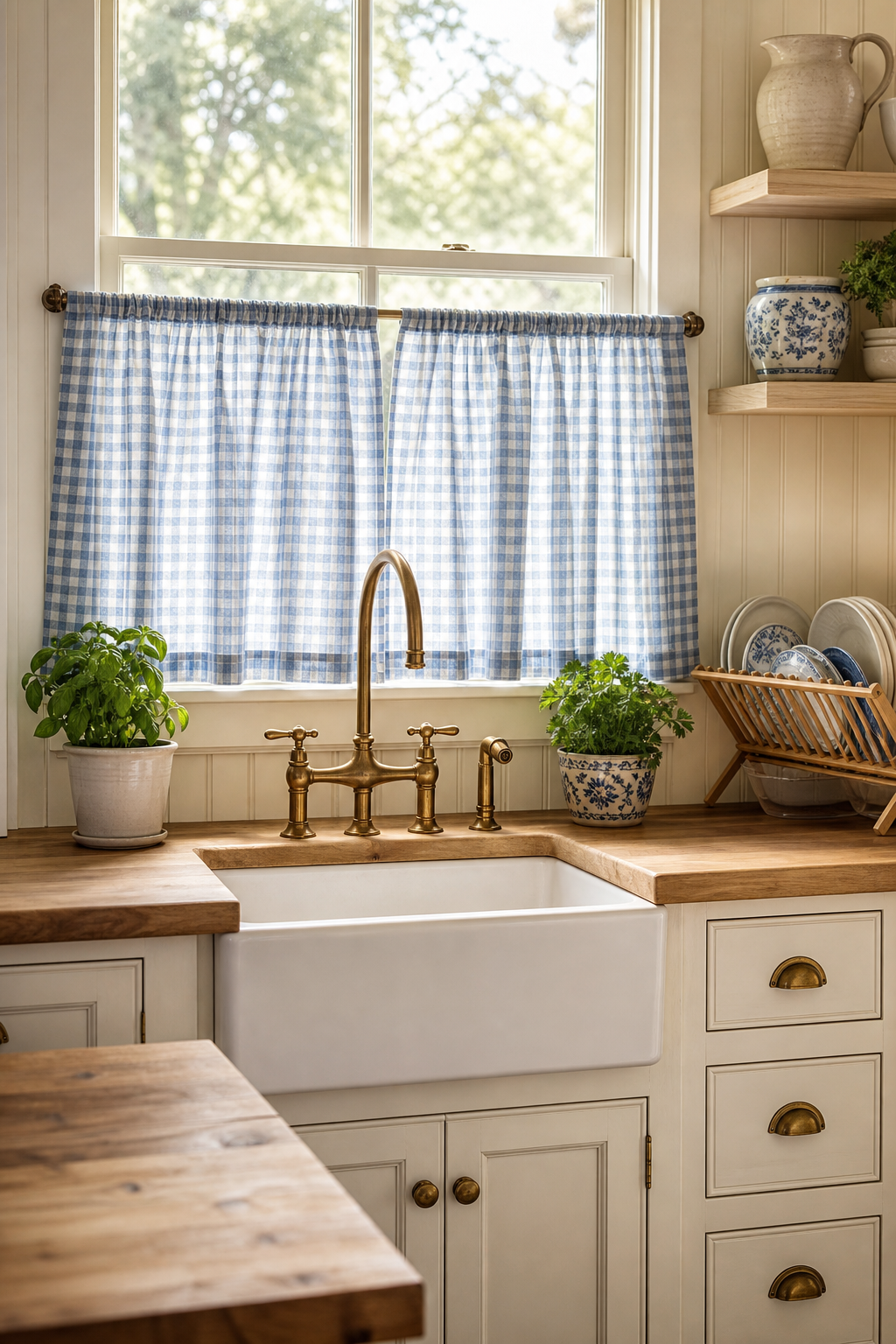

Blue gingham cafe curtains cover only the lower half of this kitchen window, introducing privacy and pattern without sacrificing the bright upper panes. Their gathered folds sit directly above a white apron-front sink and warm-metal faucet, linking softness to the working center. A timber-toned counter, pale cabinets, small plants, jars, open shelves, and side daylight complete the cottage scene without repeating the check elsewhere.
Half-Window Curtains Preserve the Bright Upper Glass
The curtains sit exactly where the eye lands above the white apron-front sink. Their half-height placement leaves the top of the window open, so daylight remains part of the room. That balance is the reason cafe curtains work here. They add softness and privacy without closing down the kitchen.
The curtain rod crosses near the window midpoint and leaves the upper divided panes fully open. This maintains daylight and an exterior view above eye level.
Blue Gingham Concentrates Pattern at the Sink
The blue gingham pattern gives the sink wall a friendly cottage character. It is more specific than plain linen, but the small check keeps it from feeling too loud. The fabric also repeats the blue-and-white ceramics on the shelves and counter. That connection makes the curtain look chosen rather than random.
The English-country cafe-curtain article uses a related treatment. This version is distinguished by a blue check, compact sink wall, and stronger contrast with warm-metal fixtures.
Gathered Folds Soften the Rectangular Window Grid
The warm-metal curtain rod and warm-metal faucet quietly relate to each other across the window. This small metal repetition gives the sink area a finished look. Because the hardware is warm, it suits the timber-toned counter and cream cabinetry better than a cooler metal would in this particular scene.
Narrow gathers create enough movement to break the grid while retaining recognizable blue and pale squares. Fabric composition is not inferred.
A White Apron Sink Grounds the Textile Above
The white apron-front sink gives the patterned curtain a clean architectural base. Its broad apron front keeps the lower wall simple while the gingham adds movement above. That contrast is useful: the sink feels solid and practical, while the curtain brings softness exactly where the window needs it.
The Warm-Metal Faucet Creates a Narrow Centerline
The timber-toned counter warms the entire window wall. Its honey tone keeps the blue gingham from feeling cold and gives the warm-metal faucet a natural companion. Wood is also doing practical work here. It makes the sink zone feel used and lived in, especially with herbs and dishes nearby.
The faucet rises between the two curtain panels and remains below the open upper glass. That alignment connects pattern, sink, and daily use.
Timber Tone Adds Warmth Below the Pale Cabinetry
Start with the window height. A cafe curtain should cover the lower portion where privacy is needed while leaving the upper glass open. Choose one small-scale pattern and let it be the main textile moment. Then keep the surrounding wall, counter and sink finishes simple enough for the curtain to read clearly.
Sill Plants Stay Clear of the Working Basin
Avoid pairing gingham curtains with too many other busy cottage details on the same wall. Pattern needs quiet neighbors. In this kitchen, the beadboard, warm-metal faucet and timber-toned counter already provide texture. The curtain does not need a valance, trim or extra fabric layer to feel complete.
Using Cafe Curtains Without Turning the Kitchen Themed
A cafe curtain is successful when it solves a functional problem and strengthens the room's character at the same time. Here, the curtain makes the sink wall softer, brighter and more memorable without hiding the window or crowding the counter.
Choose curtain height from privacy needs and preserve the bright top panes. Matching gingham on towels, cabinet skirts, or valances would weaken the focused window treatment.
A narrow towel hangs beside the apron sink and repeats pale-blue notes without copying the gingham grid.
Open shelves at the right stay outside the window frame, protecting both the upper daylight and curtain silhouette.
Small sill plants occupy the outer corners and leave the faucet axis open, keeping washing space distinct from window styling.
The gingham panels stop above the faucet handles and leave a slim strip of clear lower glass near the center. This avoids direct overlap between wet-zone hardware and fabric while preserving the distinctive half-window composition.
Warm counter tone continues to both sides of the white sink and supports cutting boards, jars, and plants in small clusters. None rises high enough to obscure the curtain hem or divide the bright window plane.