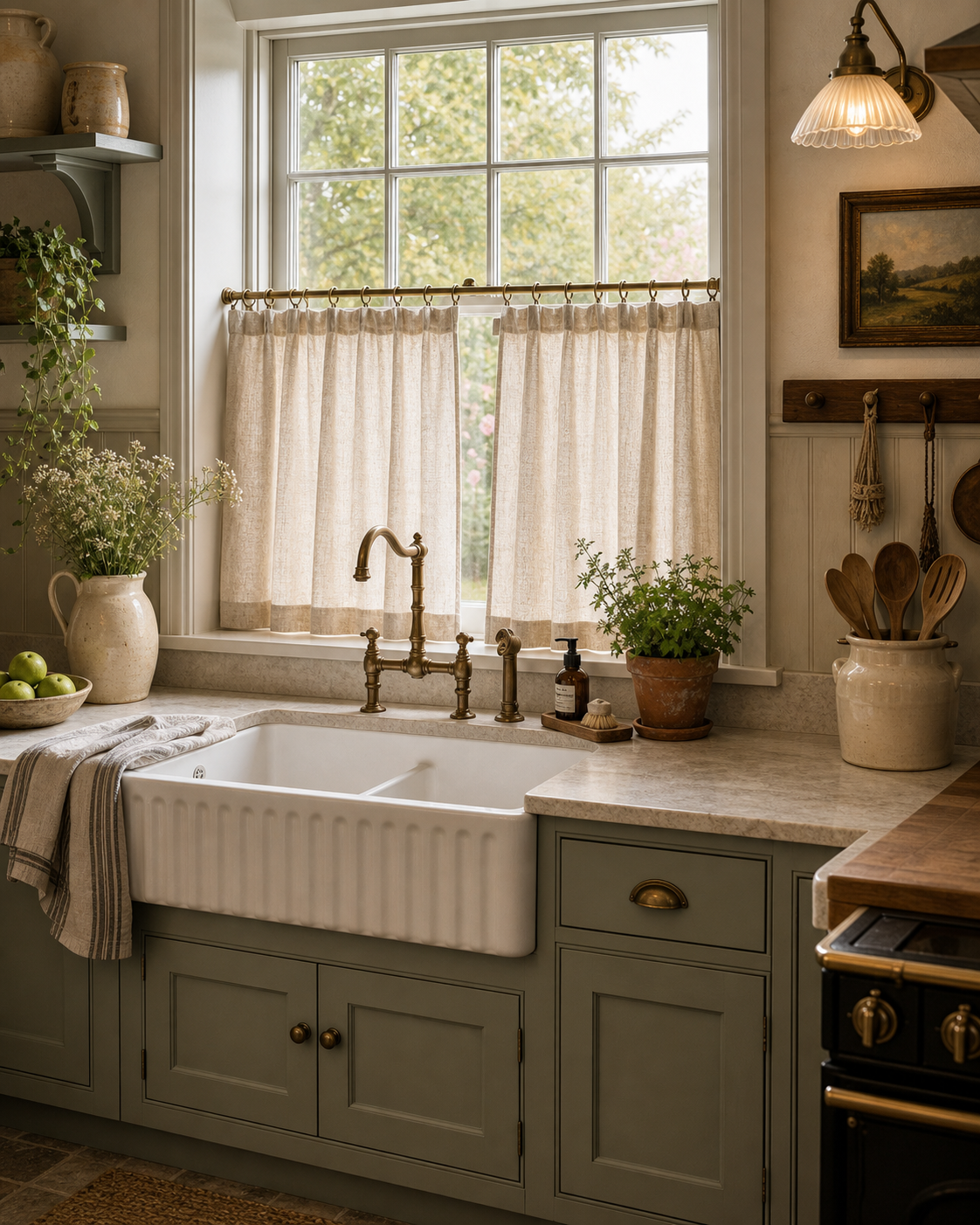

The cafe curtain solves a specific window problem with very little fabric. Mounted across the lower half of the large multi-pane opening, it screens the sink zone while leaving the upper panes open to daylight and foliage. The window remains the kitchen's brightest architectural feature rather than becoming a wall of drapery.
Below, a white apron-front sink, muted green cabinet fronts, warm metal fittings, pale counters, and a dark range create a layered working elevation. The curtain's soft pattern and relaxed folds mediate between those solid surfaces and the view. English country character comes from this practical accumulation, not from inserting decorative fabric where privacy is unnecessary.
Half-Height Fabric Preserves the Best Daylight
The curtain begins near the window's middle rail and falls to the sill, covering only the lower panes. Bright sky and tree foliage remain visible above it. This placement allows useful natural light to reach the counter while reducing direct views toward the basin and objects at hand height.
Full-length panels would be awkward beside the sink and would conceal the window grid that gives the wall its scale. A roller treatment could provide more complete coverage, but it would not introduce the same soft lower edge. The image shows why cafe curtains work best when partial screening is sufficient.
A Slim Rod Follows the Window Rather Than the Wall
A warm-toned rod spans inside the window opening with evenly spaced rings. Keeping the hardware within the reveal makes the curtain feel integrated and avoids extending a decorative line across the surrounding wall. The ring spacing creates regular folds without forcing the fabric into a stiff pleat.
The curtain divides into two panels at the center, echoing the window's vertical structure. This split allows each side to be moved independently and prevents one broad sheet from sagging across the span. Hardware finish relates quietly to the faucet and wall light.
Soft Pattern Sits Between Plain Cabinets and Outdoor Foliage
A subtle all-over motif is visible across the pale fabric, with a slightly deeper border near the hem. The print is quiet enough that individual folds remain legible. It introduces detail between the clean painted cabinet fronts below and the irregular leafy view above.
The textile appears light and softly filtered, but its exact fiber cannot be confirmed. Specifying linen would exceed the evidence. A similar result depends on moderate translucency, a small-scale pattern, and enough fullness to create depth without becoming bulky over the sink.
The Apron-Front Sink Anchors the Window Bay
A broad white basin projects slightly beyond the muted green cabinetry and aligns directly beneath the central panes. Its fluted-looking front gives the lower wall a light focal block. The tall warm-toned faucet rises in front of the curtain without obscuring the open upper view.
A wall sconce at the upper right adds local light beside the window, while a framed landscape and hanging utensils occupy the adjacent wall. These details remain outside the curtain field, allowing the sink elevation to stay readable as one focused work zone.
Muted Green Cabinets Keep the Fabric from Feeling Precious
Paneled cabinet doors and drawers form a sturdy base in a soft gray-green tone. Warm cup pulls and knobs add small highlights. Their practical scale grounds the delicate curtain, ensuring the room still reads as a working kitchen rather than a window-display vignette.
Pale counters and the white sink create a light horizontal band above the cabinetry. Small plants, a pitcher of flowers, fruit, soap, and a utensil crock occupy the edges, leaving the center around the faucet comparatively clear. The styling supports the window without concealing its function.
The Curtain Belongs to a Complete Working Composition
Open shelves at the left carry pale vessels and plants; a dark range appears at the right. These heavier side elements frame the bright sink bay and stop the curtain from seeming isolated. Their asymmetry makes the centered window feel even more deliberate.
To adapt the idea, decide first what portion of the view needs screening, mount the rod within the reveal when possible, and keep fabric clear of the basin and faucet. Let the upper glazing remain open if privacy allows. A cafe curtain is strongest here because it solves a functional boundary while preserving the kitchen's daylight.