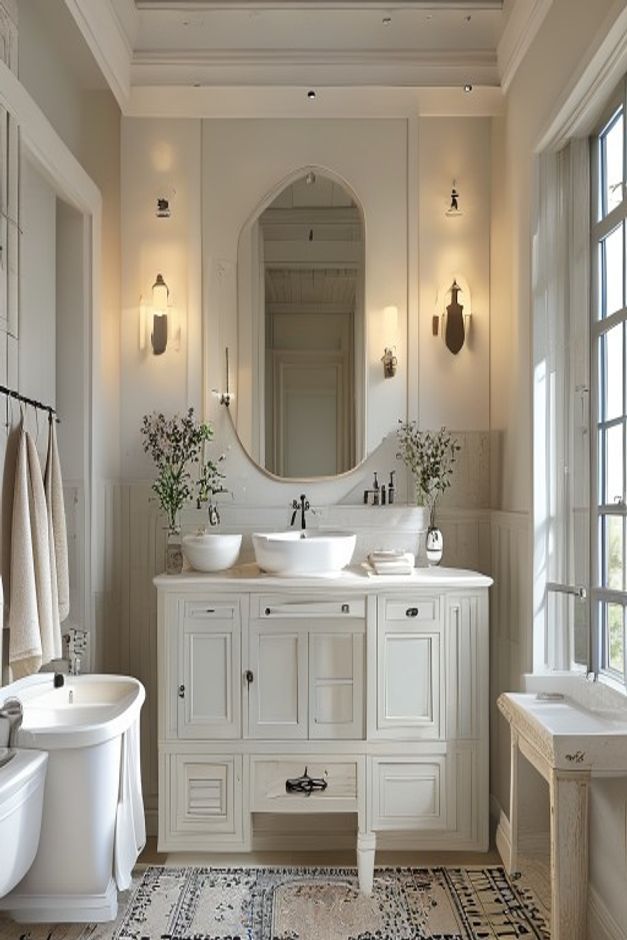

The vanity wall reads almost like a carefully proportioned piece of interior architecture. A tall arched mirror is centered above a white furniture-style cabinet, while two white vessel basins sit on the broad top. Small wall lights occupy the surrounding panels, and a large window brings strong daylight from the right.
Traditional detail is present, but the room avoids heaviness through an almost all-white palette. Cornice molding, paneled cabinet doors, slender legs, and the mirror arch provide relief through shadow rather than dark color. A patterned floor rug or tile introduces fine-scale contrast at the bottom of the composition.
The Arched Mirror Sets the Vanity's Vertical Axis
The mirror is much taller than the basins and ends in a pointed soft arch. Its shape directs the eye toward the high molded ceiling, connecting the vanity to the room's full height. A simple pale frame keeps the silhouette visible without separating it harshly from the wall.
The reflection extends the view into an adjacent doorway or wall recess, giving the narrow bathroom additional depth. Because the mirror occupies the exact center, the unequal conditions at the sides – towels on the left and a window on the right – still feel held within a stable composition.
A Furniture-Style Cabinet Grounds Two Basins
The white vanity uses paneled doors, small drawers, visible legs, and a central lower detail. Those elements give it the scale and familiarity of a chest rather than a continuous fitted block. The open strip beneath the body keeps the traditional detailing from feeling too massive.
Two round vessel basins are clearly visible on the countertop, with dark taps providing small points of contrast. Their simple forms counter the many cabinet panels below. The broader topic of multi-user vanities is treated in this warm neutral double vanity analysis, while this room uses a more decorative cabinet language.
Wall Lights Frame Rather Than Flank the Mirror
The visible sconces sit across the tall wall panels at more than one height, rather than forming one conventional pair exactly level with the face. Their warm glow produces small highlights on the pale surfaces and emphasizes the room's vertical proportions.
Daylight remains the dominant illumination in the photograph, so the sconces operate as warm accents. This balance keeps the white room from appearing cold. It also allows the moldings and mirror edge to be read through gentle shadows instead of stronger color contrast.
Side Elements Keep the Center From Feeling Staged
A curved white fixture and towel rail appear at the left edge, while a narrow console-like surface stands beneath the right window. These peripheral pieces make the room feel occupied without competing with the vanity. Their pale finishes preserve the central cabinet's dominance.
Small vases with branching stems sit near the basins and introduce irregular height against the formal paneling. The greenery is sparse enough that it does not obscure the mirror or taps. In a similar setting, one or two vertical natural accents would be more effective than a crowded countertop arrangement.
Fine Floor Pattern Anchors the Pale Envelope
A dark-on-light pattern appears beneath the vanity, supplying contrast where it will not interrupt the eye-level composition. The wood-toned perimeter floor and pale walls remain calm, allowing the patterned rectangle to establish a base for the freestanding cabinet.
The room's practical design lesson is to control detail by scale. Large pale wall panels and windows provide the background, medium-size forms define mirror and vanity, and smaller pattern appears near the floor. That progression creates richness while preserving the clarity needed around two visible basins.
Crown Molding Explains the Room's Formal Height
Layered white molding runs around the ceiling and deepens above the vanity wall. Its shadows create a clear upper termination for the tall mirror and window. This architectural frame makes the room feel finished even though the wall color and trim remain nearly identical.
The small recessed ceiling lights sit quietly within that formal border. A large central fixture would compete with the mirror arch and reduce the perceived height. The ceiling succeeds by reinforcing proportion while leaving the vanity as the visible centerpiece. Fine shadow lines between molding steps repeat the cabinet's paneled detail at a much larger scale. The hierarchy remains unmistakable.