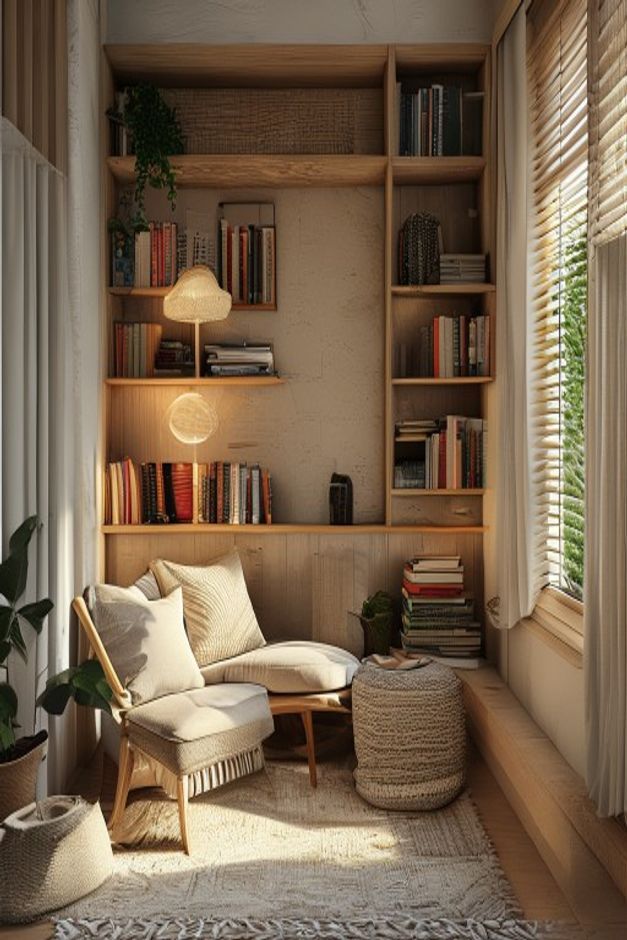

This reading nook is organized around a deliberate gap in the shelving rather than a perfectly regular bookcase. Warm wood shelves rise on the back wall, but a broad plaster-toned recess remains open behind the chair. That central pause gives the compact corner depth and prevents books from surrounding the occupant too aggressively.
Filtered daylight enters from the right through horizontal blinds, drawing thin bands across the floor and upholstery. A low timber lounge chair and rounded woven stool occupy the center, while books, plants, and baskets collect toward the edges. The combination feels Mediterranean through warm surfaces, shade, and informality rather than through literal motifs.
An Asymmetrical Bookcase Makes Space for the Chair
The left shelves extend farther across the wall, while a narrower tower rises on the right. Between them, the textured wall remains exposed. This uneven arrangement responds to the seating position and gives the chair a breathable backdrop instead of forcing it in front of a continuous grid.
Books are distributed in vertical and horizontal stacks with visible gaps. A trailing plant softens the upper left corner, and a large woven object occupies the top recess. The shelving looks used, but its contents do not erase the shape of the joinery or the calm central field.
Low Seating Keeps the Window and Shelves Connected
The lounge chair has an exposed wood frame, pale cushions, and a gently reclined profile. Its low back allows the wall recess and books above to remain visible. A higher wing chair would block the central composition and make the small alcove feel more enclosed.
The rounded woven stool can serve as a footrest or temporary surface without becoming a fixed obstacle. Its soft cylindrical form contrasts with the shelf divisions and the straight window ledge. Because it is light in scale, the path beside the chair can be adjusted as needed.
Horizontal Blinds Turn Strong Sun Into Pattern
The right-hand window is covered with warm-toned slats that temper the bright exterior light. Instead of flooding the nook evenly, the blinds create narrow shadows across the seat and rug. That controlled contrast gives the textured plaster-toned surface and timber shelves more depth throughout the day.
Full blackout treatment would remove the changing quality that makes the corner appealing. The visible solution allows privacy and glare control while preserving a connection to greenery outside. It is a useful model for reading spaces where direct sun can be as uncomfortable as insufficient light.
Pendant Forms Add Light Without Taking Floor Space
Two small woven-looking lights hang at different heights near the left side of the recess. They brighten the book spines and chair zone while keeping the floor free. Their irregular rounded silhouettes echo the pouf and baskets, tying the functional lighting into the room's tactile vocabulary.
The fixtures should be understood as local accents, not proof of a broad lighting scheme beyond the frame. A similar storage-and-seat relationship appears in this cottage reading nook with built-in wood shelving, but the present photograph relies more heavily on filtered side light and asymmetry.
Texture Is Concentrated Along the Perimeter
A soft rug, woven baskets, the slatted blind, and plant leaves gather around the clearer seating area. This perimeter strategy lets the nook feel layered without reducing its usable center. The warm neutral palette keeps those varied textures related even when their forms differ.
The design would suffer if every shelf were filled or the central wall were covered with artwork. Its character comes from alternation: books beside emptiness, direct grain beside rough plaster, sunlight beside shade. Preserving those intervals is more important than adding another Mediterranean accessory.
The Window Ledge Becomes a Secondary Horizontal Line
A deep timber ledge runs beneath the blinded window and continues visually toward the low shelf behind the chair. This repeated height ties the side opening to the book wall. It also provides a calm boundary below the bright slats without requiring decorative trim.
Books are stacked near the ledge but do not occupy the full window length. That restraint preserves a place for daylight to fall and keeps the sill from becoming another crowded shelf. The empty stretch is part of the nook's usable visual space, especially beside the movable pouf.