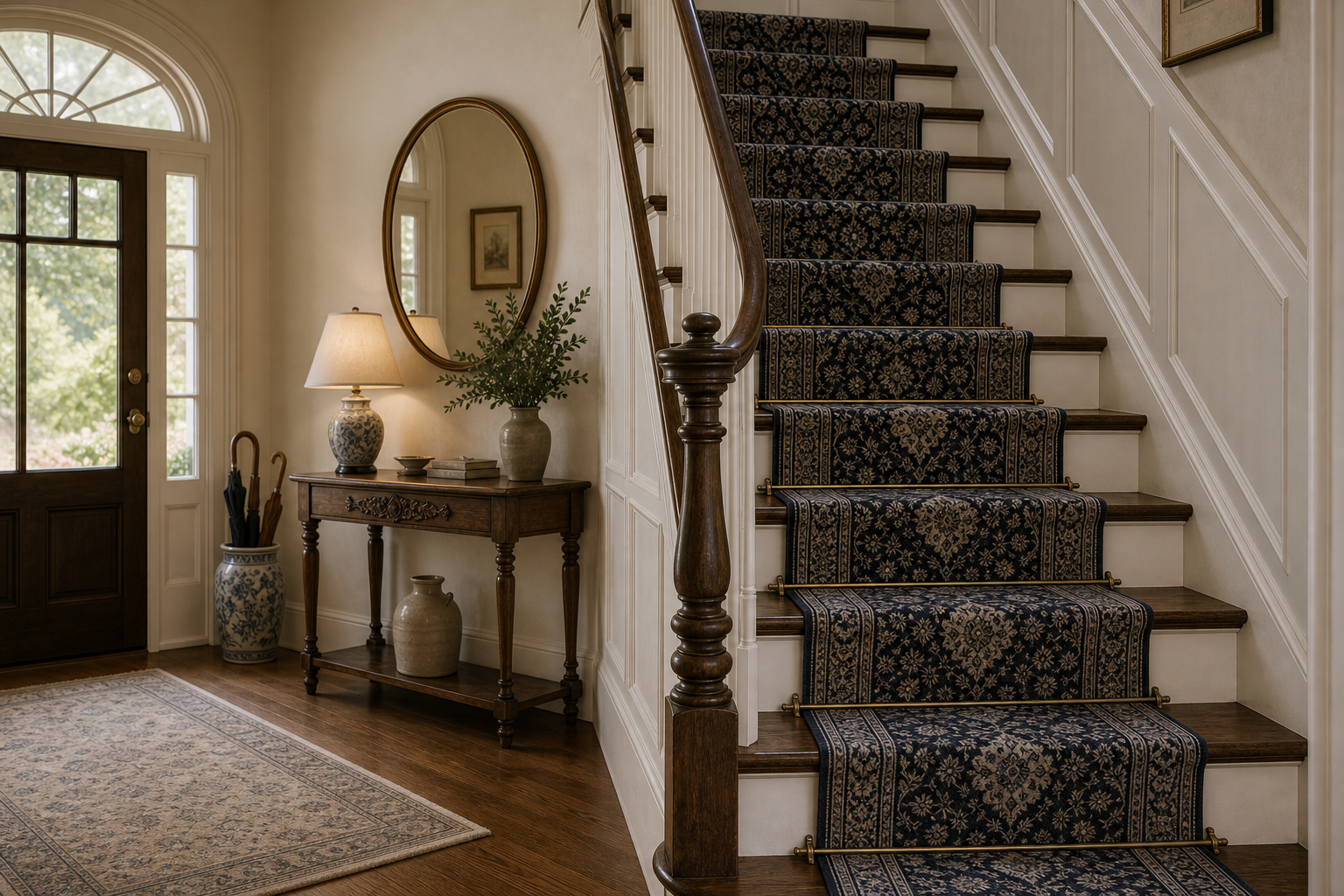

Pattern is concentrated where movement already occurs: on the staircase. A navy-and-ivory runner climbs through the narrow entry and turns each tread into part of one continuous upward figure. The dark handrail and stair edge frame it, while pale wall paneling keeps the surrounding architecture quiet. A slim console, round mirror, shaded lamp, and glazed door furnish the lower hall without competing with the stair sequence.
The Runner Converts the Stair Into a Visual Route
The navy and ivory runner is the strongest visual element because it climbs the staircase and pulls the eye upward. Its centered placement makes the stairs feel tailored. The pattern is detailed, but the limited color palette keeps it traditional and controlled.
The runner begins in the lower flight and remains consistently centered as it rises. Repeated dark motifs draw the eye away from the tight wall spacing and toward the change in level, giving circulation itself the strongest decorative role.
The warm-metal rods mark each tread and give the runner a finished edge. They also repeat the warm metal tone seen in the entry details. Because the rods are slim, they add polish without making the staircase feel overly ornate.
The Dark Handrail Frames the Pattern
The dark timber-toned handrail gives the patterned runner a strong frame. Without that darker line, the runner could feel visually disconnected from the staircase. The handrail also relates to the front door and console, tying the entry materials together.
Dark timber-toned treads and handrail create firm boundaries at the side and top. In the farmhouse brick-floor entry analysis, pattern directs movement horizontally; here, the same principle is turned upward through textile repetition.
The white paneled staircase wall gives the runner a clean architectural background. Its trim detail is traditional, but it does not compete with the woven pattern. This balance is important: pattern belongs on the stairs, while the wall provides order around it.
A Slim Console Occupies the Lower Landing
The slim dark console, round mirror and ceramic lamp create a secondary entry moment beside the staircase. They make the hall feel furnished without pulling focus away from the runner. The console's dark timber-toned tone also repeats the stair treads and handrail, strengthening the overall material relationship.
The console remains shallow and sits outside the stair width, holding only a lamp and a few small objects beneath the round mirror. Its dark tone connects to the rail, but its flat front and open lower area keep it secondary to the runner.
The floor rug near the front door is softer and lighter than the stair runner. That difference lets it define the entry zone while the staircase remains the stronger feature. Its muted pattern works because it stays visually quieter than the runner.
Doorway Light Draws the Eye Back to Floor Level
Choose a runner with enough contrast to read from the entry, then align it carefully down the center of the treads. The pattern should look intentional at every step. If using stair rods, coordinate them with door hardware, lamps or mirror frames so the metal finish feels connected.
Coordinating Pattern With a Narrow Circulation Zone
I would not add a bold wallpaper beside this staircase. The runner already provides the entry's main pattern. I would also avoid a large console arrangement that projects too far into the hall, because the stair view needs breathing room.
A second bold wall pattern would make the narrow hall feel compressed. Let the stair carry the detail, preserve pale space around it, and keep furniture depth modest wherever the route changes direction near the first tread.
The runner pattern remains contained by a pale edge before the dark tread begins. That border prevents the dense center motif from colliding visually with the handrail and wall trim, and it gives each step a readable front even as the pattern turns upward.
At the landing, the round mirror introduces the only strong curve among stair, console, doorway, and panel lines. Its reflection catches the brighter entrance rather than another object cluster. This secondary composition rewards arrival without stealing the staircase's directional role. Keeping the pattern confined to tread width also leaves each dark stair edge visible, an important visual cue where the direction changes beyond the lower flight.