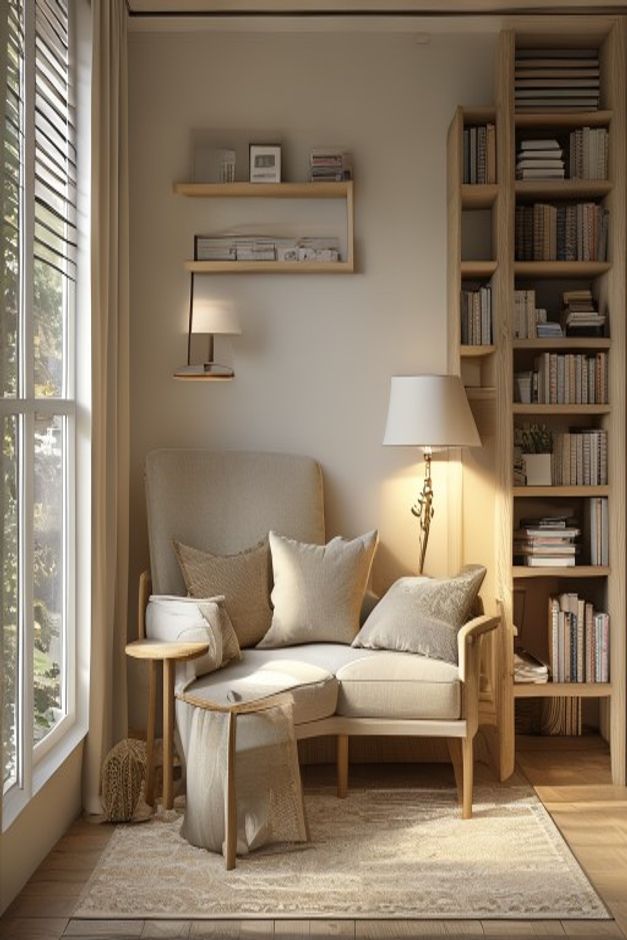

What makes this reading nook persuasive is the way storage, light, and seating occupy one narrow bay without competing for attention. A tall wood-toned bookcase anchors the right side, a generous upholstered armchair settles into the center, and a full-height window opens the left edge to daylight. The composition is compact, yet no part feels improvised.
The transitional character comes from balance rather than ornament. Straight shelf lines and a tailored chair frame provide structure, while cream textiles, a shaded floor lamp, and a small irregular side table soften the geometry. Each piece performs a practical task, but their restrained colors allow the nook to read as a single place rather than four separate furnishing decisions.
The Bookcase Turns a Narrow Bay into Architecture
The bookcase rises from floor to ceiling and fits tightly against the right wall, so it reads as part of the room rather than a freestanding cabinet. Vertical divisions create slender columns of books, with several open gaps preventing the elevation from becoming a solid grid. Its warm tone also forms a useful middle value between the bright window and pale painted wall.
At the lower level, the shelves continue behind the chair rather than stopping above it. That depth visually wraps the seat and makes the nook feel protected. A shallower unit would preserve more floor area, but it would not create the same sense of enclosure or offer the same quantity of immediately accessible books.
The Chair Is Generous Without Blocking the Window
The armchair has a high upholstered back, visible wood arms, and a broad seat layered with several cushions. It is large enough for prolonged reading, yet its frame remains open at the sides. That openness matters next to the glazing: daylight can still reach the rug and the chair does not become an opaque barrier along the window line.
Its slight angle avoids the stiffness of facing directly into the room. The reader can turn toward the window or the bookcase with minimal movement, while the front legs remain fully on the rug. The resulting posture is informal, but the position is precise enough to keep the narrow passage beside the glass legible.
Three Light Sources Cover Different Times of Day
Daylight is strongest from the left, a shaded floor lamp provides warm local illumination at the chair, and a small wall-mounted light sits beneath the floating shelves. The fixtures are not arranged as a matched set. Their different heights allow the wall, books, and seat to receive separate pools of light rather than one flat ceiling wash.
The wall-mounted fixture also illuminates the small floating shelves above it, making that secondary display useful after sunset. Because the shade and shelf edges remain shallow, they do not create a bulky layer over the seated reader. The lighting plan respects both the activity and the limited depth of the wall.
Small Surfaces Stay Proportional to the Seat
A slender round wood table stands beside the chair and offers just enough area for a cup or book. In front, a soft cylindrical piece acts as a flexible footrest or low surface without adding another hard-edged object. Both are noticeably smaller than the armchair, preserving a clear hierarchy in a footprint where a standard coffee table would obstruct movement.
The floating shelves above the wall light follow the same economy. They hold a few horizontal books and framed pieces, adding visual interest to the blank wall without projecting into head space. The nearby cottage reading nook with wood shelving demonstrates a more enclosed alternative; here, leaving part of the wall open keeps the chair bay brighter.
A Quiet Textile Palette Lets the Books Supply Detail
Cream upholstery, off-white cushions, a light rug, and softly hanging curtains create a low-contrast foreground. Texture replaces color: the rug has a subtle border, the cushions shift from smooth to nubby, and the curtain folds temper the hard window frame. The books then become the nook's most varied visual element without making the room look busy.
The useful lesson is to allocate space in the right order. First protect the chair's sitting depth and the route beside it; then fit shelving and small surfaces around that zone. This photograph does not rely on spare floor area. It succeeds because every object is scaled to support the act of reading and no accessory asks for a separate circulation path.