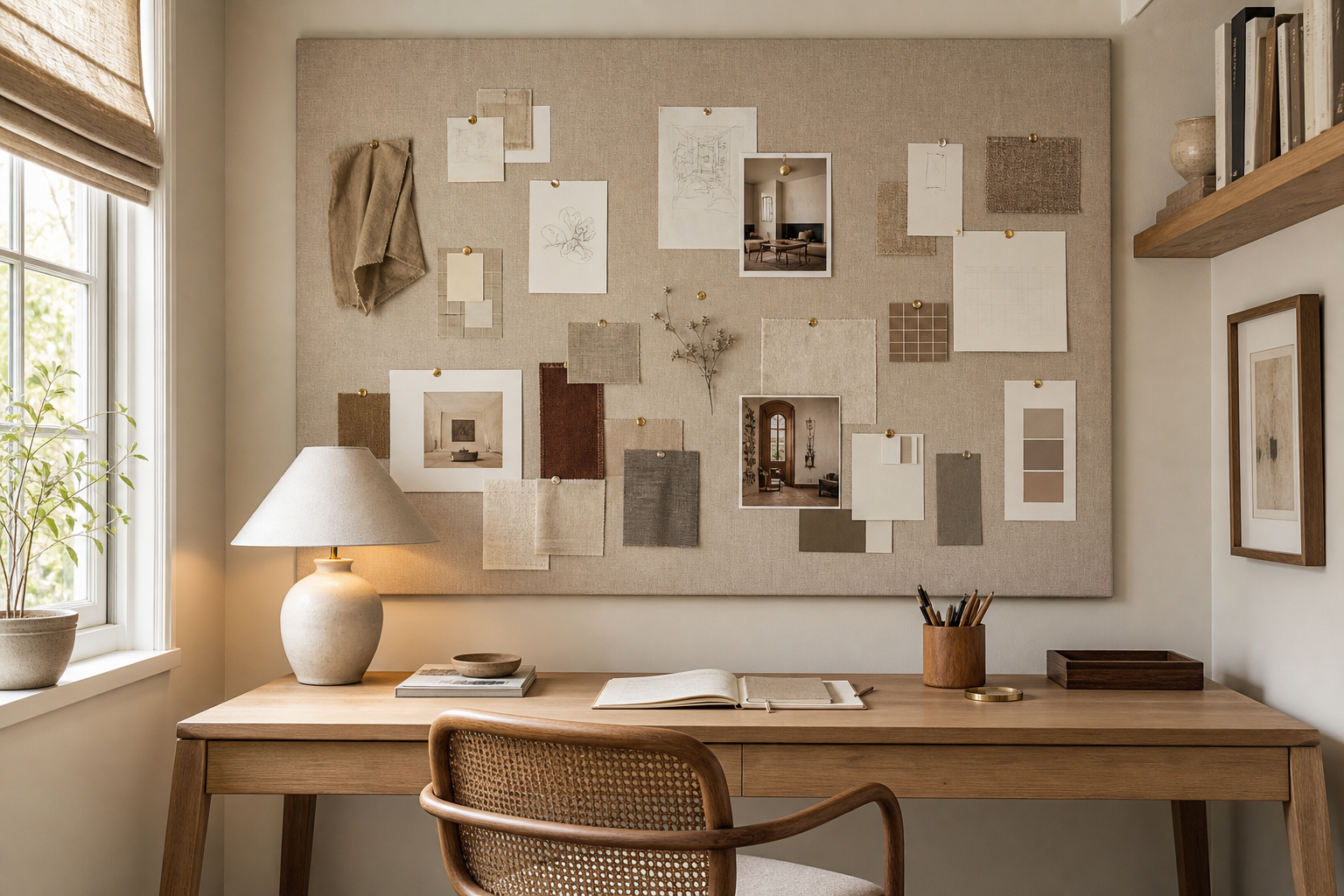

The pinboard is treated as the office's primary working surface rather than a small accessory. A large warm fabric-covered rectangle fills the wall above the desk, holding sketches, swatches, notes, and cards in loose clusters with visible gaps. The timber-toned desktop remains comparatively clear. A woven-back chair, rounded ceramic lamp, side shelf, window shade, and daylight add texture without competing with the evolving information field.
The Pinboard Claims a Full Working Wall
The board is large enough to fill the wall above the desk, so it becomes the room's main working surface. It gives visual planning a dedicated zone instead of letting papers spread across the desktop. Because the board is covered in fabric, it feels softer than a hard whiteboard or metal grid. That material choice is what keeps the office warm.
The board is wider than the chair position and nearly fills the space between desk and ceiling, giving visual planning a permanent address. Its single outer boundary is calmer than several unrelated small notice boards.
The pinned pieces vary in size, but they are spaced with enough air around them. That makes the wall feel active without becoming messy. The small pins create small repeated points across the board, which helps the arrangement feel intentional.
Loose Clusters Preserve Areas for New Material
The wood desk is broad and mostly clear, which is important because the board already carries the visual detail. The open notebook, pencil cup and tray support work without crowding the surface. This is a practical lesson for home offices: if the wall is information-rich, the desk should stay edited.
Pinned pieces vary in size and orientation but do not touch edge to edge. The earlier Scandinavian built-in desk analysis uses a compact central pinboard; this office expands the working display while simplifying the desk below.
The Desk Remains Clear Below the Active Wall
The woven-back chair introduces a woven texture that relates to the pinboard fabric and window shade. It gives the workspace a handcrafted quality without adding pattern. Its curved back also softens the straight desk and rectangular board.
Notebook, small tray, lamp, and pencil vessel occupy separate points rather than forming a continuous row. Moving most visual information onto the wall protects a broad area for writing or arranging samples.
A Woven-Back Chair Adds a Smaller Texture Scale
The ceramic table lamp gives the desk a warm pool of light below the board. That lower glow balances the daylight from the left window. The lamp also adds volume to the desk, preventing the workspace from feeling like a flat wall of pinned papers.
The chair's woven back introduces a regular open grid against the desk's long straight edge. It repeats texture without imitating the irregular paper collage or adding another strong color.
The palette stays close to warm ivory, oatmeal, light wood and taupe. That restraint lets the board hold many items without feeling loud. Muted clay and brass details add depth, but they remain small enough to keep the office calm.
Window Light Keeps Neutral Papers Distinct
Start with one large board rather than several small boards. A single surface creates a clearer visual field above the desk. Cover it in fabric or another quiet fabric, then group swatches, sketches and cards in loose clusters. Leave blank areas so the wall can evolve.
Designing a Pinboard That Can Change Over Time
I would avoid placing another busy gallery wall beside this board. The pinboard already provides the office's visual energy. I would also avoid covering the desk with trays and files. The point of the board is to move inspiration and planning off the work surface.
Leave meaningful blank zones and remove obsolete material as new work is pinned. A second gallery wall or numerous desk organizers would duplicate the board's visual load and make the office feel archival rather than active.
Several pale sheets overlap slightly near the board center, while darker swatches remain dispersed toward the edges. The arrangement feels active yet each item retains a readable outline against the warm backing.
The board begins just above the desktop and leaves a slim strip of pale wall at each side. That margin keeps the large working surface from reading like permanent wall cladding.
Because the lamp and chair use rounded outlines, they temper the board's strict rectangle without distracting from pinned material. The office gains softness through shape and texture rather than an additional decorative layer.