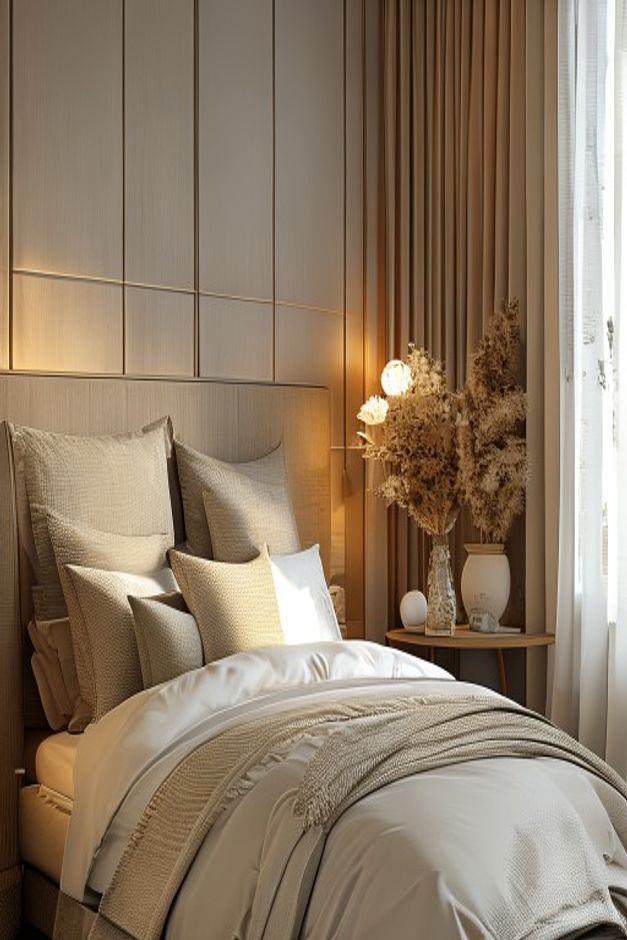
The round nightstand resolves a narrow gap between the bed and full-height curtain without introducing a sharp corner. Its slim top supports two vessels and small objects, while fine legs leave the wood-toned slatted wall visible behind. The piece is visually light enough to sit beside substantial layered bedding.
A tall paneled headboard wall extends across the background, interrupted by one warm horizontal light line. Vertical slats at the right create a darker edge beside the bright window. The nightstand succeeds because its curved outline mediates between those strict verticals and the soft volume of the bed.
The Circular Top Uses a Narrow Bedside Gap
The table occupies a slim strip beside the mattress and does not project beyond the visible bed edge. Its round perimeter eliminates a front corner near the curtain route. This is especially useful where the window and bed leave limited room for a conventional rectangular cabinet.
The top remains open around a tall clear vessel, a pale ceramic form, and one small object. Grouping those items toward the wall preserves a usable front edge and prevents the table from appearing overloaded.
The nightstand top aligns near the mattress height, allowing its objects to remain accessible without rising into the curtain. Its diameter is just broad enough for the visible arrangement. Leaving the outer arc empty reinforces the table's useful edge and its circular outline.
Fine Legs Keep the Wall Treatment Visible
Three narrow supports lift the table above the floor and expose the vertical slats behind it. This transparency stops the small piece from becoming a dark block at the edge of the bed. It also lets daylight reach beneath the top and across the lower wall.
Vertical Slats Give the Nightstand a Darker Backdrop
Closely spaced wood-toned slats rise from floor to ceiling beside the window. Their shadows create a deeper zone around the table and make the pale vessels easier to read. The repeated lines also distinguish this bedside from the broader pale panels behind the headboard.
The slatted section is narrow enough to act as an accent rather than a full room envelope. It concentrates warmth at the window edge and visually links the nightstand to the darker curtain fabric.
The dried branch arrangement reaches upward in front of the slats but remains narrow enough that their repeated lines stay visible. A shorter, wider display would crowd the table and window junction. Here the vertical arrangement amplifies the wall height instead of consuming bedside width.
A Horizontal Light Line Widens the Bed Wall
Warm concealed light runs across the paneled wall above the headboard. It establishes a low horizontal datum against tall vertical joints and slats. The line broadens the perceived bed zone and adds depth without placing another fixture on the crowded nightstand.
The exact source is hidden, so the image supports discussing only the visible diffuse glow. Its role is architectural: it separates panel levels and gives the headboard a defined background after daylight fades.
The headboard sits below the illuminated horizontal joint, leaving a pale panel band visible between them. That spacing makes the glow readable as part of the wall rather than a line attached to the bed. It also gives the tall pillows a clean background.
Layered Bedding Supplies the Main Soft Volume
Large textured pillows, white bedding, and a folded neutral throw create considerable visual mass at the center. The nightstand remains deliberately lighter in response. Matching that softness with a bulky upholstered table would make the bedside feel compressed.
A published warm neutral bedroom curtain study demonstrates how fabric can shape the perimeter. Here, the compact round table protects that curtain edge and lets the textile continue uninterrupted toward the floor.
Daylight Clarifies the Neutral Differences
A bright window at the right sends light across the table, dried branches, pillows, and throw. The scene contains several close beige and ivory values, but side illumination reveals their different textures. This prevents the palette from collapsing into one flat tone.
The transferable decision is to select bedside furniture after measuring the relationship between mattress and curtain, not in isolation. When the gap is narrow, a round open base preserves movement and allows wall treatments, daylight, and bedding to remain the larger composition.