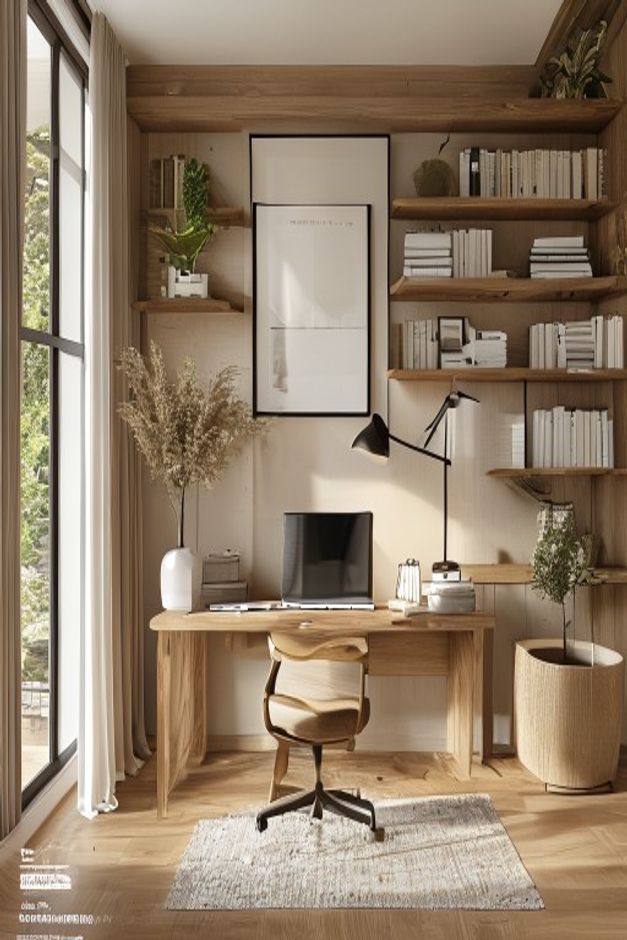

The wood desk and shelving work as one storage wall in this home office. Their similar tone reduces visual breaks, while a clear desk surface and partly open shelves leave room for actual work. The warm-neutral palette helps, but the useful design move is the division between what stays on the work surface and what belongs on the shelves.
Match the Desk and Storage Wall
The decision to match the desk wood grain with the built-in shelving unit creates a seamless visual flow that anchors the entire room. When the primary furniture pieces share a consistent tone, the eye perceives the workspace as a singular, intentional installation rather than a collection of disparate items. This strategy is particularly effective in smaller rooms where reducing the number of distinct visual planes helps to prevent the space from feeling overwhelmed by heavy cabinetry or oversized desks.
Beyond the surface color, the consistency in the wood finish allows the room’s other elements to stand out without competing for attention. The light oak tones provide a grounding warmth that balances the cooler, black accents found in the task lighting and minimalist art frames. By maintaining this wood-tone continuity, the office achieves a sense of architectural permanence, turning a standard wall into a custom-designed feature that feels both permanent and highly curated.
Leave Working Space on the Shelves
Integrating a desk directly against a wall-to-wall shelving unit requires a careful balance between hard surfaces and soft, tactile accents. In this space, the inclusion of textured linen curtains and a woven fiber planter softens the rigid geometry of the wooden shelves. These organic materials provide a necessary counterpoint to the linear nature of the desk, ensuring the room remains inviting and comfortable for long hours of work.
Furthermore, the arrangement of books and decorative objects on the shelves is not merely for storage; it is a deliberate exercise in curation that mirrors the desk’s clean lines. By avoiding overcrowding and allowing for negative space, the shelving unit acts as a backdrop that supports the desk’s function without distracting from it. This balance of curated display and functional storage is essential for maintaining the serene, warm neutral atmosphere that defines the room’s character.
Place Task Light Where Work Happens
Lighting in a warm neutral workspace must serve both a functional purpose and an aesthetic one. The black adjustable task lamp positioned on the desk provides a sharp, high-contrast element that draws the eye toward the workspace. Because the lamp is finished in a matte black, it acts as a visual anchor, punctuating the light-toned wood surfaces and preventing the overall palette from appearing too washed out or monochromatic.
The placement of this lamp is equally important, as it highlights the desk surface while creating a focal point against the neutral backdrop of the shelving. By choosing a task lamp with a minimalist profile, the design maintains the room’s clean aesthetic while ensuring that the light itself is directed exactly where it is needed. This combination of form and function is a hallmark of professional design, where every accessory is chosen to reinforce the room’s overarching theme without cluttering the visual field.
Curating Shelving for Visual Harmony
The shelving unit serves as the backbone of the room, and its organization is critical to the success of the warm neutral theme. Rather than filling every inch with files or bulky equipment, the shelves are populated with a mix of books, framed minimalist art, and a white vase holding dried pampas grass. This variety of objects creates a rhythm that guides the eye across the wall, making the storage system feel like a gallery display rather than a utilitarian archive.
To achieve this look, it is vital to keep the color palette of the displayed items within a tight range of creams, beiges, and muted tones. When the items on the shelves coordinate with the room’s broader color scheme, the shelving unit ceases to be a source of visual noise. Instead, it becomes a cohesive feature that enhances the room’s tranquil atmosphere, proving that storage can be as much about visual delight as it is about organization and accessibility.
The Importance of Negative Space
A common mistake in home office design is the urge to fill every available surface, but this room demonstrates the profound impact of negative space. By leaving sections of the shelving empty and keeping the desk surface largely clear, the design allows the wood grain and the wall color to breathe. This restraint is what gives the room its luxurious, high-end feel, as it suggests that the space is designed for clarity of thought rather than just storage capacity.
Practicing this level of restraint requires a disciplined approach to what is kept on the desk and what is stored away. In this environment, the desk is kept free of excessive equipment, allowing the user to focus on the task at hand. This emphasis on simplicity is a design principle that can be applied to any home office, regardless of its size, by focusing on the quality of the furniture rather than the quantity of the objects displayed within it.
Frequently Asked Questions
How can I ensure my desk and shelves look cohesive?
The most effective method is to match the wood tones and finishes of your desk and shelving units. By using the same material or a complementary wood species, you create a unified architectural foundation that makes the room feel custom-designed rather than furnished with separate pieces.
What is the best way to style open shelving in an office?
Focus on a mix of functional items and decorative accents, such as books, minimalist art, and vases. Maintain a consistent color palette for these items to avoid visual clutter, and always leave sections of the shelves empty to provide negative space that allows the eye to rest.
How do I incorporate warmth into a neutral workspace?
Introduce warmth through tactile materials like linen curtains, woven baskets, or organic decor such as dried grasses. These textures soften the hard lines of wooden furniture and provide a sensory layer that prevents a neutral room from feeling cold or sterile.
For a related lighting approach, see how task lighting and light wood work together in a home office.