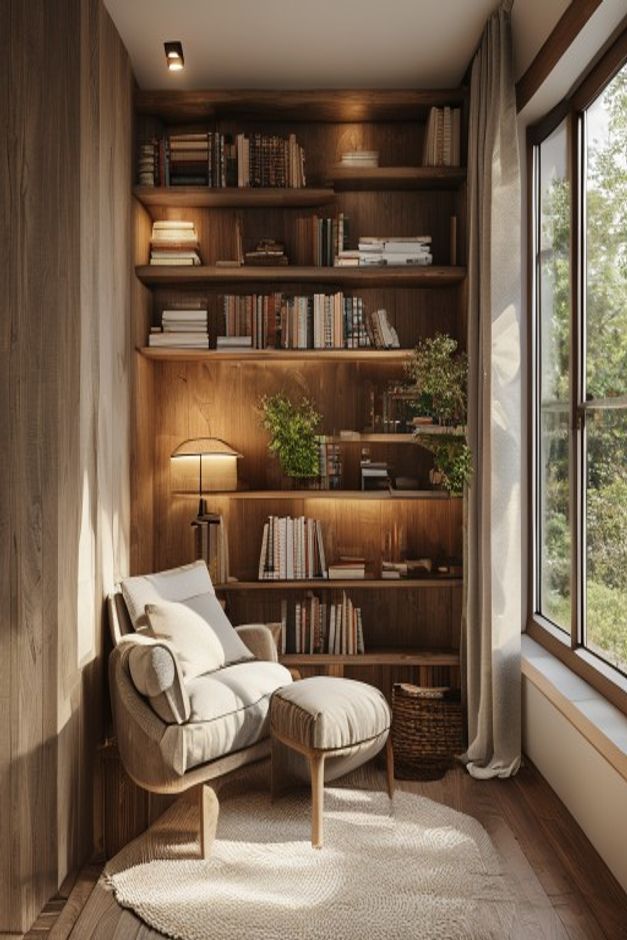

A deep warm-wood bookcase closes one end of this slender bay, while a tall window opens the entire right side to trees. The chair occupies the hinge between those two conditions. It faces slightly toward the shelves, receives daylight from the side, and retains a view beyond the glass; that three-way relationship defines the nook more strongly than any decorative object.
A Dark Book Wall Gives the Bay a Definite End
Broad shelves span the full width between timber side panels. Their deeper brown tone makes the far wall advance visually, shortening what might otherwise feel like a passage. Books are grouped in uneven stacks, leaving horizontal bands of bare wood that keep the construction legible.
The upper shelves carry denser rows, while the chair-height zone includes plants, a lamp, and more open surface. That change in density draws attention downward to where reading happens. It also prevents the bookcase from becoming a single block of small repeated spines.
The Chair Turns Toward Books and the View
The pale lounge chair is angled away from a strict frontal pose. Its back rests near the left timber wall, its seat addresses the bookcase, and its occupant would still look toward the right-hand trees. Slender wood legs keep the upholstered body above the floor and preserve the narrowness of the bay.
Rounded arms and a loose back cushion give the seat a softer silhouette than the shelf wall behind it. The chair does not attempt to fill the width between wall and window. That modest scale leaves a visible strip of rug at each side and prevents the reading position from feeling wedged into the alcove.
Shelf Lights Concentrate on Reading Height
Warm light appears beneath selected middle boards rather than under every shelf. These illuminated strips reveal book edges and the wood grain directly behind the chair. The top stays comparatively dim, allowing the storage to recede above eye level.
A compact shaded lamp stands at the chair's left shoulder and creates a lower, localized pool. It does not duplicate the shelf strips; its rounded shade interrupts their long horizontal lines. This small difference makes the nook feel assembled for use rather than uniformly lit for display.
The illuminated timber can be considered beside this cottage reading nook shelving treatment, although the present bay is darker, narrower, and defined by one uninterrupted window edge rather than wraparound glazing.
The Ottoman Occupies the Only Spare Floor Patch
A matching pale ottoman stands close to the chair, leaving the right-hand window route visible. Its rounded cushion and light wood legs form a compact pair with the seat. Pulling it farther into the bay would block movement; keeping it close allows reclining without turning it into a separate island.
Curtain and Window Form a Soft-Hard Pair
A gray-beige curtain hangs in the narrow gap between bookcase and dark window frame. Its folds conceal the junction of timber and glass, while its neutral color avoids adding a third strong vertical band. The fabric can temper glare without permanently hiding the wooded outlook.
Sunlight crosses the curtain, chair, and rug at an angle, creating bright patches that move independently of the shelf lighting. This side illumination is the reason the dark book wall feels warm rather than enclosed. The window must remain largely free of tall furniture for that exchange to continue.
Plants Break the Long Shelf Lines
Two leafy plants sit around the middle shelves, where their irregular silhouettes interrupt the strict timber bands. Their green also repeats the view beyond the glass. The limited number matters: a plant on every level would blur the distinction between library wall and exterior landscape.
The Rug Keeps the Seating From Drifting
A pale textured rug begins under the chair and ottoman and stops before the window base. Its soft, irregular surface separates the seating from the wood floor and walls. The lighter rectangle gives the two upholstered pieces a shared ground against the darker shelves.
A woven basket occupies the lower right corner of the bookcase, adding one dark rounded form near the floor. Nothing else is needed in the center. The nook remains convincing when books stay on the end wall, softness stays around the chair, and the glazed side remains open.