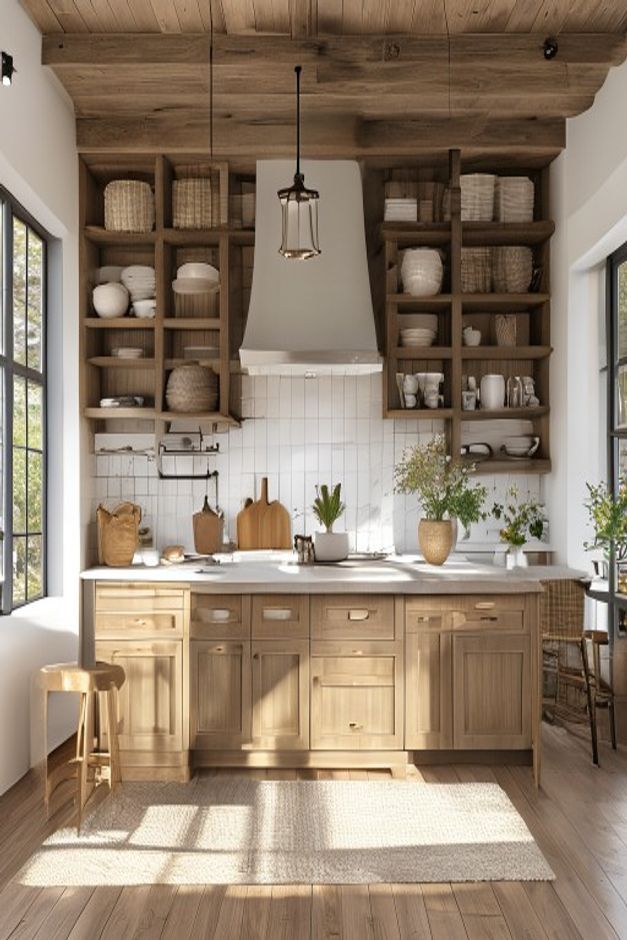
The range hood is the architectural center of this kitchen, not simply an appliance cover. Its broad pale form rises between two banks of dark wood open shelving and aligns with the main counter below. Windows on both side walls bring daylight toward that center, reinforcing a composition that feels symmetrical even though the room extends beyond the frame.
Modern farmhouse design is often reduced to surface cues. This kitchen is more useful to study because its character comes from proportion: a simple hood against a gridded backsplash, tall shelf towers around it, substantial lower cabinetry, and wood carried across the ceiling. The rustic notes are integrated into the room's structure rather than added as small themed objects.
The Range Hood Holds the Central Axis
The pale hood begins narrow near the ceiling, widens toward the cooking zone, and terminates in a horizontal ledge above the backsplash. Its tapered outline interrupts the rectangular shelf grid and draws the eye inward. Keeping the surface largely plain allows the silhouette to provide emphasis without decorative trim.
Open Shelf Towers Frame Rather Than Compete
Deep wood-toned shelves rise on both sides and divide into irregular compartments. Woven baskets occupy the highest bays, while dishes, pitchers, and bowls sit lower where their pale surfaces contrast with the darker backing. The shelf towers are visually substantial, yet the central hood remains strongest because the surrounding objects are grouped by tone and scale.
The lowest shelves sit close to the backsplash and keep frequently handled pieces within reach. Nothing projects over the cooking center. This preserves a clear working zone while making the wall feel inhabited, a more convincing result than filling every shelf with purely decorative objects.
A Gridded Backsplash Provides a Quiet Middle Layer
Pale rectangular tiles run behind the counter and hood, introducing a regular joint pattern between the expressive shelving and paneled base cabinets. The grid is visible but low contrast. It adds scale to the wall without challenging the stronger vertical uprights and tapered hood.
Lower Cabinets Give the Wall a Solid Base
Warm wood drawer and door fronts span the full lower elevation. Their frame-and-panel construction supplies familiar farmhouse depth, but the hardware remains compact and consistent. A light counter separates these cabinets from the backsplash, creating a clean horizontal line beneath the range hood.
The cabinet run is more closed and regular than the shelves above. That difference is sensible: the lower half needs to read as a dependable working base, while the upper half can accommodate open display. The photograph does not reveal internal storage, so the design value lies in the visible balance of closed mass and open recesses.
Side Windows Pull Daylight Across the Work Surface
Tall dark-framed windows on both sides send light toward the center counter. Their black outlines sharpen the pale walls and relate to the pendant stem. Because the openings sit perpendicular to the range wall, they illuminate shelf depth and cabinet grain rather than creating glare directly behind the hood.
The Wood Ceiling Extends the Kitchen's Warmth
Broad boards and a substantial beam cross the ceiling above the storage wall. This upper timber plane prevents the dark shelves from appearing isolated against a pale room. It also creates a warm canopy over the central counter while leaving the side walls bright.
A Single Pendant Marks the Center Without Obscuring It
One dark pendant drops in front of the hood and uses a narrow, open frame. Its scale is modest enough that the tapered hood remains visible behind it. The fixture reinforces the axis and adds a vertical line, but the room does not depend on it for visual drama.
The use of open shelving beside a hood can be compared with this published cottage kitchen backsplash wall, where a lighter treatment shifts attention toward surface texture. Here, darker shelving gives the pale hood a stronger silhouette.
The Display Works Because Useful Objects Repeat
Stacks of white dishes, cutting boards, baskets, and vessels recur on both sides without creating exact mirror images. Their repetition gives rhythm while slight differences keep the wall natural. Plants and branches remain concentrated near the counter, adding a softer line without obscuring the storage structure.
A successful adaptation should begin with the hood width and the clear work zone beneath it, then size the shelf towers to the remaining wall. Styling comes last. The photograph proves that the central form, shelf depth, window light, and lower cabinet mass can carry the design even before accessories are considered.