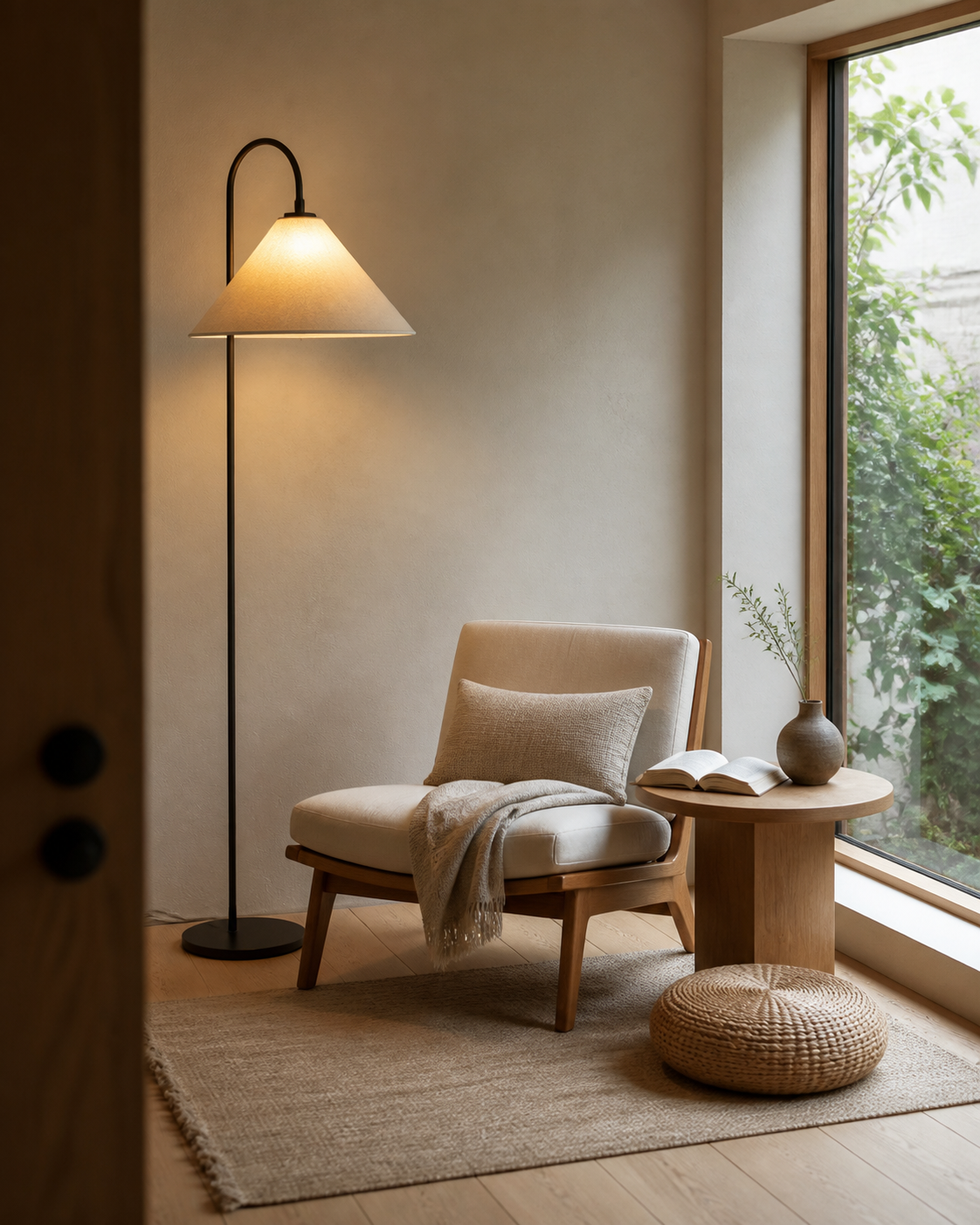

The floor lamp gives this reading nook a boundary without building a wall. A slender dark stem rises beside the chair, curves forward, and lowers a broad pale shade over the seat. Its outline encloses the user at one side while the full-height window opens the opposite edge to greenery and daylight.
Furniture is kept low and close to the floor: a wood-framed lounge chair, small round table, woven cushion, and lightly textured rug. That low horizon leaves the lamp and window as the two main vertical elements. The corner feels restful because illumination, seating, and reach were planned around one activity rather than assembled as a generic empty-space vignette.
The Curved Lamp Defines the Reading Position
The lamp base sits just behind the chair's left front corner, and the stem rises without crossing the seat. Its curved upper section brings the shade inward, placing light closer to the book while keeping the floor footprint outside the sitter's immediate leg space. This is more efficient than setting a straight floor lamp farther into the route.
A warm pool is visible on the wall and chair, yet the image cannot establish a precise bulb temperature. The useful evidence is direction and diffusion: the shade conceals the source, sends light downward, and softens the edge across the pale wall.
The Chair Stays Low Enough to Preserve the Window
A broad cushioned chair with exposed wood-toned framing sits below the window's middle height. Its low back allows the outdoor view and daylight to remain dominant above it. One textured pillow and a loose throw add comfort without widening the chair's silhouette or obscuring the frame.
The chair is angled slightly toward the round table rather than aligned rigidly with the glass. This position gives the reader access to both book and view while keeping the front legs fully on the rug. The modest rotation also prevents the nook from feeling staged against the wall.
A Round Table Fits the Reach Zone Without Adding Corners
The small pedestal table stands at the chair's right arm and holds an open book and one vessel. Its round top avoids projecting a corner into the narrow space between seat and window. The height appears close to the chair arm, making the surface readable as part of the activity rather than a decorative stand at the edge.
Its warm wood tone connects with the chair frame, window lining, and floor. Because the tabletop remains mostly visible, that relationship is easy to read. A larger stack of accessories would reduce the usable area and compete with the lamp as the nook's second focal object.
The Window Supplies an Expansive Counterweight
A tall pane of glass fills the right side and brings dense green foliage close to the interior. The deep reveal and wood-toned trim give the opening physical depth. That strong vertical aperture balances the lamp's narrow black line without needing artwork or shelving on the blank wall between them.
Daylight reaches across the table, chair, and floor cushion, revealing subtle texture in upholstery and rug. The lamp remains visibly on, so the photograph demonstrates simultaneous layers rather than treating natural and artificial illumination as separate design schemes.
The Rug and Woven Cushion Build a Low Textural Field
A pale rectangular rug gathers the chair, table, and lamp base into one zone. A round woven floor cushion overlaps its front edge and introduces a compact circular form that echoes the table. Both pieces remain low enough that the path into the chair is still easy to understand.
Blank Wall Space Is an Active Part of the Composition
A large area of softly textured wall remains empty above and beside the chair. This restraint allows the lamp's curve and shade to register clearly. Adding a gallery arrangement would fragment the very surface that currently makes the localized pool of light visible.
To recreate the logic, mark the seated reach zone first, then place a curved lamp outside the feet but inside the reading field. Keep the side table small, preserve the view above the chair, and use one rug to define the footprint. Japandi calm here is a consequence of spatial editing, not a list of themed accessories.
The vessel on the table remains narrow enough that it does not compete with the open book or interrupt the view through the glass.