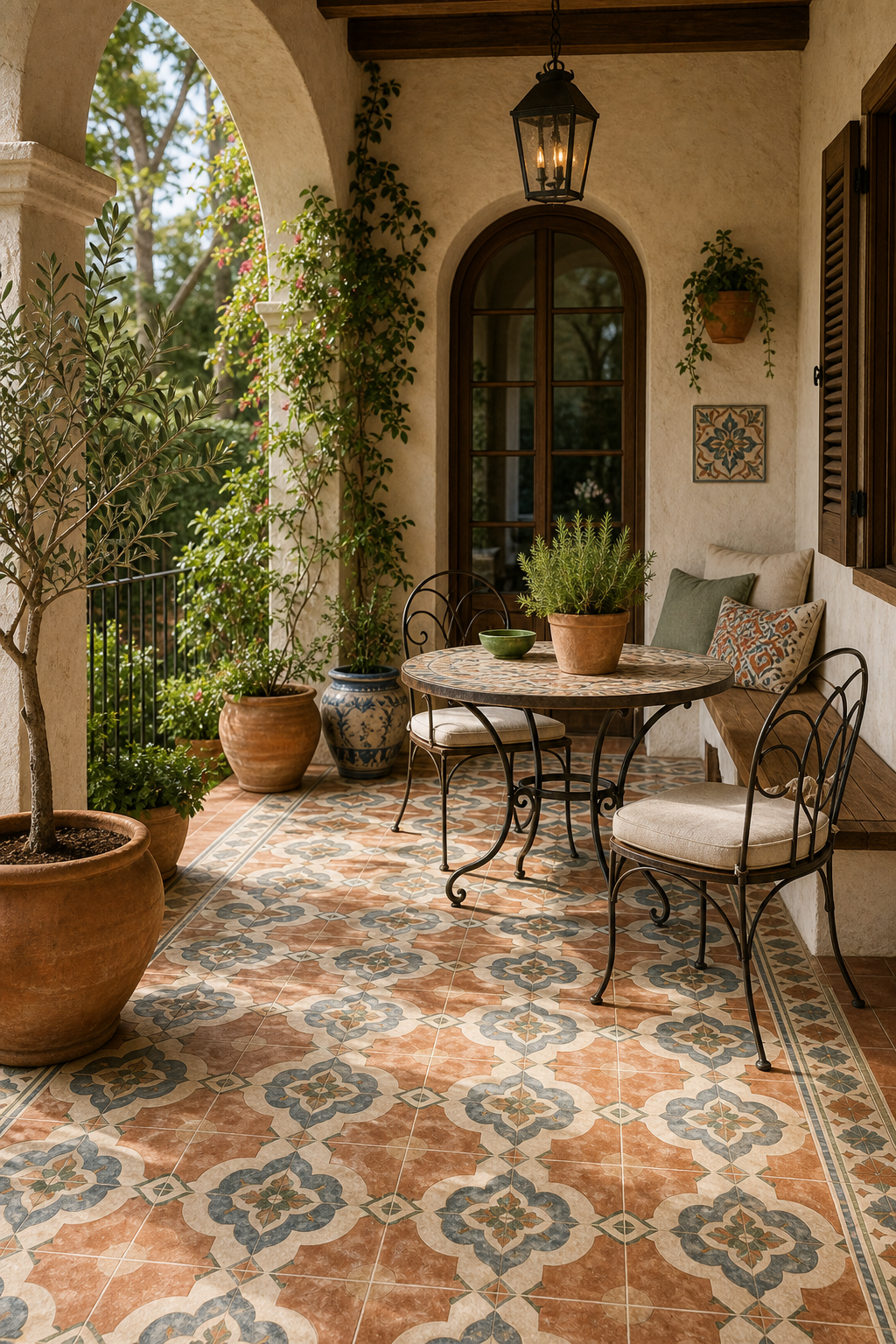

The patterned floor turns this narrow covered patio into a composed outdoor room. Repeating terracotta, muted blue, cream, and green motifs run from the foreground toward the arched door, while a darker border traces the perimeter. The pattern creates direction and enclosure before furniture is considered.
Architecture and furnishings respect that ground plane. Stucco arches rise at the open edge, dark beams cross overhead, and slender iron chairs gather around a round table near the far end. Large pots stay mainly along the sides, preserving the central tile sequence and a readable route through the patio.
The Border Defines the Patio as One Room
A continuous patterned band runs close to the wall and open edge, framing the larger field of repeated motifs. This border prevents the tile from looking like an endless decorative surface and makes the long rectangle feel intentional. Furniture sits inside it rather than cutting randomly across the boundary.
At the foreground, the border remains visible beside large terracotta pots. Keeping that edge exposed is crucial; hiding it under planters would weaken the floor's architectural role and make the pattern appear partially cropped.
Large Motifs Slow the Long Circulation Axis
The central units are broad enough to read individually as the eye moves toward the door. Their alternating dark and warm shapes interrupt the patio's strong length, reducing the corridor effect. Smaller busy units would create visual noise across the same narrow span.
Tile joints form a regular grid beneath the ornamental shapes, giving the pattern constructional order. Exact tile composition is not verifiable, but the visible relationship between module, border, and patio width is clear.
Iron Furniture Leaves the Floor Legible
Curved black metal chairs use fine legs and open backs, allowing motifs to remain visible beneath and around them. A round table repeats some of the floor's color and pattern without occupying a large opaque base. The seating group feels light enough for the active surface.
A timber bench runs along the right wall and keeps its support close to the perimeter. Cushions add comfort in cream, muted green, and terracotta pattern, echoing the floor without replicating it exactly.
Arches and Timber Openings Frame the Pattern
A broad stucco arch opens to greenery at the left, while an arched timber-and-glass door closes the far wall. Their curved tops soften the tile grid and create two strong vertical destinations. Dark shutters at the right add another warm timber plane.
Overhead beams run across the view and a hanging lantern marks the seating area. The ceiling structure confirms that this is a covered room-like patio, not an uncovered terrace with decorative flooring alone.
Plants Occupy the Edges Rather Than the Route
Olive-like foliage, climbing vines, and potted herbs gather along the arch, wall, and table. Containers vary in scale, but the largest remain outside the main walking line. This edge planting makes the rigid floor feel inhabited while preserving movement.
To apply the strategy, choose the border and field together, center the repeat on the circulation axis, and select furniture with open bases. Keep large pots at structural edges and let the floor remain visible around them. The patio succeeds because pattern is treated as spatial organization rather than surface decoration.
The Floor Pattern Organizes Near and Far Zones
The bordered tile field extends from the foreground seating area toward the arched opening, giving near and far parts of the patio one continuous surface. Larger central motifs are readable close to the camera, while repeated bands carry the eye into depth. The floor therefore contributes to perspective rather than behaving as a decorative patch beneath one furniture group.
Muted blue, terracotta, cream, and charcoal are distributed across many small units, so no single color forms a flat block. Terracotta connects with surrounding walls and pots; blue provides a cooler counterpoint under the open sky. Because the iron furniture is visually porous, those relationships remain visible through chair backs and table bases instead of being hidden by solid upholstery.
The tile meets planted edges and pale walls with clear straight boundaries, containing an intricate pattern inside simple architecture. This contrast is essential. Repeating equally complex textiles or wall finishes would compete with the ground plane. Here, plain cushions, restrained pots, and broad plaster surfaces allow the walking surface to carry the ornamental role on its own.