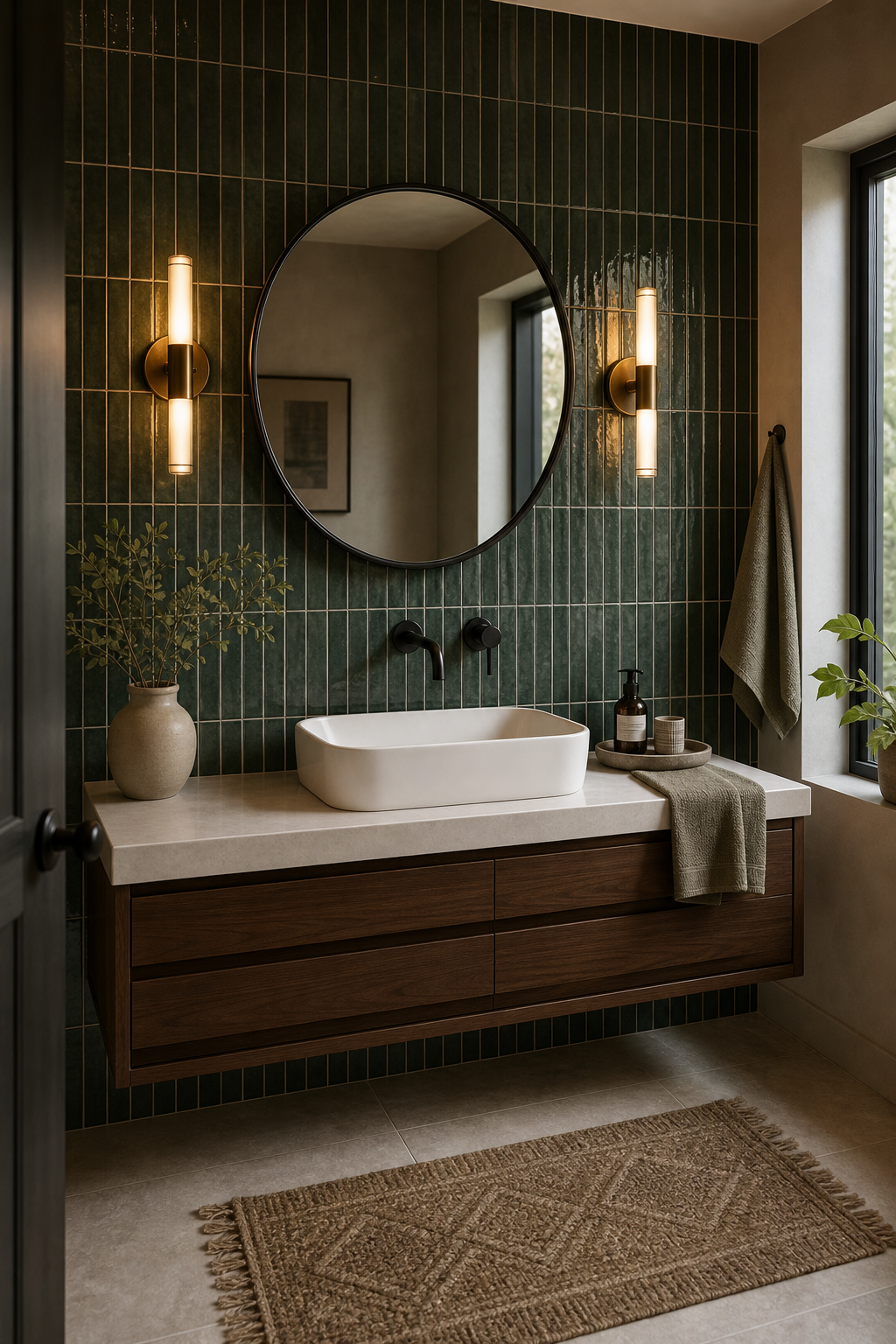

The green tile wall carries the entire mood of this bathroom. Narrow vertical units rise from the floor line to the ceiling behind the vanity, their varied dark tones shifting as daylight and sconces move across the glossy surface. A large round mirror interrupts the grid, while a white vessel basin and pale counter create a clean working band below.
Color succeeds because it is concentrated rather than repeated everywhere. Adjacent wall returns remain warm neutral, the floating cabinet introduces a deep wood tone, and the floor stays comparatively pale. Green therefore reads as architecture, not an accent scattered through accessories. The limited palette gives every material a clear role.
Vertical Tile Makes the Vanity Wall Feel Taller
Each narrow tile is set upright, producing many continuous vertical joints behind the mirror. The format draws attention from the suspended vanity toward the ceiling and gives a compact room more apparent height. Horizontal grout lines remain visible, but they are subordinate to the repeated upward movement.
The wall is tiled beyond the immediate splash zone, which turns color into a full architectural plane. Stopping at a short backsplash would fragment the elevation and leave the large mirror without an equally strong background. Here, the complete field gives the vanity a deliberate destination.
Tonal Variation Prevents Dark Green from Looking Flat
Individual tiles shift between near-black green and clearer forest tones. Glossy highlights appear strongest around the sconces and window edge, while shaded sections remain deep. This irregularity supplies movement without adding a second pattern or contrasting grout color.
The exact tile material and glaze specification cannot be confirmed from the photograph. The visible design lesson is to use a finish that can register directional light and slight tonal variation. Uniform dark panels would create a calmer but less tactile wall.
The Round Mirror Breaks the Grid at the Right Scale
A large black-framed circle occupies the center of the tiled plane. Its diameter is broad enough to interrupt many vertical joints, creating a strong geometric counterpoint. A small mirror would disappear within the active grid; a rectangular one would simply add another set of parallel lines.
The mirror reflects a pale wall, side window, and framed artwork, bringing lighter values into the dark elevation. That reflected depth keeps the green field from closing in around the basin and makes the central circle function almost like an opening.
Twin Sconces Reveal the Tile's Surface
Two slim vertical sconces flank the mirror and cast warm highlights across nearby tile faces. Their cylindrical shape relates to the tile orientation without copying its rectangular geometry. Warm-toned bases add a restrained accent between the black mirror frame and deep green wall.
The fixtures are positioned close enough to the mirror to support the vanity but far enough apart that their light grazes a substantial section of tile. Exact brightness and color temperature remain unverified; the observable value lies in the way side light reveals surface variation.
White Basin and Pale Counter Create Visual Relief
A sculptural white vessel basin sits on a light-toned counter and forms the brightest solid object in the room. Its rounded corners mediate between the circular mirror and straight tile joints. Dark wall-mounted fittings remain visually quiet against the green background.
The counter extends to both sides with a vase at the left and a low tray at the right. These asymmetrical objects frame the basin without displacing it from the center. A green towel hangs near the right edge, repeating the wall color at a softer texture.
A Dark Floating Vanity Grounds the Color Field
Broad wood-toned drawer fronts form a deep horizontal base and stop above the tiled floor, leaving a shadow line beneath. Their visible grain adds warmth without competing with the tile's reflectivity. The floating gap also prevents dark wall and cabinet from becoming one continuous block to the floor.
For a similar palette, commit one complete wall to the dominant color, then create relief with one pale working surface and a darker but warmer cabinet. Use rounded geometry to interrupt repeated tile lines and position light to reveal the finish. The room demonstrates color balance through area and value, not through a list of matching accessories.
A patterned brown rug sits forward of the vanity and introduces a softer, matte counterpoint to the reflective tiled wall.