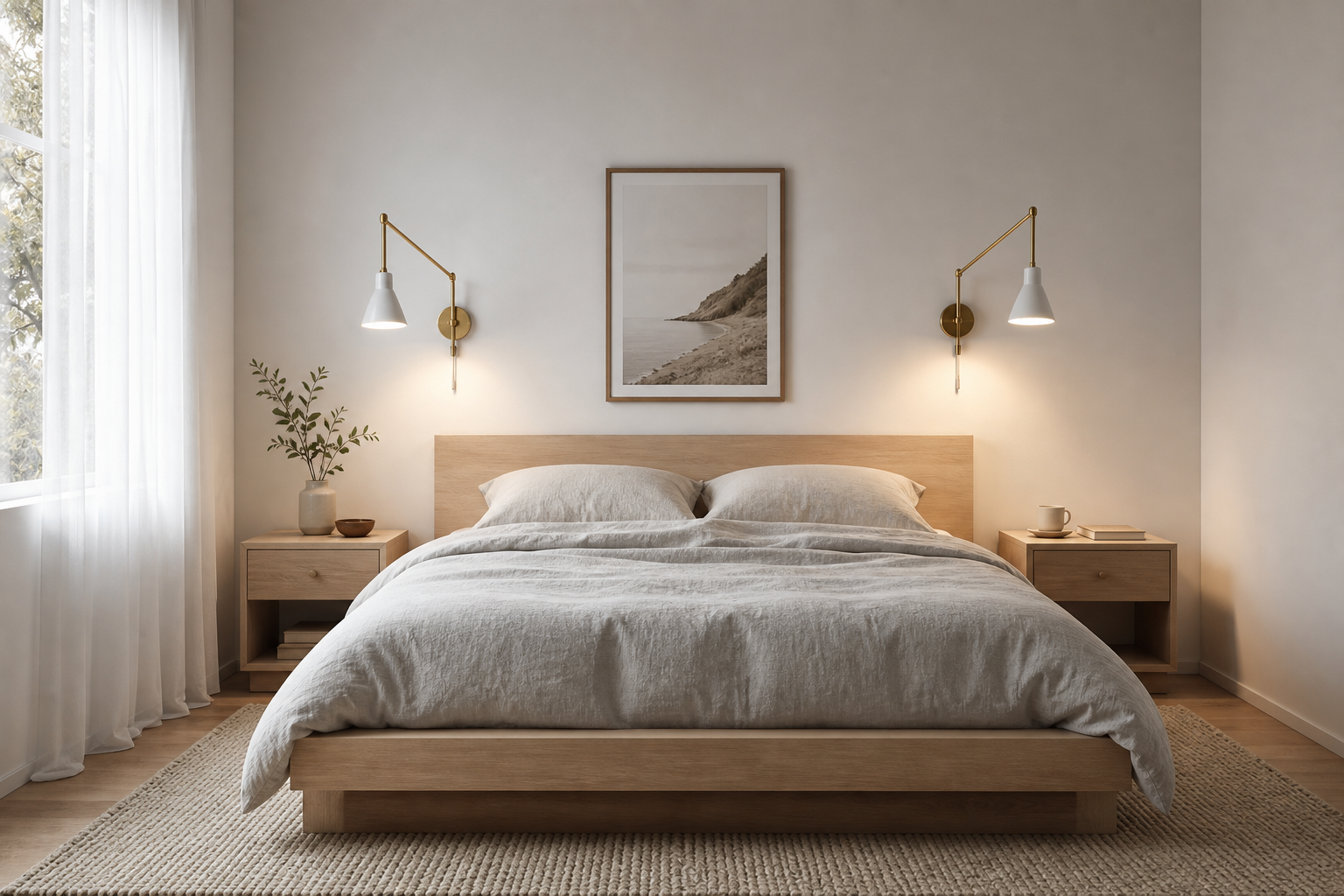

Two adjustable wall lights give the bed wall its finest and most functional lines. Each sconce begins above a small nightstand and angles inward toward the pillows, freeing both tabletops while keeping light close to reading position. A low timber-toned bed, pale bedding, centered artwork, and sheer side curtains maintain a quiet Scandinavian field. The fixtures stand out because everything around them is broad, soft, and visually restrained.
Adjustable Arms Define Each Reading Position
The paired sconces sit above the nightstands and extend inward toward the pillows. That position makes them both functional and architectural. Because the wall is otherwise quiet, the warm-metal arms become the sharpest lines in the room. They give the bed wall definition without requiring a heavy headboard treatment.
The arms project inward but stop before crossing the centered artwork, so each fixture has a distinct working territory. Their fine warm-metal lines remain readable against the plain wall without becoming a decorative frame around the entire bed.
The angled arms matter because they can direct light toward the bed rather than simply glowing on the wall. That makes the sconces useful for reading, not just decorative. For a similar bedroom, the fixture should clear the pillow area and aim down toward shoulder height. The exact placement depends on bed height, but the goal is controlled light near each sleeper.
Books and a small vessel can occupy the tables because no lamp bases claim their centers. The earlier paired bedside-sconce layout uses the same wall-mounted principle with a darker, more graphic fixture language.
Paired Fixtures Hold a Calm Bedside Symmetry
The bed, nightstands, sconces and framed print create a balanced wall. The symmetry is not stiff because the fabric bedding is relaxed and the left window softens the edge of the room. That balance is especially useful in a Scandinavian bedroom. It lets simple materials feel intentional instead of sparse.
The Low Bed Protects the Sconce Silhouettes
The light timber-toned bed and nightstands reflect the warm sconce glow gently. That prevents the lighting from feeling harsh against the warm white wall. The wood also connects the bed frame to the nightstands, so the sconces read as part of one coordinated wall rather than two separate fixtures added later.
Bed, headboard, and nightstands stay low enough for the extended arms to float clearly above them. This nested set of heights gives the wall definition while preserving generous blank space between furniture and ceiling.
Centered Artwork Occupies the Gap Between Arms
The light gray fabric bedding introduces texture beneath the clean lines of the sconces. Its wrinkled surface keeps the room from becoming too perfect. That contrast is important: precise lighting above, soft fabric below. The bedroom feels designed, but still relaxed enough for daily use.
Daylight from the left window gives the room its first layer of brightness. The sconces then add a second, more focused layer around the bed. The sheer curtain keeps the daylight diffuse, which works well with the gentle Scandinavian palette.
Daylight enters from the left, revealing fabric folds across the bed. The sconces add local light near each sleeper, but the photograph does not justify exact output, color temperature, or mounting dimensions.
Small Tables Keep Bedside Use Focused
Start by centering the bed, then position the sconces in relation to the pillows rather than the nightstands alone. The fixtures should feel reachable and visually aligned with each side of the bed. Use a small nightstand below each sconce. This keeps the surface open for books or a cup while the wall fixture handles the real lighting work.
Planning the Lights From Pillow Position
I would avoid table lamps in this exact arrangement because they would duplicate the sconces and crowd the nightstands. I would also avoid a busy wall covering behind the bed. The simple wall is what lets the thin warm-metal arms remain clear and elegant.
Position fixtures in relation to seated shoulder and pillow location, then confirm that arms can move without meeting artwork or curtains. A duplicated table-lamp layer would reduce surface space and weaken the clarity of the wall-mounted solution.
The nightstands align below the outer sconce joints and remain narrower than the pillow zones. This creates clear vertical territories for each sleeper while the centered picture occupies a separate shared field.