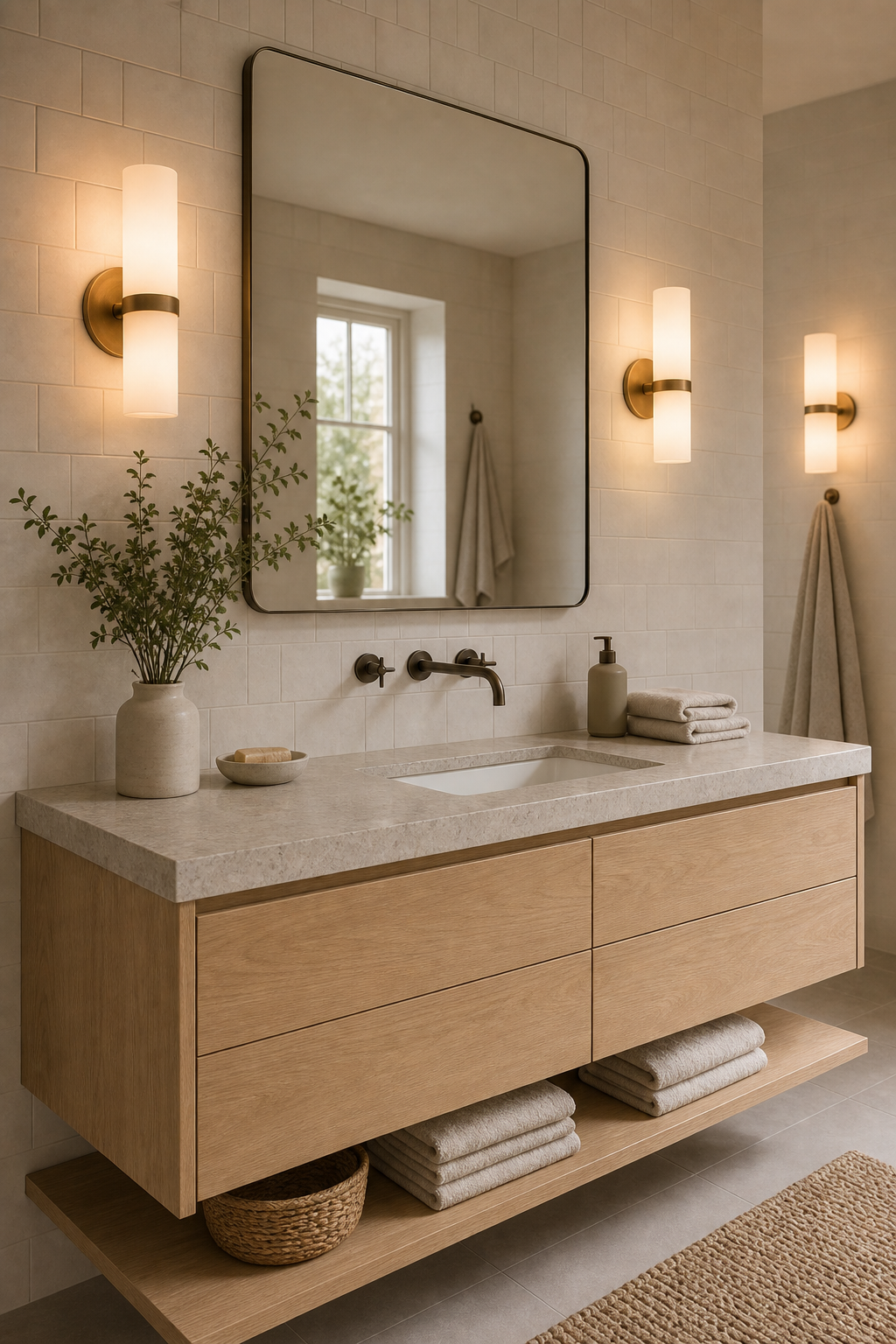

The lighting in this bathroom is successful because it belongs to the wall composition rather than floating above it. Two vertical sconces flank the large rounded-corner mirror, while a third continues the rhythm on the return wall. Their elongated glow traces the pale tile and frames the vanity at eye level, exactly where a broad ceiling fixture would be least precise.
Natural light remains visible in the mirror and at the right edge, so the sconces are not asked to illuminate the entire room alone. They add local definition around the basin and repeat a warm metal tone already present in the mirror edge and wall-mounted faucet. The result feels layered, calm, and practical without relying on a decorative chandelier.
Vertical Sconces Light the Face from Both Sides
One cylindrical fixture sits on each side of the mirror at comparable height. This bilateral placement creates a more even field across the reflection than a single source above would provide. The long diffusers spread light vertically, reducing the visual concentration of brightness at one small point.
Their centers align close to the mirror's useful viewing area rather than with the top of the tiled wall. That relationship is the transferable decision. Fixture height should respond to the user and mirror, while the exact mounting dimension must be resolved on site rather than guessed from a photograph.
A Third Fixture Extends the Rhythm Around the Corner
The right wall carries another matching sconce above a towel hook. It confirms that the lighting language belongs to the room, not only to the vanity. Because the third fixture is set farther back, its glow also reveals the depth of the corner and prevents the return wall from becoming a dark visual dead end.
Repeating the design three times could feel rigid, but the corner breaks the sequence into two planes. The pair remains symmetrical around the mirror; the single light addresses a secondary zone. That distinction gives repetition a functional reason rather than using matching fixtures as automatic decoration.
Pale Tile Reflects Light Without Erasing Texture
Small rectangular tiles cover the visible walls in a soft neutral tone. Their fine joints catch shallow shadows from the sconces, making the surface readable after dark. A glossy, highly reflective field might produce distracting hotspots; here the illumination appears diffuse enough to preserve a quieter material impression.
The exact tile composition is not verifiable, but its scale is. Numerous small units create a delicate grid behind the large mirror and broad vanity. The sconces bridge those scales: each is taller than several tile courses yet much narrower than the mirror.
The Mirror and Faucet Share a Restrained Metal Outline
A thin warm-toned frame surrounds the mirror, and similar tones appear at the sconce bases and wall-mounted faucet. Repeating this narrow accent gives the pale wall definition without creating a heavy border around every object. The darker lines remain subordinate to the luminous cylinders and the wood-toned cabinet below.
The faucet is centered over the rectangular basin and leaves the counter mostly open. Its wall-mounted position makes the vertical sequence especially clear: mirror above, fitting at hand height, basin below. Lighting supports that order by remaining at the sides rather than interrupting the centerline.
A Floating Vanity Keeps the Lower Composition Light
The vanity projects from the wall and ends above a broad open shelf. Large drawer fronts create useful visual mass beneath the slim counter, while towels and one woven basket occupy the lower level. Only this visible storage should be discussed; the photograph does not reveal internal organizers or drawer fittings.
Daylight and Sconces Divide Their Responsibilities
A bright window is reflected in the mirror, and another opening appears at the right. Daylight reveals the room's overall pale palette and cabinet grain, while the sconces supply warm local emphasis on both wall planes. Neither source tries to imitate the other, which gives the bathroom depth across changing conditions.
For a similar result, begin with side lighting that relates directly to the mirror, then decide whether a secondary wall genuinely needs continuation. Keep metal accents narrow, use a wall surface that can reveal grazing light, and preserve natural openings. The image demonstrates layering through placement, not through an excessive number of fixture types.