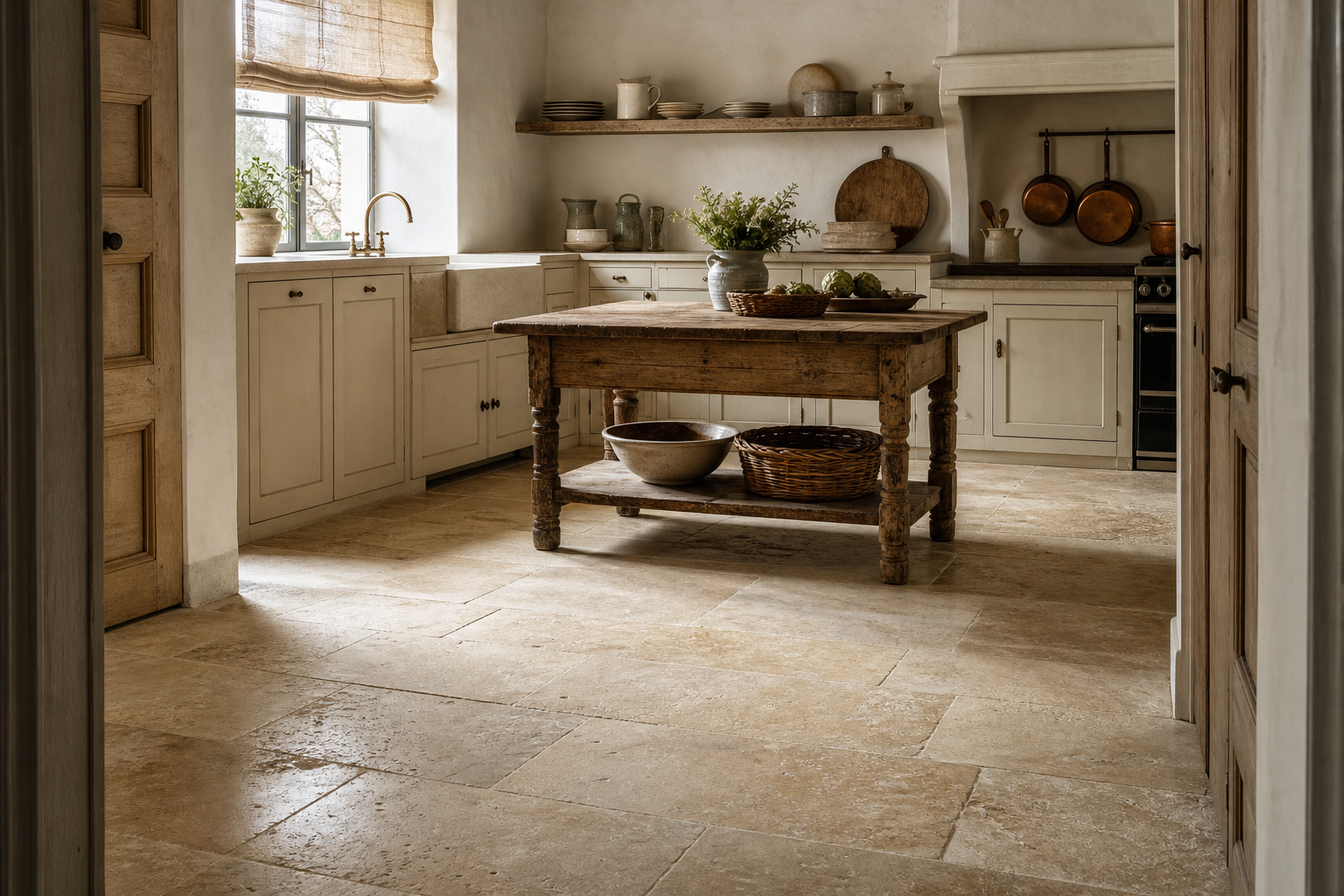

The floor supplies the kitchen's sense of age before any cabinet detail is considered. Large pale tiles extend across the foreground with softened tonal variation and relatively few joints, forming a calm base for cream cabinetry and an aged timber-toned prep table. The table's open lower shelf lets the floor continue through the center. Window daylight, simple shelves, warm cookware, and a deep sink complete a room whose character depends on broad working surfaces rather than ornament.
Large Tiles Give the Floor Visual Continuity
The stone floor takes up the largest visible surface in the photograph, so it naturally becomes the first design decision. Its uneven tone and large tile scale give the kitchen a sense of age without adding ornament. A smoother modern floor would change the entire character of the room. Here, the pale floor tile makes the kitchen feel grounded, practical and lived in.
Only a limited number of joints cross the visible floor, allowing each broad tile to register as a field rather than a small repeating module. The room feels settled because the ground plane is substantial and uninterrupted.
The large-format tiles reduce visual clutter across the floor plane. Instead of many small grout lines, the room gets broader stone fields that make the kitchen feel calmer. That scale also suits the aged timber-toned prep table. The table legs sit firmly on the stone rather than fighting a busy pattern below.
An Open Prep Table Leaves the Center Permeable
The cream painted cabinets stay close to the pale floor tile's warm undertone. That color relationship prevents the lower cabinetry from feeling pasted onto the room. Because the cabinets are quieter than the floor, the stone remains the strongest material. That is the right hierarchy for this French country look.
The central table stands on slender legs and holds baskets and vessels on an open shelf. The nearby rustic brick cooking-wall study concentrates age on a vertical surface; here, variation remains underfoot while walls and cabinetry stay quieter.
The center prep table introduces a darker, worn wood tone that balances the pale stone and cream cabinetry. Its turned legs and rough surface give the kitchen a working-room quality. The table is also visually lighter than a built-in block would be. Open space below it lets the pale floor tile continue through the room.
Cabinet fronts and toe lines sit close to the floor's warm pale range, avoiding a hard perimeter band. Their panel detail is visible, but it does not fragment the base more strongly than the tile joints.
Window Light Reveals the Surface Changes
Daylight from the sink window catches the surface variation in the pale floor tile. The floor needs that light because its beauty comes from subtle texture rather than strong color. The pale Roman shade softens the brightness, which keeps the stone from looking glossy or overly polished.
The softly textured walls have a quiet, imperfect surface that belongs with the aged floor. They avoid the crispness that would make the pale floor tile feel artificially rustic. The range niche and open shelf continue that simple wall language, letting ceramics and copper-toned provide small moments of warmth.
The table is darker, rougher in appearance, and centered within the light field. That contrast gives the eye a working anchor without requiring a permanent island block that would hide more of the floor.
Open Shelves Keep the Upper Wall Informal
Choose stone with variation, not a perfectly flat beige finish. The floor should show movement, softened edges and enough tonal change to feel natural. Pair it with painted cabinetry, aged wood and simple linen rather than glossy finishes. The goal is a kitchen that looks assembled over time, not installed in one decorative sweep.
Protecting the Floor as the Main Material Gesture
I would avoid high-contrast black-and-white accents in this kitchen. The stone's warmth is subtle, and sharp graphic contrast would pull the room away from its French country character. I would also avoid covering the floor with a large patterned textile. The pale floor tile is the reason this room works, so it needs to remain visible.
Leave broad areas uncovered and select movable furniture with open bases. A large patterned runner or closed island would conceal the very surface that gives this French country kitchen its depth and believable working-room quality.
The sink window brightens the rear cabinet run while the foreground remains softly shadowed, making tile variation more visible close to the camera. Baskets beneath the table remain separated by open space and do not conceal the broad floor field.