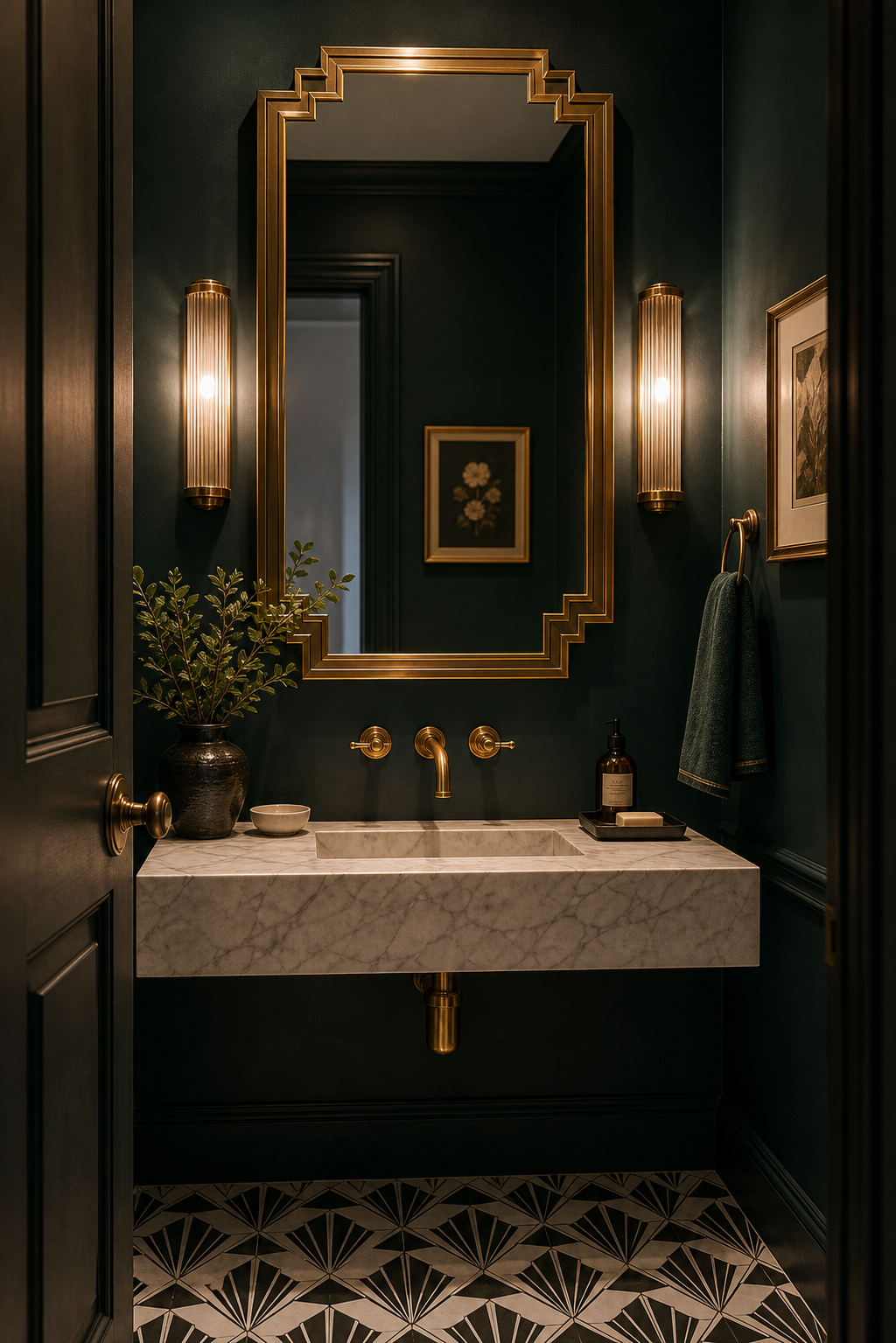

The mirror is not round, and its stepped profile is the room's clearest Art Deco gesture. A tall gold-toned frame rises above the compact wall-hung sink, widening at the upper and lower corners in a precise geometric sequence. Ribbed sconces flank it against deep green walls, while the pale veined basin and graphic floor provide lighter counterpoints. The narrow room feels dramatic because every strong line remains aligned to the central wash zone.
The Stepped Mirror Defines the Deco Geometry
The geometric mirror is the strongest element because it brings shape, shine and vertical emphasis to the compact wall. Its stepped frame gives the room an Art Deco signal immediately, while the sink and sconces stay simple enough to support it.
The frame changes direction in short right-angled steps rather than a continuous curve. Those offsets are mirrored at the top and bottom, producing a controlled silhouette that can remain ornamental without relying on etched glass or an oversized width.
The deep emerald wall color gives the brass frame a rich backdrop. That contrast matters in a powder room. The dark paint makes the mirror feel intentional, not simply decorative.
Paired Ribbed Sconces Reinforce the Vertical Axis
The slim sconces sit on both sides of the mirror, adding height and symmetry. Their warm light catches the brass frame and helps the vanity wall feel polished rather than flat.
The two sconces sit just outside the widest mirror points and extend vertically through the middle third. Their ribbed shades introduce another fine rhythm, but the simple cylindrical forms do not imitate the frame's stepped outline.
Deep Green Makes the Gold Outline Legible
The pale stone sink gives the vanity wall a clean base without adding a bulky cabinet. That choice is useful in a compact powder room because it leaves more visual air below the basin.
The near-black green wall absorbs the door and panel edges, allowing the gold-toned perimeter to read as a luminous drawing. A lighter wall would reduce that contrast and make the many metallic details appear less intentional.
The Pale Sink Creates a Quiet Lower Plane
The gold-toned faucet repeats the metal tone of the mirror and sconces. That repetition ties the small room together. Without it, the mirror could look isolated from the rest of the vanity wall.
Small Gold Fittings Repeat the Frame
The black-and-white floor tile adds another Art Deco cue at a lower level. Because the wall color is solid, the floor can carry pattern without making the powder room feel overloaded.
Graphic Flooring Keeps Pattern Underfoot
Start with a mirror that has a strong geometric outline and enough height for the wall. Then choose side sconces, a simple sink and one saturated wall color. The powder room should have one main glamorous gesture, not five competing ones.
Using Deco Detail Without Multiplying Motifs
I would not replace the deep wall color with plain white. The brass frame needs contrast to feel special. I would also avoid a large vanity cabinet here. The floating sink keeps the small room from feeling visually packed.
The quieter approach in this Art Deco living-room symmetry study distributes geometry across furniture. This powder room concentrates it on mirror, sconces, and floor, leaving the small wall-hung sink comparatively plain.
The sink projects as a simple rectangular slab and leaves its exposed trap centered below, maintaining the room's vertical symmetry without adding a cabinet. A small branch vessel occupies the left corner while soap and towel remain on the right. These everyday objects are kept below mirror height, ensuring the stepped outline and paired lights continue to dominate the narrow view from the doorway.
Framed botanical art appears in the mirror reflection and on the right wall, but each piece is small and held within the deep green field. This secondary layer rewards a closer view without challenging the gold-toned perimeter. The powder room's hierarchy remains clear from the threshold: geometric mirror first, paired lights second, pale sink and graphic floor as the lower anchors. Door and wall moldings are painted in the same deep tone, allowing their relief to appear through shadow instead of another color. This containment makes the brighter frame and sconces feel deliberate, while the doorway itself remains a quiet dark border around the composition.