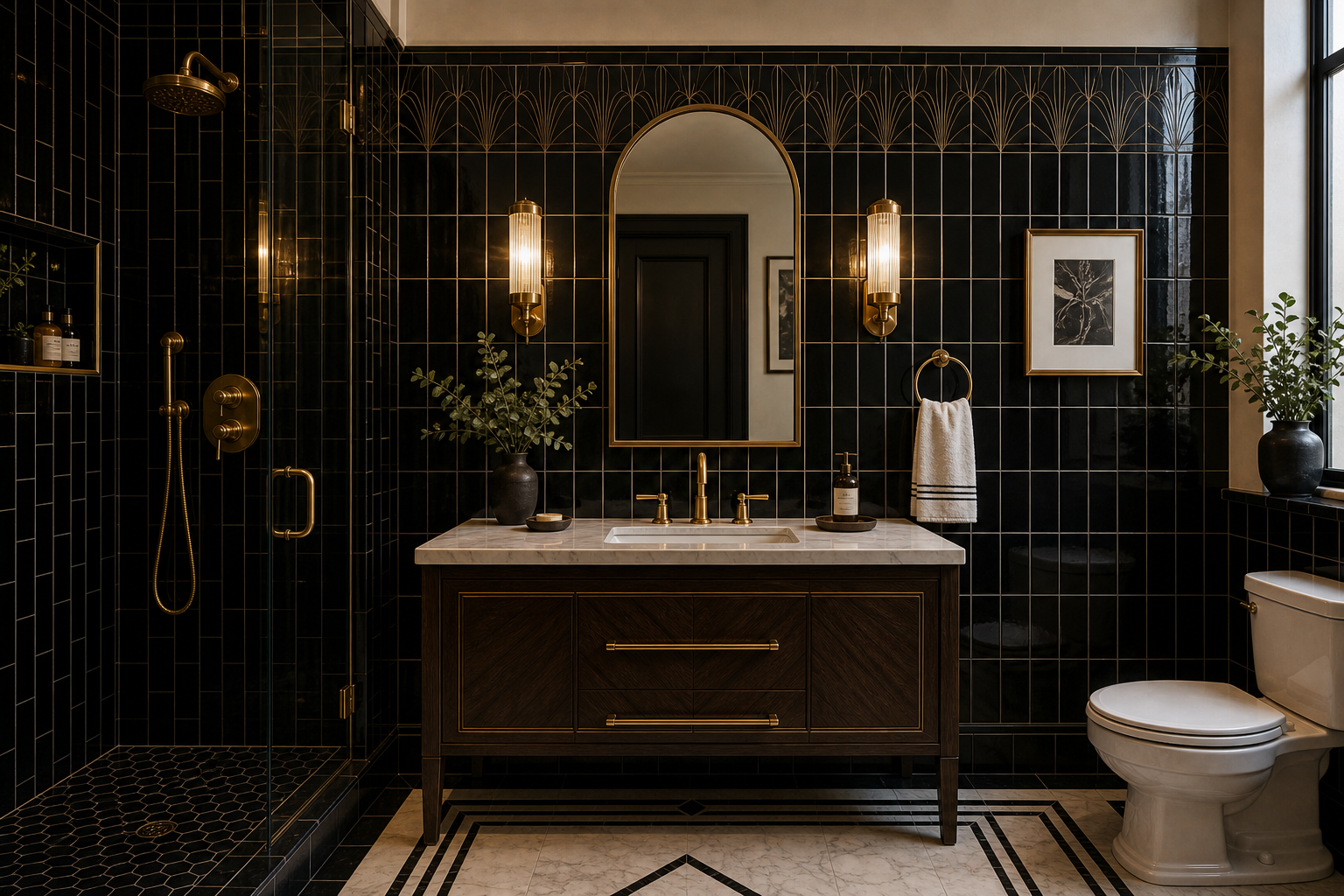

Glossy black tile is used as the bathroom's architecture, not a small accent. It wraps the vanity wall, shower, toilet backdrop, and lower window return, creating one dark enclosure around the room's pale floor and counter. Fine brass-toned joints and a fan-pattern border keep the surface from reading as a featureless black plane.
The tile's reflective finish multiplies window light, sconces, shower fittings, and greenery across the walls. An arched mirror and two ribbed vertical sconces establish a bright central group above a dark timber vanity. Pale stone-like surfaces and white fixtures provide relief, but black remains the dominant field from floor edge to upper border.
Rectangular Black Tile Creates the Main Grid
Glossy rectangular units are stacked in a regular grid across the vanity and shower walls. Narrow warm-toned joints outline every tile, making scale and alignment visible despite the deep color. The repetition gives the room a disciplined geometric base.
Tile composition and grout material cannot be verified. The observable strategy is contrast within one surface: dark reflective faces are separated by fine metallic-looking lines, allowing the grid to remain legible in low light.
A Fan Border Introduces an Art Deco Motif
A horizontal band of stylized fan or scallop outlines runs above the mirror and around the room. The motif uses the same black field and warm linework as the rectangular tile below, so pattern changes without adding another material color.
The border sits high enough to read as a frieze and stops before the pale upper wall. This placement gives the dark tile a finished architectural height rather than an arbitrary endpoint.
The Arched Mirror Breaks the Tile Grid
A tall brass-toned arched mirror is centered over the basin. Its curved top interrupts the many right angles while staying inside the patterned border. The reflection returns a dark door and pale adjacent wall, adding depth to the black elevation.
The mirror is narrower than the vanity, leaving tile visible on both sides for the sconces. That margin allows arch, light, and grid to remain distinct rather than overlapping.
Ribbed Sconces Add Vertical Light
Two slim ribbed glass sconces with brass-toned bodies flank the mirror. Their warm glow produces long reflections across the glossy tiles. The fixtures align below the fan border and above the counter, filling the side margins without covering the grid.
Exact lamp temperature is not measurable. Visually, the fittings provide concentrated vertical brightness that counteracts the dark wall and makes the mirror group the room's primary focal area.
The Dark Vanity Grounds the Central Wall
A timber-toned vanity with deep brown fronts, geometric grain, and brass-toned inlay stands below a pale counter. Long horizontal pulls repeat the warm tile joints and fixture finish. Slender legs leave a narrow shadow beneath the cabinet.
The pale basin and counter create a bright horizontal break between dark cabinet and wall. A branch vase, soap, and towel remain compact, preserving that contrast.
Shower and Main Floor Use Different Black Patterns
Small black hexagonal units cover the shower floor, contained behind clear glass and a slim brass-toned frame. The main floor is pale with black geometric border lines and central diamond accents. These two patterns distinguish wet and dry zones while sharing black and warm detailing.
The floor material itself is uncertain, but the visual zoning is clear. A pale field prevents the dark wall enclosure from extending uninterrupted underfoot.
Daylight and Greenery Keep the Black Room Dimensional
A tall black-framed window lights the right wall and reveals tile reflections. Dark vessels with branching greenery appear at the window and vanity, introducing irregular silhouettes against the grid. White toilet and pale towels add small functional contrasts.
For a similar bathroom, commit the dark tile to complete wall zones, define joints clearly, and reserve one high motif band. Use pale floor and counter surfaces as relief. The scheme works because gloss, line, curve, and light prevent the black envelope from becoming visually flat.
A recessed shower shelf continues the black tile and contains three dark bottles and a small branch arrangement within one outlined rectangle. Its brass-toned edge echoes the wall joints and fittings. Keeping the niche inside the same grid avoids introducing a pale interruption in the shower's deepest surface.