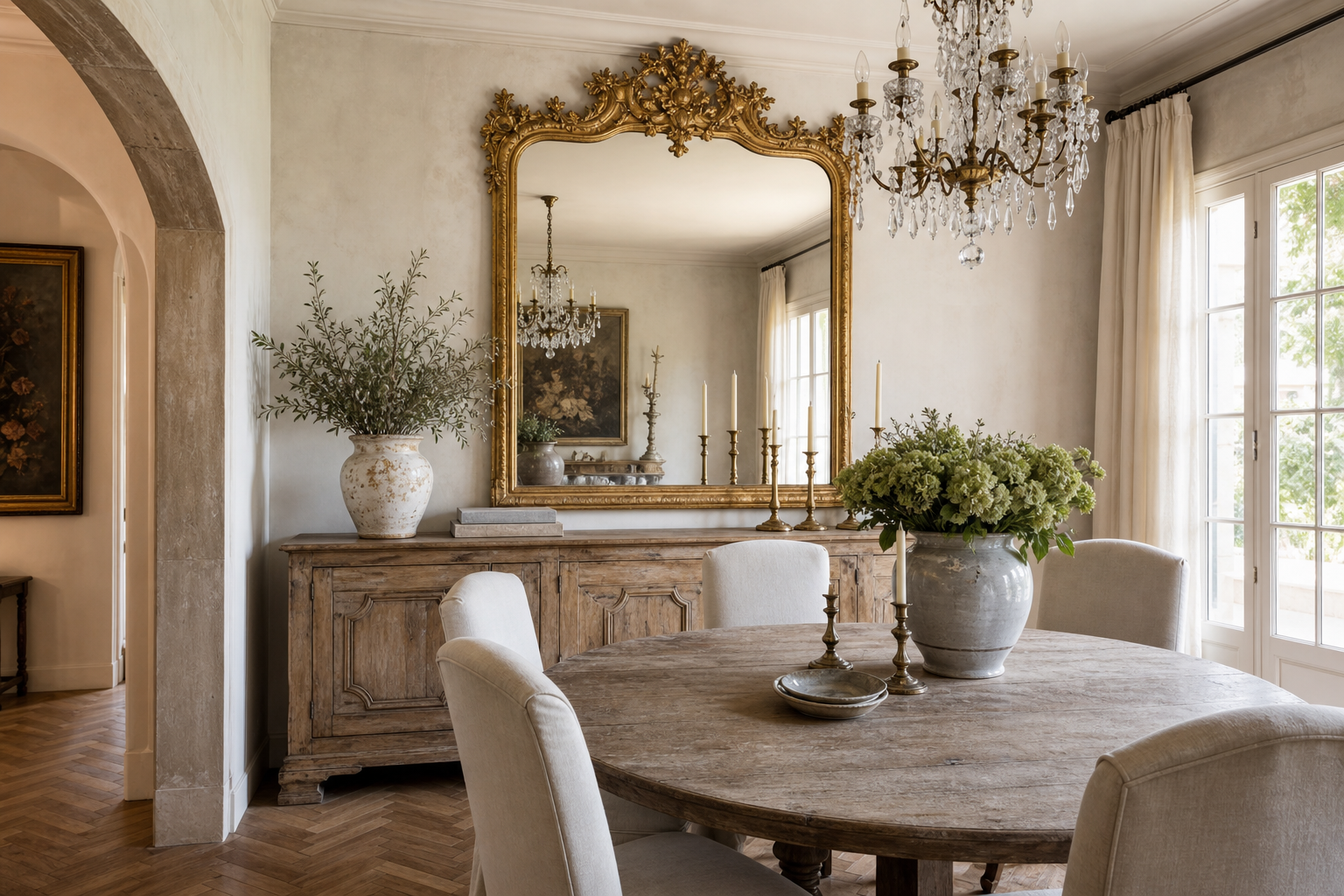

The ornate gilded mirror gives this dining room ceremony, but its placement keeps that ornament useful. It is centered above a long dark timber-toned sideboard, where the reflective field captures the chandelier and bright garden windows rather than floating as an isolated gold object. A round dining table, pale upholstered chairs, framed art, large vessels, and greenery remain quieter. The strongest decision is the pairing of one elaborate vertical accent with broad, grounded furniture below.
The Gilded Mirror Gives the Side Wall a Ceremonial Center
The mirror is the most ornate object in the dining room, so it naturally becomes The primary feature. Its antique gilded tone frame brings height, curve and detail to the plaster wall. Because it sits above a long sideboard, the mirror feels anchored. It is not floating as decoration; it completes the dining wall.
The frame rises well above the sideboard and has enough pale wall around it to preserve its carved outline. A smaller mirror would be lost behind the table and chandelier.
The weathered wood sideboard keeps the gilded frame from feeling too polished. Its worn surface gives the room age and texture. That pairing is central to French country design. Elegance needs a rustic counterweight, and the sideboard provides it.
The French Country display-hutch study uses storage as the wall feature. Here, the sideboard remains low so reflection and frame can control the upper elevation.
Reflections Extend Chandelier and Window Light
The round dining table softens the room's formal back wall. Its weathered surface connects to the sideboard, while its curve balances the mirror's ornate top. The table also keeps movement around the chairs more fluid than a large rectangular table would in this view.
The mirror repeats the multi-arm chandelier within its surface, doubling points of light without adding another physical fixture. Exact glass age or frame material cannot be verified from the photograph.
The Round Table Softens the Formal Elevation
The multi-arm chandelier adds sparkle in the same visual zone as the mirror, but it hangs forward over the table. That separation keeps the two ornate elements from merging into one heavy cluster. The chandelier also appears in the mirror, which increases the room's sense of depth without adding another object.
Pale Chairs Keep the Foreground Quiet
The linen upholstered chairs calm the room. Their pale fabric gives the eye a softer place to land after the mirror and chandelier. Their shape is traditional enough to belong, but the plain upholstery keeps the dining area from becoming overly decorative.
Chair backs remain below the tabletop sightline from this angle and do not interrupt the sideboard. Their pale fabric provides a soft foreground against the darker wall furniture.
Large Vessels Balance the Mirror's Scale
Daylight from the windows lightens the plaster walls and prevents the antique gilded tone from feeling heavy. The mirror reflects brightness back into the dining area. That natural light is why the room feels graceful rather than dim or museum-like.
Garden Glazing Prevents the Gold From Feeling Heavy
Choose a mirror large enough to relate to the sideboard below it. If the mirror is too small, the dining wall will look under-scaled. Balance the gilded frame with weathered wood, pale upholstery and simple ceramics. The goal is elegance with age, not shine on every surface.
Using One Ornate Piece Without Theming the Room
A gilded mirror succeeds when the room gives it both importance and restraint. Here, the mirror leads the dining wall, but weathered wood, linen, daylight and a round table keep the French country character approachable.
Choose the mirror and supporting cabinet as one composition, checking width, centerline, and reflected view. Extra gilded accessories would dilute the authority of the single oversized frame.
The sideboard top holds two large pale vessels at its ends and leaves the mirror center unobstructed.
The round table sits forward of the wall feature, so chair movement and serving access remain distinct from the display elevation.
The mirror top reaches into the chandelier's visual field but does not overlap the actual fixture, creating layered depth between wall and room center.
Daylight enters from tall doors at the side and keeps the gilded frame bright while the dark sideboard retains its grounding role.