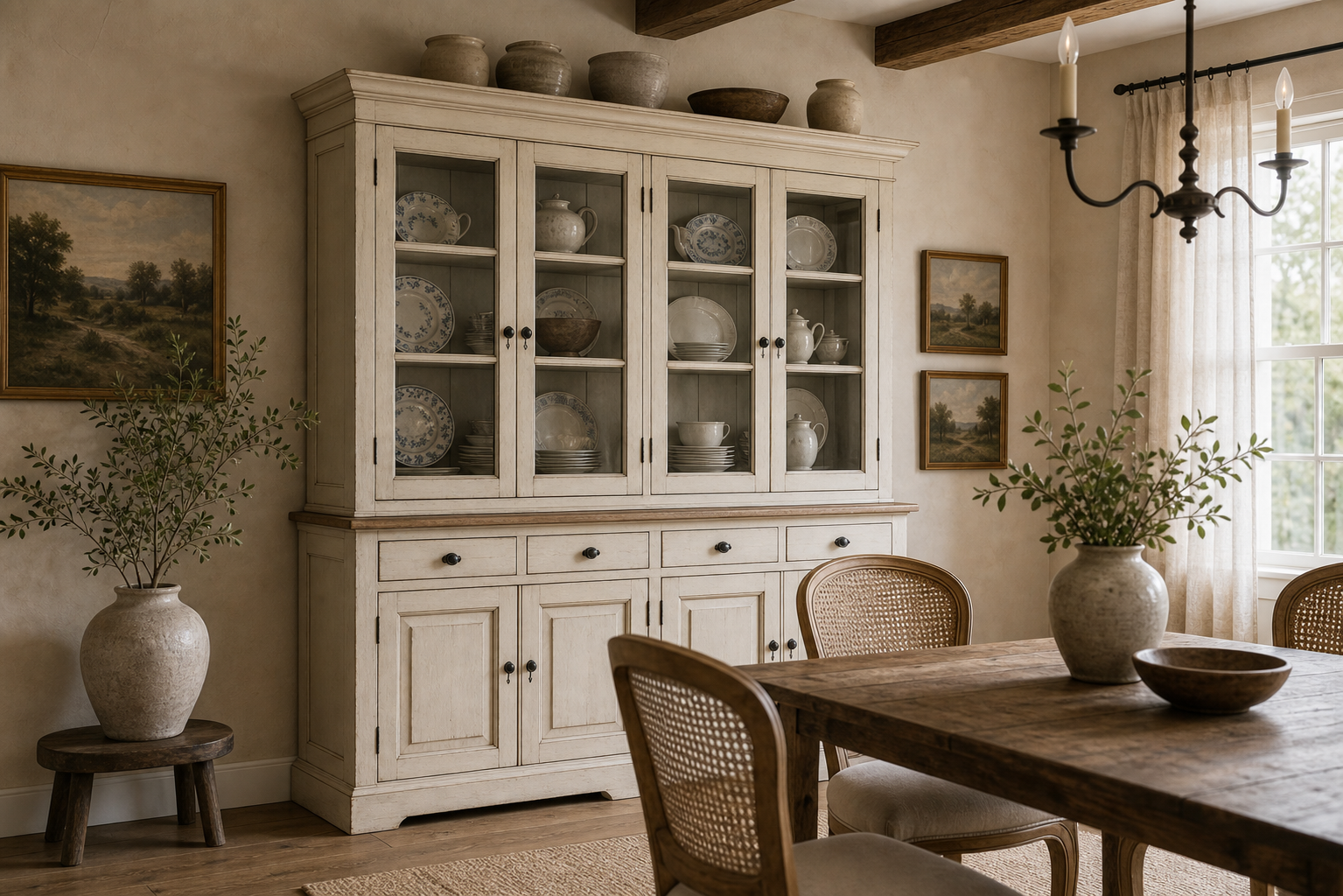

The tall painted hutch gives this dining room a permanent service wall without looking like fitted kitchen cabinetry. Glazed doors reveal an edited arrangement of pale dishes, while solid paneled doors and drawers form a heavier base. The dining table sits perpendicular in the foreground, allowing the cabinet to be read as the backdrop to meals rather than as a freestanding object stranded in a corner. Its muted color keeps the considerable volume gentle.
The Hutch Establishes a Service Elevation
The hutch is the tallest and most detailed piece in the room, so it naturally becomes the main feature. Its glass doors reveal plates, bowls and pitchers, turning everyday dining storage into part of the room's character.
The cabinet nearly reaches the ceiling and occupies a full section of wall, giving it architectural presence. A narrow crown and repeated door widths keep the large piece proportioned, while the slight recess at each side allows the room wall to remain visible.
The upper glass doors break up the large painted cabinet face and keep the hutch from feeling too heavy. They also create depth because the eye can see into the shelves rather than stopping at a flat surface.
Vertical divisions in the glass correspond with the lower doors, so the transparent section still feels structured. Reflections from the nearby window brighten the panes and soften the stored outlines; completely open shelves would introduce more edges and make the wall considerably busier.
Solid Lower Panels Provide a Visual Base
The lower drawers and cabinet doors give the hutch practical storage for pieces that do not need to be displayed. That balance is essential in a dining room. The visible shelves feel curated because not everything has to be seen.
Dish Displays Follow the Cabinet Grid
The aged cream paint makes the hutch feel collected rather than newly installed. Its slight warmth works with the plaster wall and wood floor, giving the cabinet a softer French country presence.
Bowls, plates, and vessels are spaced rather than stacked to maximum capacity. Larger pieces sit toward the center and lower shelves, with smaller forms above. The arrangement demonstrates visible display only; internal fittings behind the opaque doors remain unknown.
The Table Approaches Without Blocking Access
The dining table has a heavier wood texture that grounds the room in front of the painted hutch. Because the table styling is simple, the cabinet remains the primary display feature while the table stays ready for use.
The table edge ends short of the cabinet doors, preserving a usable strip between dining and storage zones. The camera view shows no chair trapped against the hutch, an important planning cue when a deep cabinet and a full dining set share one wall.
Woven Chairs Loosen the Painted Formality
The cane chair backs add another woven, traditional texture without adding bulk. They sit between the rustic table and painted hutch, helping the room feel layered rather than matched.
Artwork Extends the Composition Sideways
The linen curtains filter daylight at the window, while the landscape art repeats the traditional country mood around the hutch. These details keep the large cabinet from feeling like the only decorative moment in the room.
Choosing Display Depth Without Creating Clutter
Start with a hutch that combines glass display above and closed storage below. Then style it with pieces that share a palette: ceramic plates, serving bowls and pitchers. Let the cabinet feel useful first and decorative second.
The modern organic dining table analysis focuses on a more minimal central object. Here, the furniture hierarchy is broader: table manages use, while the tall hutch supplies storage, display, and the room's French country character.
A dark chandelier hangs over the dining table rather than in front of the hutch, establishing a separate center for eating while the cabinet controls the wall. Its branching arms and small shades provide a lighter silhouette than another large pendant volume would. The room can therefore support two important elements without confusing them: the chandelier identifies the table in plan, and the tall glazed cabinet identifies storage and display in elevation.
A large pale vessel beside the cabinet broadens the lower composition without covering a door. Its rounded body also mediates between the rectilinear hutch and the woven curves of the dining chairs.