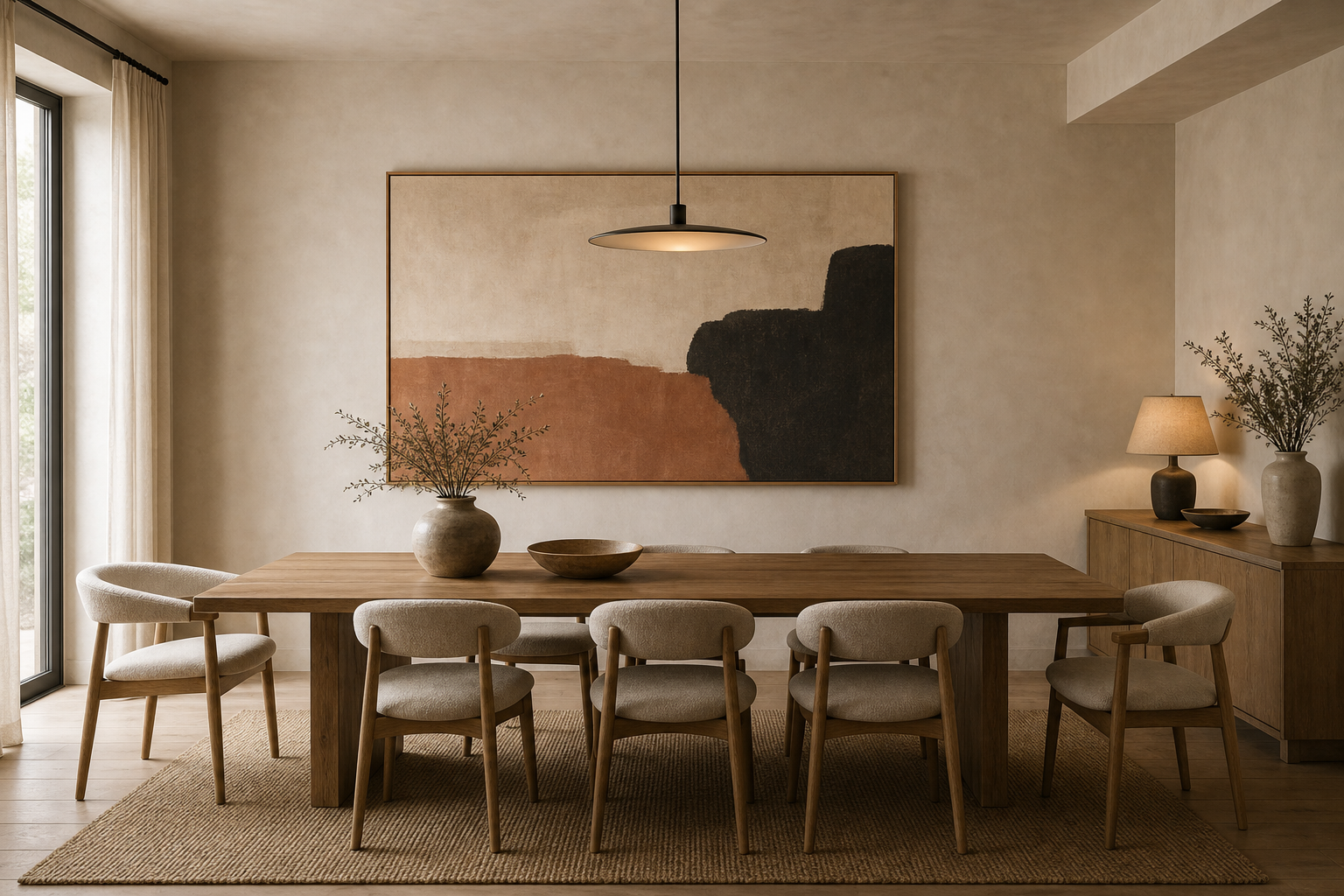

The artwork is not simply filling an empty dining wall; it sets the room's proportions and color logic. A very large horizontal canvas nearly matches the usable length of the timber table below, while broad fields of cream, muted terracotta, and black divide its surface into a few legible shapes. The scale gives one picture the authority of an architectural feature.
Furniture and lighting answer that composition without imitating it literally. Six pale upholstered chairs create a repeated soft rhythm, the long table supplies a warm horizontal base, and a thin dark pendant drops through the center. The room remains minimalist because each element has a clear role and generous space around it.
Canvas Width Establishes the Dining Elevation
The frame begins near the table's left end and stops before the sideboard zone, covering most of the central wall while preserving a pale border. That margin is crucial: it allows the image to feel large without appearing wedged between window and cabinet. The top edge also remains comfortably below the ceiling.
Its horizontal format echoes the long tabletop and woven rug. Three parallel layers are easy to read from the front: art on the wall, table through the middle, and rug at floor level. This alignment creates order even though the painted forms themselves are irregular.
A Limited Palette Travels Beyond the Frame
The canvas's warm cream field relates to the plaster-like walls and chair upholstery. Muted terracotta introduces a grounded accent close to the timber table, while the large black shape corresponds to the pendant stem and dark window frame. Color therefore moves through the room in different proportions.
No additional bright hue interrupts that relationship. Green branches in two pottery vessels provide a living accent, but their fine silhouette remains secondary. The palette feels warm because tan, clay, timber, and off-white overlap without becoming a uniform beige field.
The Table Provides a Stable Lower Register
A long rectangular table with thick slab-like legs forms a strong base beneath the art. Its plain geometry keeps the composition from becoming overly delicate, and its visible grain introduces finer variation than the canvas's large painted blocks. The table is almost completely free of small objects.
Two rounded vessels and a shallow bowl sit toward the left half of the top. Their placement avoids a rigid centerpiece on the exact axis. Keeping these objects low protects the artwork and allows diners on opposite sides to maintain a clear view across the table.
Soft Chairs Moderate the Rectangular Framework
Six chairs use rounded upholstered backs, curved arms at the ends, and visible timber frames. Four align along the near side, with armchairs closing the composition at both ends. Their pale textured surfaces soften the hard edges of table, frame, sideboard, and ceiling beam.
The chair spacing remains regular but not crowded. Openings between the timber frames reveal the rug and table legs, preserving depth. Exact clearances cannot be measured from the image, yet the arrangement visibly leaves enough separation for each chair to read as an individual place.
The Pendant Marks Center Without Becoming a Second Artwork
A slim black stem suspends a shallow disc directly over the central table zone. Its narrow profile crosses the canvas but obscures very little of it. The warm underside creates a focused horizontal glow that repeats the picture's long format at a much smaller scale.
A shaded lamp on the sideboard adds a lower pool of light at the right, while daylight enters from the full-height opening on the left. Those sources prevent the art wall from receiving uniform flat illumination. Exact output is unknown; the visible effect is layered emphasis across different heights.
The Sideboard Completes the Room Without Extending the Gallery
A low timber-toned sideboard occupies the right wall beneath a ceiling projection. Its top holds a lamp, bowl, and tall branch vessel, all grouped away from the canvas. This creates a secondary functional station without adding more pictures around the main artwork.
The strongest transferable move is restraint after scale: choose one image large enough to organize the wall, align it broadly with the dining table, then repeat its tones through furniture and light rather than through numerous accessories. The room feels complete because the art establishes a system, not because every surface is decorated.