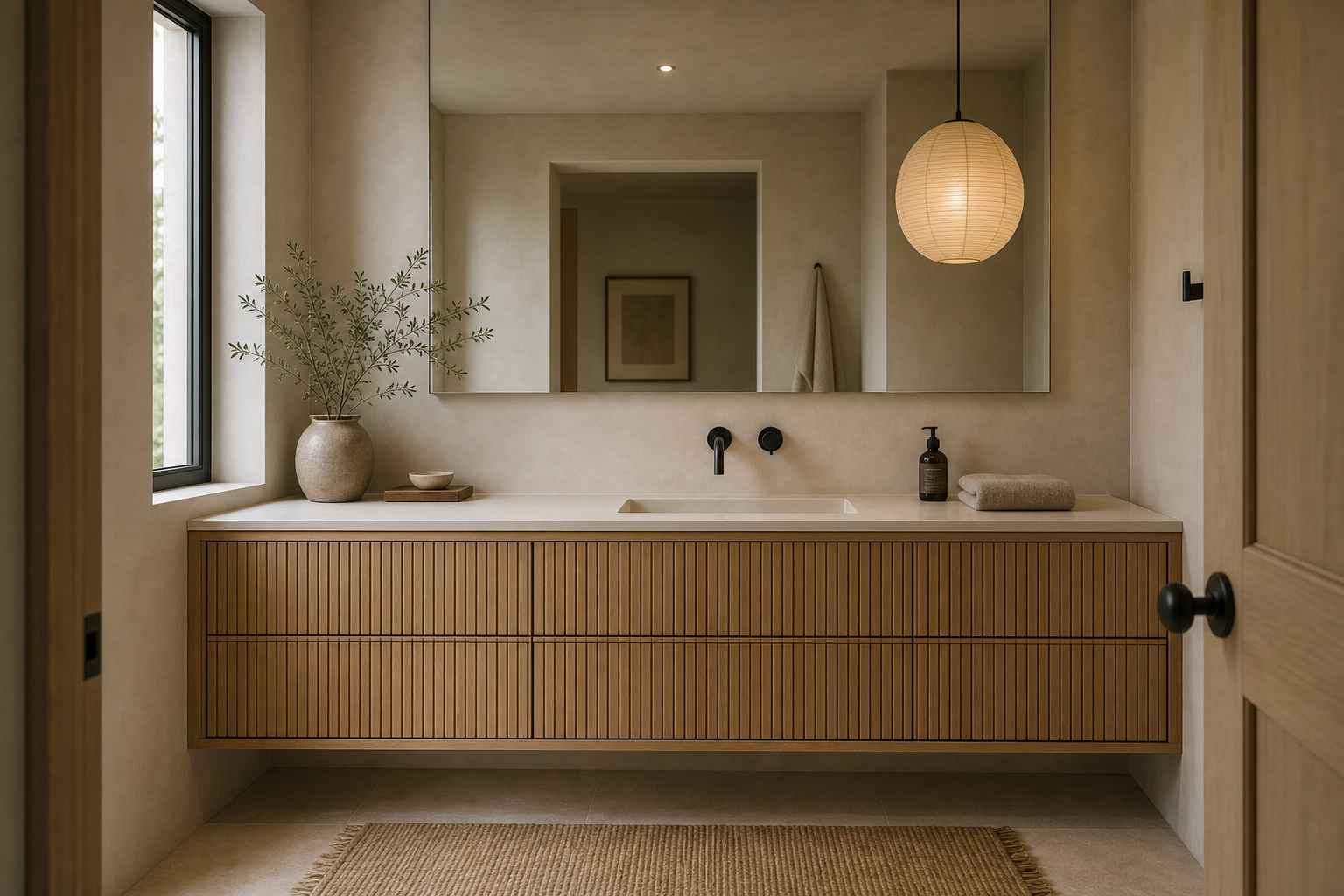

The vanity gives this bathroom texture without sacrificing the quiet that Japandi interiors depend on. Closely spaced vertical slats run across a long timber-toned drawer front, while the entire cabinet lifts above the floor on a deep shadow line. A pale counter, dark wall faucet, wide mirror, round paper pendant, and softly textured walls remain simple enough for that repeated joinery rhythm to stay central.
Vertical Slats Give the Vanity Its Fine Rhythm
The long floating vanity is the dominant element because its vertical slats create the strongest texture in the bathroom. The rhythm is precise but still warm. Its length also gives the back wall a calm horizontal base, while the slats add enough detail to keep the surface from feeling flat.
The slats are consistent from one end of the drawer bank to the other, so the front reads as a continuous crafted surface rather than applied decoration. Their narrow shadows provide depth while the warm tone remains close to the rest of the room.
The vanity lifts off the floor, leaving shadow and open space below. That makes the bathroom feel lighter than a full-height cabinet would. This floating detail is especially useful in a Japandi room because it preserves quiet negative space.
Open floor is visible beneath the full cabinet length. The related minimalist wall-faucet vanity analysis also releases the counter visually; this room extends that lightness downward by separating the vanity from the floor.
The Long Counter Balances the Narrow Grooves
The dark faucet creates a small point of contrast against the pale counter and softly textured wall. It sharpens the sink area without overpowering the wood. The black detail also relates to the window frame and door hardware, which helps the contrast feel intentional.
A Dark Wall Faucet Marks the Washing Point
The paper pendant adds a round, warm element beside the large mirror. Its softness balances the strict vertical lines of the slatted drawer fronts. Because the pendant is light in color and material, it does not compete with the vanity.
The Wide Mirror Expands the Upper Field
The warm softly textured walls give the wood a quiet background. Their matte finish supports the natural character of the vanity without adding another pattern. This is why the bathroom feels calm rather than overly detailed.
A Paper Pendant Introduces One Soft Curve
The large frameless mirror keeps the upper wall clean. A heavy frame would interrupt the balance between slatted wood and soft softly textured. Its simple edge also helps the vanity feel wider and more architectural.
The pendant hangs beside the mirror rather than in front of it. Its pale rounded shade counters the strict drawer grooves and dark faucet line without claiming that the fixture supplies all of the room's illumination.
Empty Space Protects the Japandi Restraint
Choose a vanity where the slats are aligned and consistent across the drawers. The texture should look built into the furniture, not applied afterward. Pair it with a pale counter, dark or dark bronze faucet, simple mirror and soft lighting.
Using Texture Without Adding Visual Noise
I would not add a busy backsplash behind this vanity. The timber-toned slatteds already give the room enough visual movement. I would also avoid oversized hardware because it would break the vertical rhythm.
Do not repeat slats on every nearby surface. One finely detailed front is enough when mirror, counter, wall, and floor remain broad and quiet. The restraint around the vanity is what allows its craftsmanship to be read at first glance.
The sink is centered within the long counter but does not require a visible cabinet break beneath it. Keeping the slatted front continuous allows the vanity to read as one piece of joinery rather than several small bathroom units assembled side by side.
A warm shadow forms beneath the cabinet and another appears where the counter meets the wall. These two fine horizontal lines temper the vertical slats, giving the composition balance without introducing trim or a patterned backsplash.
Only a few dark bottles and a small pale vessel occupy the counter. Their scale remains minor beside the mirror and pendant, preserving enough open surface for the washing area to feel practical as well as carefully edited.