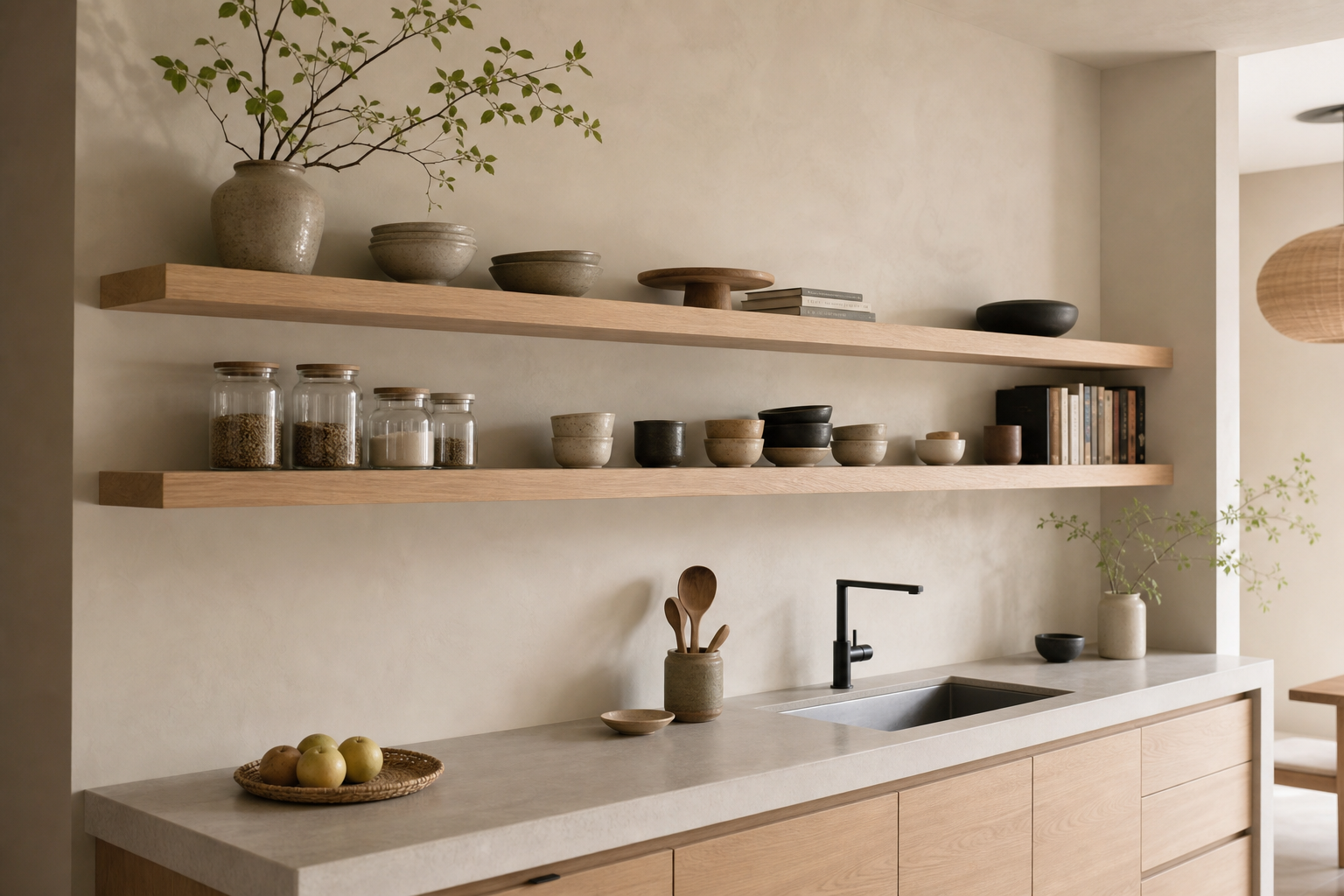

Two floating shelves turn one calm kitchen wall into useful display without surrounding the sink with upper cabinets. Their long pale timber planes run almost the full width of the counter, leaving generous wall between them and a larger open zone above the work surface. The effect is spacious because storage is organized into two precise horizontal lines rather than scattered across small ledges.
The shelves are not styled as identical twins. Large branches and broad vessels give the upper level a loose sculptural rhythm; jars, cups, bowls, books, and smaller pieces make the lower shelf more closely connected to daily reach. This difference allows the pair to share one geometry while performing distinct visual roles.
Shelf Length Follows the Counter Rather Than the Sink
Each board begins near the left wall and extends past the sink toward the open right edge. That span relates to the entire counter, not to one fixture below it. The horizontal alignment makes drawers, worktop, and shelves read as a single broad elevation even though no side panels connect them.
Both ends appear thick and clean, with no visible brackets. The actual fixing method and load capacity cannot be verified from the image. From a design standpoint, concealed support matters because uninterrupted fronts preserve the quiet linear character that defines the wall.
The Wider Gap Below Protects the Work Surface
The lower shelf sits high enough to leave an open field above the counter and faucet. Wooden utensils rise comfortably beneath it, and leafy branches at the far right fit without touching the shelf edge. This breathing room prevents open storage from pressing down on the preparation zone.
The sink remains clearly visible within a pale continuous worktop. A dark angular faucet is the strongest small contrast, while an open fruit tray, utensil pot, dish, and vase stay low. Because the counter is only lightly occupied, the shelf display does not create a second layer of clutter below itself.
Objects Are Grouped by Scale and Tone
Large pale vessels and branching greenery anchor the upper left. Low stacked bowls occupy the middle, while books and a dark rounded bowl provide weight toward the right. The spaces between these groups are large enough for every outline to remain readable against the warm pale wall.
On the lower shelf, four glass jars form a compact run before small cups and bowls continue across the center. Dark pieces punctuate a collection dominated by cream, taupe, clear glass, and light timber. The palette is controlled, but changes in height and silhouette keep it from becoming monotonous.
Warm Drawers Ground the Open Composition
Flat timber-toned drawer fronts extend beneath the counter with narrow recessed pulls. Their continuous grain and low horizontal joints give the lower half more mass than the airy display above. This balance is important: a wall of open objects needs a calm, substantial base.
Only drawer fronts can be seen, not internal organizers or storage functions. The honest practical lesson is placement. Closed cabinetry holds the visual floor of the composition, while the shelves reserve a limited amount of visible storage for selected pieces.
Daylight Keeps the Neutral Palette Dimensional
Light enters from the open right side and moves across the wall, producing soft shadows beneath both boards and behind bowls. Those shadows reveal shelf thickness and separate similarly toned objects. A woven pendant is partly visible beyond the wall, but it does not illuminate the photographed counter directly enough to justify a detailed lighting claim.
For a comparable kitchen, set shelf width from the worktop elevation, keep a generous clear zone above the faucet, and assign larger decorative forms to the upper level. Concentrate reachable items below and preserve blank wall between groups. The design succeeds through measured spacing, not through filling every available inch.
Dark Accents Are Sparse but Strategically Placed
The faucet, a handful of bowls and cups, and books at the right provide isolated dark points across the pale elevation. They do not form a continuous stripe. This measured distribution helps the eye travel from counter to lower shelf and upper shelf while keeping the overall wall light and unforced.
Branching Greenery Supplies the Tallest Silhouettes
Large branches rise from the upper-left vessel, and a smaller arrangement appears at counter height on the right. Their open leaves occupy otherwise blank wall without hiding it. The two placements balance diagonal height across the composition and soften the long shelf edges with forms that are neither stacked nor rectilinear.
The Open Right Edge Prevents a Boxed-In Effect
Shelves stop before the wall opens into the adjacent dining area, leaving their ends fully visible. That termination confirms their thickness and keeps the kitchen from feeling enclosed by upper storage. The glimpse of a bench and woven pendant beyond also gives depth while remaining clearly secondary to the sink elevation.