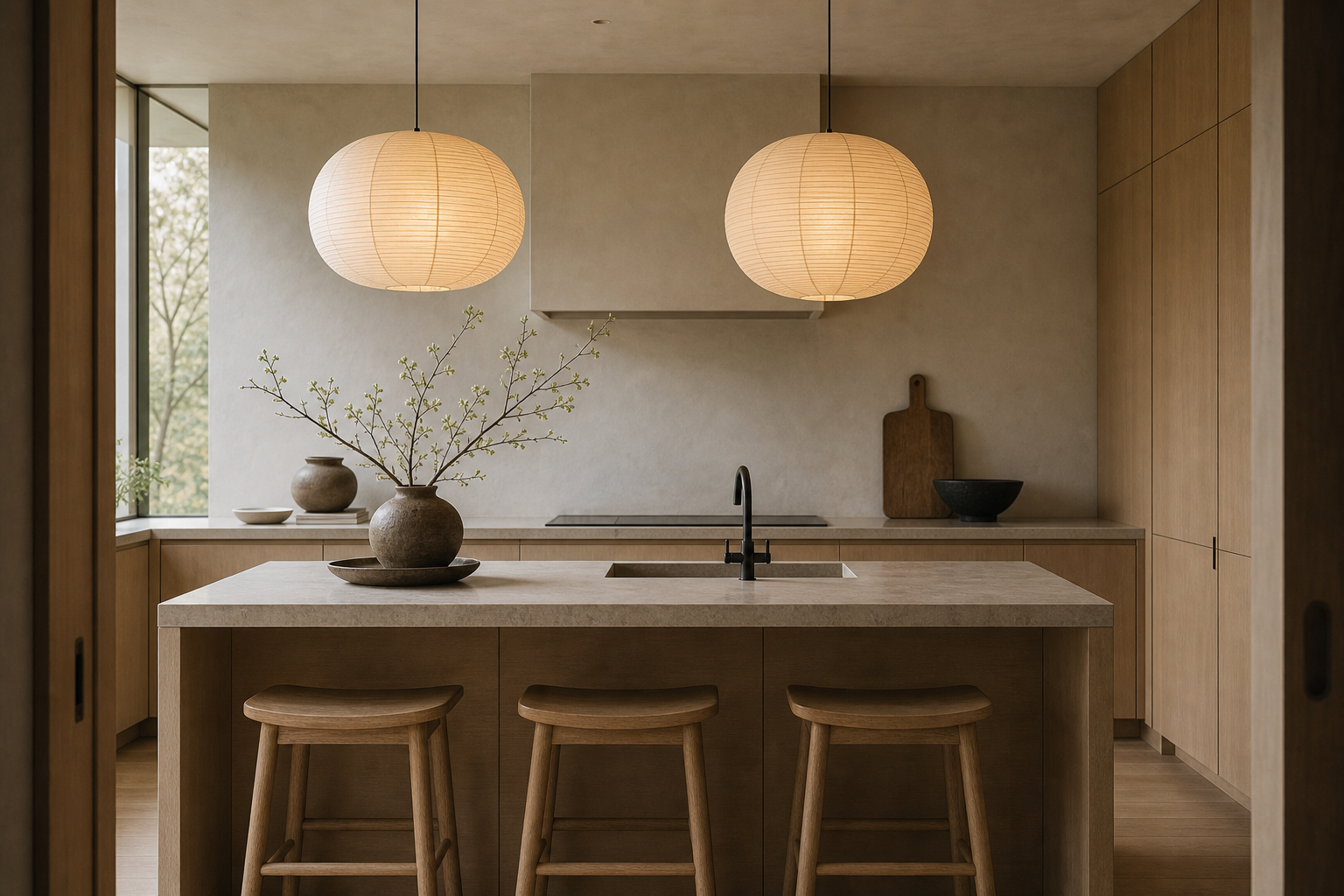

Two rounded paper pendants establish the kitchen's calm overhead rhythm before the cabinetry is read. They hang at equal height above a pale island, their soft translucent forms contrasting with straight timber-toned cabinet lines and a dark faucet below. The veined backsplash remains quiet, and a low branch vessel avoids entering the fixtures' visual field. Daylight from the side opening keeps both shades luminous without requiring exact claims about bulb temperature.
Twin Paper Shades Establish the Overhead Rhythm
The two paper shades are the first elements the eye reads. Their scale is generous enough to belong above the island, but the translucent material keeps them from feeling heavy. In a Japandi kitchen, that balance matters. The pendants bring softness and warmth without introducing ornament, which keeps the room aligned with both Japanese restraint and Scandinavian simplicity.
The shades are separated by a generous gap, allowing each outline to remain complete. Together they span the working island without forming a dense cluster, and their equal diameter makes the pair read as one lighting decision rather than two unrelated fixtures.
The long island gives the pendants a clear stage. Its pale stone top and wood base create a calm horizontal plane below the round lights. Three wood stools tuck under the island, so the lower half of the kitchen stays orderly. That clean base helps the pendant shapes remain visually dominant.
The Island Fixes the Pendants' Shared Axis
Natural light enters from the left window and prevents the pendant glow from becoming the only atmosphere in the kitchen. The combination creates a softer, more layered reading of the space. The paper shades are especially successful because daylight reveals their ribbed surface while the warm glow gives them depth from within.
Both pendants align over the long center of the island, while stools occupy the near side and the sink sits farther back. This shared axis connects preparation and seating without requiring another ceiling feature above the perimeter counter.
Equal Hanging Height Preserves Calm Symmetry
The flat-front cabinetry has very little visual interruption. That restraint is important because busy door profiles would compete with the soft geometry of the pendant lights. Tall wood panels on the right add vertical weight, balancing the large shades without needing color contrast or decorative trim.
Timber-Toned Cabinetry Holds the Warm Perimeter
The matte black faucet gives the sink area a precise line against the pale stone island. It is a small detail, but it keeps the kitchen from becoming too soft. That dark accent also relates to the thin pendant cords, tying the lighting and sink together without making either element feel overdesigned.
Cabinet fronts create broad warm vertical planes at both sides, framing the lighter backsplash and island. Their quiet grain gives the delicate paper texture a compatible background but does not imitate the rounded fixture shape.
The ceramic vase and branches sit low enough that they do not block the pendants. Their organic shape adds life, but the lighting remains the main upper-level feature. This is a useful lesson for island styling: when the pendants are this sculptural, countertop objects should stay quiet and grounded.
Low Styling Leaves the Fixtures Unobstructed
Start with pendant scale. Use two large paper shades over a long island rather than several small fixtures, especially if the kitchen already has calm cabinetry and a simple counter. Pair the lights with pale wood, off-white plaster and a slim stone surface. The paper shades need a quiet material field around them to feel intentional.
Selecting Pendant Scale for a Restrained Kitchen
I would avoid glossy statement pendants in this kitchen. The paper texture is what gives the space its softness, and reflective metal would change the mood entirely. I would also avoid heavy upper shelving near the pendants. The open wall behind them allows the light shapes to breathe.
The open storage in this scheduled Japandi floating-shelf kitchen study emphasizes warm horizontal lines. Here, twin suspended spheres introduce the principal curves while the cabinet envelope stays deliberately simple.
Two stools tuck under the near island edge and keep their backs below the counter, leaving the sink and pendant spacing visible. The branch vessel stands behind rather than between the shades. This placement preserves the pair as the first overhead feature while acknowledging work and seating beneath it.