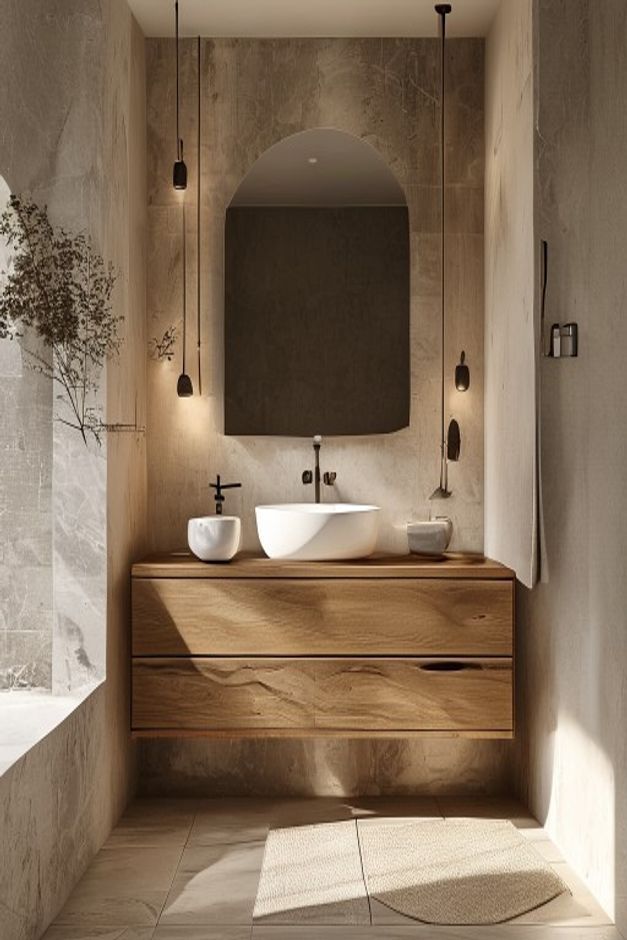

This bathroom shows how a singular, well-executed vanity can define the architectural character of an entire space. By lifting the storage unit off the floor, the design creates an immediate sense of openness that challenges traditional notions of bathroom utility. It is an essential study for those seeking to balance the warmth of organic materials with the crisp, unforgiving lines of a strictly minimalist aesthetic.
The composition relies on a deliberate interplay between the softness of natural wood grain and the tactile, rugged quality of textured wall cladding. This contrast prevents the room from feeling sterile, instead grounding the space in a tactile experience that rewards close observation. By stripping away excess, the design forces a focus on the quality of the finish and the precision of the installation, proving that simplicity is often the most complex design challenge to resolve.
A Floating Vanity Makes the Floor Feel More Open
Incorporating a floating wood vanity into a bathroom layout is more than a trend; it is a structural decision that fundamentally alters the perception of floor space. By eliminating the visual weight of legs or a pedestal, the eye travels uninterrupted across the floor, making the footprint appear significantly larger than its actual dimensions. This technique is particularly effective in compact niches where every square inch of floor area contributes to the overall feeling of spaciousness.
Beyond the spatial benefits, the floating form introduces a sense of lightness that contrasts with the substantial, gravity-defying nature of the cabinetry itself. The two-drawer configuration provides necessary storage while maintaining a low-profile silhouette that does not overwhelm the wall. This Quiet Luxury Bathroom: Mastering the Floating Vanity Aesthetic emphasizes that furniture should act as an extension of the architecture rather than an afterthought placed within a room.
Wood Grain Adds Warmth Against Stone and Plaster
The choice of wood for the vanity introduces a necessary warmth that anchors the cooler, neutral tones found elsewhere in the room. Natural wood grain offers a complex, shifting pattern that provides visual interest without requiring additional decorative clutter. When paired with a textured stone or plaster wall, the material palette achieves a sophisticated balance between organic imperfection and refined geometric order.
This combination of materials is vital for creating a space that feels lived-in rather than institutional. The interaction between the smooth, finished surface of the wood and the rougher, matte texture of the wall creates a dialogue of light and shadow. For those interested in this approach, Minimalist Bathroom Design: Mastering Textured Plaster and Warm Wood Tones offers deeper insight into how these surface treatments interact to define a room’s atmosphere.
An Arched Mirror Softens the Bathroom’s Straight Lines
In a room defined by sharp, linear transitions and right angles, the introduction of an arched wall mirror serves as a crucial softening agent. The curve of the mirror frame breaks the rigidity of the surrounding architecture, providing a gentle focal point that guides the viewer’s eye. This shape is not merely aesthetic; it serves a functional purpose by echoing the organic nature of the wood grain and the botanical elements present in the space.
Placement is everything when dealing with arched forms. By centering the mirror above the vessel sink, the design establishes a vertical axis that anchors the vanity to the wall. This deliberate alignment ensures that the mirror feels like an integrated component of the vanity ensemble rather than a disconnected accessory. The interplay between the curved glass and the linear wood drawers creates a balanced tension that is central to successful minimalist design.
Lighting Strategies for Minimalist Environments
Lighting in a minimalist bathroom must be both functional and sculptural, acting as a bridge between the ceiling and the vanity. Dual pendant lights, suspended at a precise height, provide task-oriented illumination while reinforcing the verticality of the niche. By choosing fixtures with a downward focus, the design ensures that light is directed exactly where it is needed, highlighting the texture of the vanity surface and the depth of the vessel sink.
The choice of minimalist hardware prevents the lighting from becoming a distraction. Instead of ornate chandeliers, these pendants rely on clean lines and a neutral finish to complement the vanity. This strategy of using lighting as an architectural tool is explored further in Mastering the Modern Organic Bathroom: The Floating Vanity Aesthetic, where the integration of light and structure is shown to be the key to achieving a cohesive, high-end look.
The Utility of Ceramic Vessel Sinks
A ceramic vessel sink acts as the functional centerpiece of the vanity, elevating the act of washing into a deliberate, ritualistic experience. Unlike integrated basins that disappear into the countertop, the vessel sink asserts its presence through its form and material. Its crisp white finish provides a clean contrast against the warm wood, emphasizing the purity of the design and the quality of the craftsmanship.
When selecting a vessel sink, one must consider the height in relation to the vanity top. The goal is to create a harmonious proportion where the sink sits comfortably atop the wood without appearing oversized or unstable. This balance is essential for maintaining the clean, uncluttered look that is the hallmark of modern bathroom design, ensuring that the vanity remains the primary focus of the wall.
Curating Minimalist Decor with Intent
Minimalism does not mean an absence of objects; it means an intentional selection of items that serve a specific purpose or aesthetic goal. A single dried botanical branch placed near the vanity adds a layer of organic life that connects the interior to the natural world. This small addition provides a necessary contrast to the man-made surfaces, softening the edges of the room without introducing unnecessary clutter.
Similarly, a minimalist ceramic soap dispenser serves as both a functional tool and a decorative element. By choosing accessories that share a common color palette—such as beige, charcoal, or white—the design maintains a sense of unity. Every object in the room is held to a high standard of utility, ensuring that the space remains serene and free from the distraction of excess items that often accumulate in bathroom environments.
Niche Placement as a Spatial Strategy
The decision to place the vanity within a dedicated niche is a powerful architectural move that defines the boundaries of the bathroom. This layout creates a sense of enclosure, making the vanity area feel like a private sanctuary within the larger room. By framing the vanity with walls on either side, the design emphasizes the horizontal lines of the wood drawers and the verticality of the mirror.
This niche-style placement also offers practical benefits, such as protecting the vanity from splashes and providing a contained area for daily routines. It allows for a more controlled environment where lighting and decor can be curated without competing with other areas of the bathroom. For those looking to optimize their layout, Minimalist Bathroom Floating Vanity and Tiled Wall Design Principles provides a framework for understanding how spatial boundaries can be used to enhance design outcomes.
Maintaining Balance in a Neutral Palette
A neutral color palette, composed of beige, warm wood, charcoal, and white, relies on the quality of light to reveal its depth. In a minimalist bathroom, color is not applied as a paint or a finish but is instead inherent in the materials themselves. The warmth of the wood, the coolness of the stone, and the brightness of the ceramic sink work together to create a multi-dimensional environment that feels both sophisticated and welcoming.
To maintain this balance, one must be careful not to introduce too many competing textures or tones. The goal is to create a cohesive whole where each element supports the others, contributing to a sense of calm and order. By sticking to a restrained palette, the design achieves a level of timelessness that is rarely found in more trend-focused interiors, proving that a well-considered neutral space is the ultimate luxury.
How do I choose the right wood for a floating vanity?
Select a moisture-resistant hardwood with a clear, durable finish that highlights the natural grain while protecting the surface from the humid bathroom environment.
What is the ideal height for a floating vanity?
Standard installation height for a vanity is approximately 32 to 36 inches from the floor, though this can be adjusted based on the height of the vessel sink.
How can I keep a minimalist bathroom from feeling cold?
Introduce warmth through organic textures such as natural wood, soft lighting, and botanical elements, which balance the sterility of stone and ceramic surfaces.
Homeowners can learn that the success of a minimalist bathroom relies on the quality of the materials and the precision of the installation rather than the quantity of the furniture. By prioritizing a single, high-quality floating vanity and curating a limited set of functional accessories, one can create a space that is both visually striking and highly practical. The key takeaway is to view the bathroom as an architectural composition, where every element—from the lighting to the mirror—is chosen to support a unified and serene aesthetic.