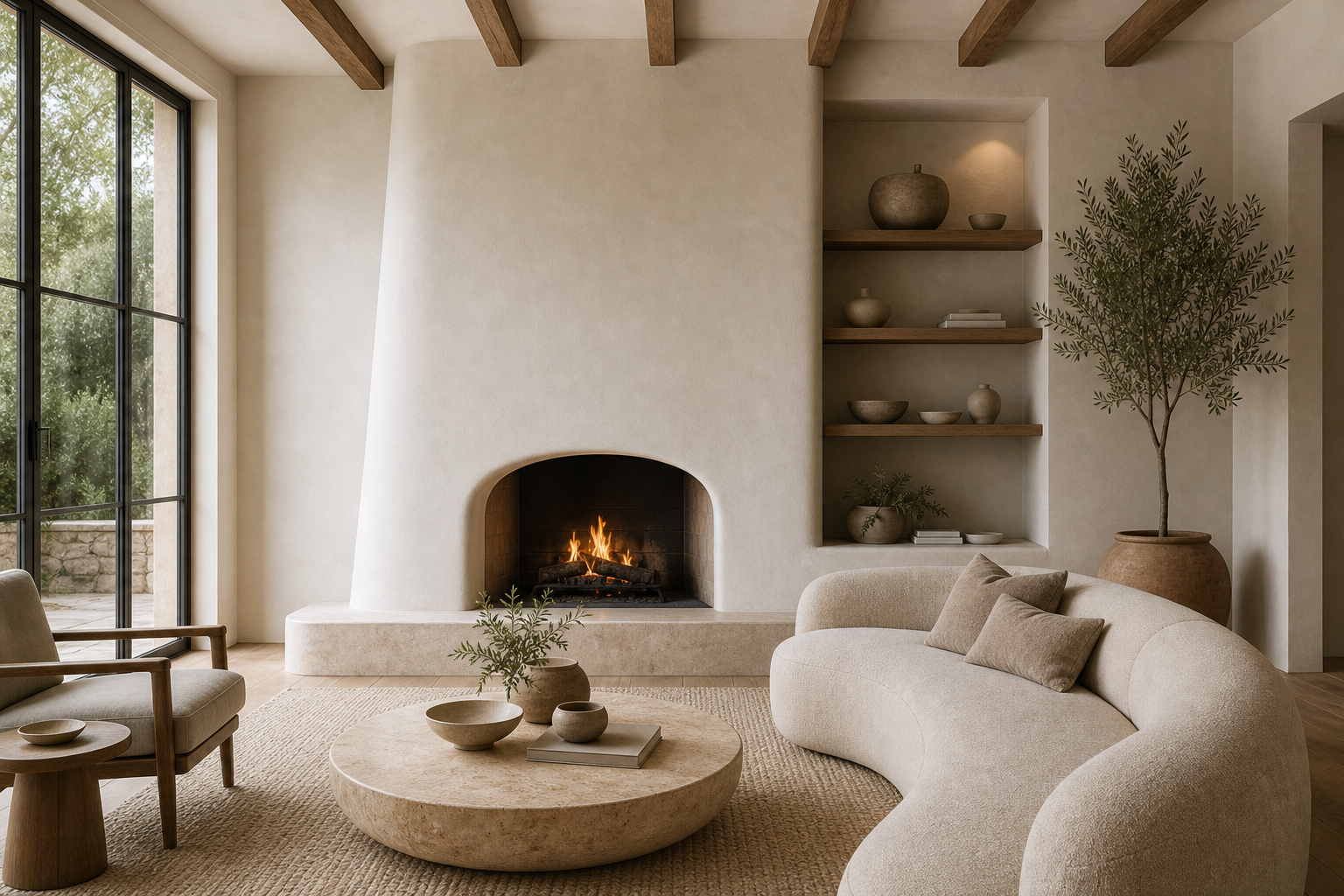

The fireplace wall bends gently into the room instead of forming a flat rectangular chimney breast. Its pale surface gathers a dark fire opening at the base and curves toward a recessed shelf column on the right. A low rounded sofa and circular coffee table respond to that geometry, while timber beams and tall glazing introduce straighter counterlines. The room feels organic because architecture and furniture share softened outlines, not because every object imitates nature.
The Hearth Wall Uses a Soft Architectural Curve
The fireplace wall has soft rounded edges and a deep arched firebox opening, which makes it read as a sculptural volume. Its warm-white plaster surface keeps the scale large but not harsh. A low hearth stretches across the base, grounding the fireplace without adding a heavy mantel. That restraint is what gives the wall its modern organic character.
The wall swells outward near the fire and returns toward the ceiling without a hard mantel line. This continuous profile allows shadow to describe depth and keeps the hearth substantial even though its color remains close to the surrounding plaster-like walls.
The curved beige sofa mirrors the softness of the plaster form. It turns the seating area toward the fire while avoiding the stiff rectangle that a straight sofa would create. Because the sofa is low and rounded, it allows the fireplace to remain the tallest and strongest element in the room.
The opening is low, wide, and almost black, providing a precise visual base beneath a largely unbroken pale field. A modest fire glow is enough to identify function; extra trim or a projecting shelf would interrupt the curve that gives the wall its character.
Recessed Shelves Balance the Right Side
The round stone coffee table reinforces the same curved language as the firebox and sofa. Its thick profile adds weight in the center of the seating group. The travertine-like surface also connects to the pale hearth, so the table feels tied to the architecture instead of floating as a separate object.
A narrow stack of recessed shelves sits within the right return and carries only a few vessels. The openings provide small horizontal lines that balance the firebox while leaving plenty of pale wall visible between shelf contents.
Curved Seating Responds Without Copying the Wall
The recessed shelves to the right of the fireplace give the wall depth without competing with the plaster volume. Their horizontal wood shelves create a quieter rhythm beside the rounded firebox. Ceramic vessels and stacked books are spaced with restraint, which keeps the shelving from pulling attention away from the fireplace.
The wood ceiling beams introduce a strong linear counterpoint to the curved fireplace below. They make the ceiling feel intentional and give the room a warmer architectural frame. Their tone relates to the shelves and side table, helping the upper and lower parts of the room feel connected.
Timber Beams Add a Straight Overhead Counterline
Large black-framed windows bring daylight across the rug, sofa and plaster surface. The dark frames add crispness, which prevents the neutral palette from becoming too soft. The armchair near the window uses the daylight side of the room without interrupting the main seating relationship around the fireplace.
Begin with a simple plaster volume and a rounded firebox opening. Keep the hearth low, wide and pale so the fireplace has weight without looking bulky. Then repeat the fireplace's softness through a curved sofa, a round coffee table and textured upholstery. Natural materials should echo the architecture, not compete with it.
Translating One Curve Across an Entire Living Room
I would not place a television above this fireplace. The plaster wall is already the architectural anchor, and a screen would cut into the quiet surface. I would also avoid high-contrast patterned pillows. The room depends on texture, proportion and curved forms rather than decorative noise.
The more rectilinear mass in this scheduled concrete fireplace analysis depends on planar weight. This room uses a softened continuous profile and repeats that movement at sofa and table height.
The sofa curves around the round table but leaves a broad opening toward the hearth. A small lounge chair remains near the glazing and does not close that route. Furniture supports the wall's geometry while preserving a direct visual and physical approach to the fire.