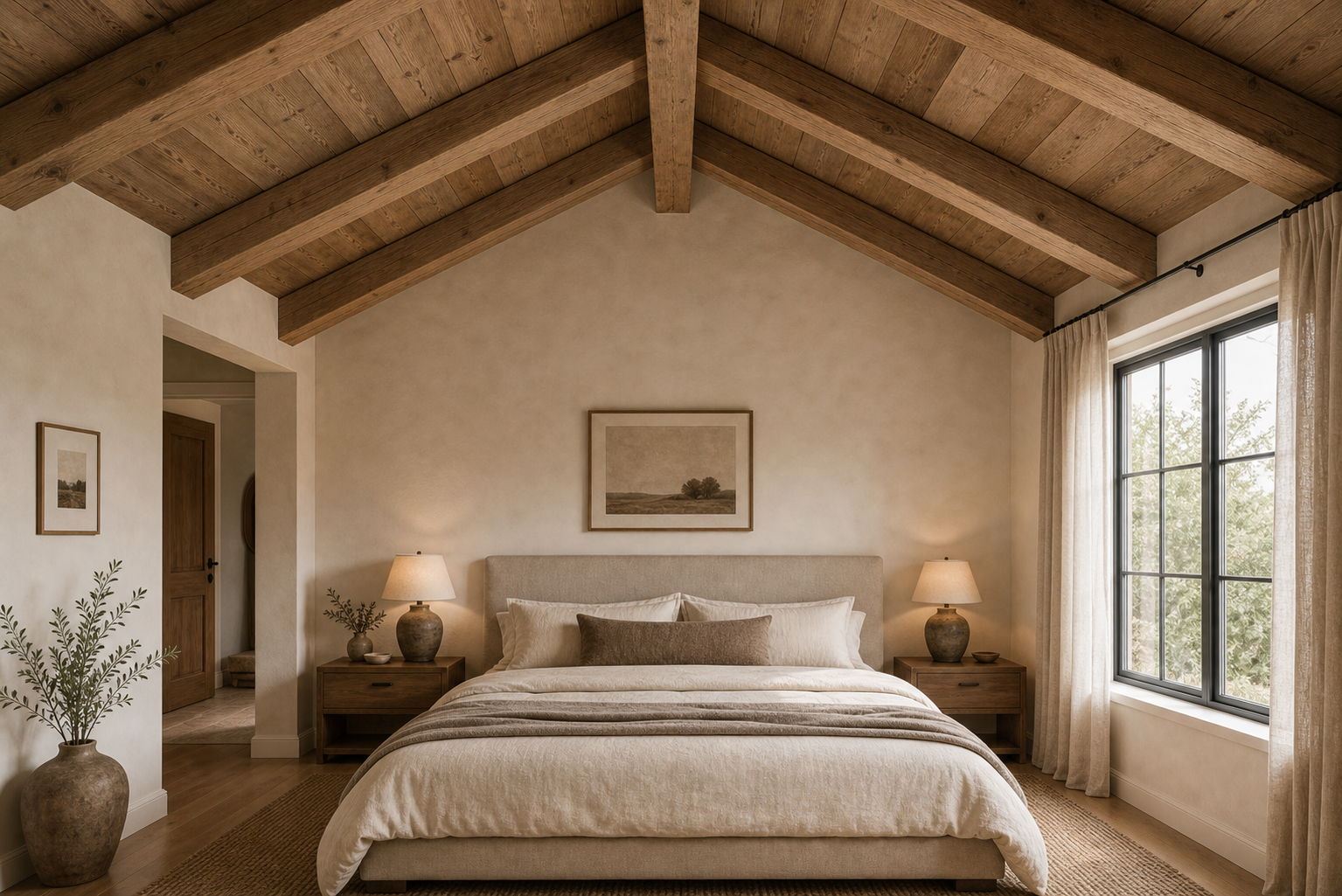

The bedroom's rustic identity is carried overhead, where timber boards follow the two roof slopes and exposed beams cross the full width. Everything below is deliberately lower and quieter: the upholstered bed is centered beneath the ridge, nightstands remain compact, and warm wall surfaces hold only one small framed work. This distribution protects the volume of the vault while bringing enough fabric and low-level light back to human scale.
The Vault Establishes the Room's Volume
The beams occupy the largest and highest plane in the room, so they immediately set the bedroom's scale. Their warm timber tone brings rustic warmth, while the clean vaulted geometry keeps the room feeling modern rather than cabin-like.
Boards run along each slope toward the ridge, making the ceiling's geometry immediately legible. Their warm tone is continuous enough to read as one canopy, but beam shadows interrupt the surface and prevent a broad timber plane from appearing flat.
The sloped ceiling lifts the center of the room above the bed, making the sleeping area feel more generous. That height matters because the bed and nightstands remain low and simple. The ceiling provides the drama, not the furniture.
The heavy cross members occur at measured intervals and remain visible against lighter infill. They provide scale: without those interruptions, the roof could feel visually remote from the bed. Their depth also records the change in daylight across the ceiling.
The Ridge Fixes the Bed on Center
The ridge beam runs directly above the bed wall, giving the room a clear center line. That alignment makes the bed placement feel deliberate and helps the symmetrical lamps and nightstands read as part of the architecture.
Bed, artwork, and ridge occupy the same central axis, while paired lamps stabilize the lower corners. This alignment gives the irregular texture overhead a formal base and makes the room calm without relying on a perfectly mirrored arrangement at every edge.
Quiet Walls Give the Timber a Boundary
The warm plaster walls give the wood ceiling a quiet vertical boundary. Without that calm wall surface, the amount of wood overhead could feel heavy. The plaster gives the eye a place to rest.
An Upholstered Bed Softens the Lower Register
The upholstered bed softens the lower half of the room and prevents the rustic ceiling from dominating every surface. Its neutral fabric works well because it does not compete with the grain and structure above.
The headboard rises enough to separate pillows from the wall but never challenges the ceiling. Pale upholstery absorbs sound visually and offers a soft counterweight to the many hard lines above; the photograph does not confirm its fiber and does not need to.
The ceramic lamps add warm pools of light at the human scale of the room. That lower glow balances the height of the ceiling and makes the bedroom feel intimate despite the large overhead volume.
The Side Window Reveals Board and Beam Relief
Daylight from the right window washes across the beams and reveals the wood grain. The pale curtains diffuse that light, so the ceiling texture reads warmly rather than harshly.
Balancing a Strong Ceiling With a Restrained Bed Wall
Start by deciding whether the beams should be the main architectural feature. If they are, keep the bed wall and lighting simpler. Use plaster, linen, ceramic and woven texture below the ceiling. Those softer materials allow the wood beams to lead without making the bedroom feel heavy.
The fabric-led approach in this warm neutral bedroom curtain study builds enclosure around the windows. In this room, the roof already supplies that enclosure, so curtains and bedding appropriately remain secondary.
The right window is tall but narrower than the bed wall, so daylight grazes across one roof slope instead of flattening the ceiling from the front. A pale curtain softens the opening and leaves the dark frame legible. At floor level, the rug and bed remain fully inside the visual footprint established by the beams above. This nested scale, from ceiling bay to bed and then to rug, is what makes the generous volume feel settled rather than oversized.
At the foot of the bed, the visible floor and rug edge remain quiet and unobstructed. This open foreground lets the eye travel upward from the low bed to the ridge without meeting another tall furniture element.