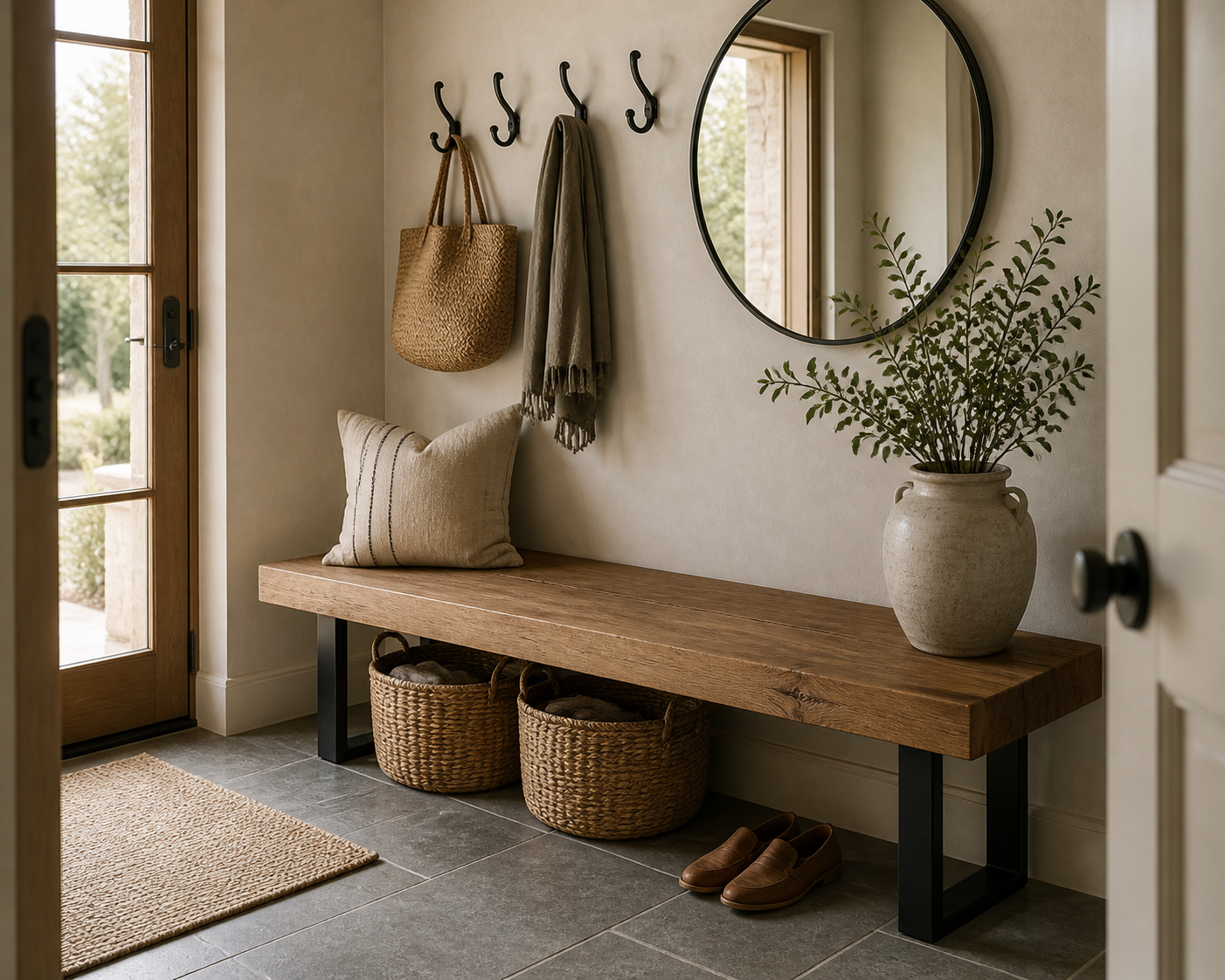

The long timber bench gives this entryway one dependable horizontal line between a glazed exterior door and an interior opening. Its thick seat spans the wall without built-in side panels, leaving the dark floor visible beneath. Black metal legs keep the piece visually direct, while baskets and shoes occupy the lower zone without turning it into an enclosed cabinet.
Above, a row of dark hooks distributes bags and a hanging textile across the pale wall. The bench and hooks operate as a single arrival station even though they are not physically joined. A round mirror and large branch vessel soften the composition, introducing curves and foliage where the storage elements are predominantly straight and functional.
Bench Length Creates a Stable Landing Zone
The seat is wide enough to accommodate a pale cushion and still leave a long open area for sitting or setting down belongings. It stops before both doorways, preserving strips of clear wall at the ends. That restraint is important in a passage: an entry bench should feel generous in use but should never erase the distinction between furniture and the openings that control circulation.
Open Space Below Keeps the Floor Continuous
Two woven baskets sit beneath the left half, while a pair of shoes occupies the right. Because the center and outer edges remain open, the dark rectangular floor units can be seen running beneath the bench. No hidden drawers or internal organizers are visible. The open frame makes stored items immediately accessible and prevents a substantial timber seat from becoming a solid wall at knee height.
Hooks Use the Wall Above Seated Height
Four dark hooks form a measured row high enough that hanging bags clear the bench cushion. Their spacing allows each item to retain its outline rather than gathering into one dense cluster. A compact sconce at the far right is aligned above the hook level, separating illumination from storage hardware. The arrangement uses vertical space without extending shelving over the user's head.
The Mirror Relieves a Linear Composition
A large round dark-framed mirror occupies the wall beyond the hooks, partly above the branch vessel rather than centered over the bench. Its curved edge interrupts the seat, hook rail, door frames, and floor joints. This asymmetry avoids the formality of a perfectly centered entry elevation and lets the mirror return daylight from the glazed door across the storage wall.
Garden Light Makes the Material Contrast Legible
The glass door at the left introduces bright exterior light behind the bench. It reveals grain across the timber seat, the coarse weave of the baskets and mat, and the smooth pale wall. Exact species and fiber content are uncertain, but their contrasting textures are visible. This controlled mix is what gives the entry its rustic warmth without adding distressed signs or themed decoration.
Circulation Remains Separate from Storage
A small woven mat sits inside the exterior door and ends before the bench legs, keeping the threshold distinct from the sitting area. The route toward the interior opening passes in front of the furniture with no projecting console. A related modern organic entryway storage wall encloses more functions; this room proves that a bench and hooks can be enough when the path remains the first planning priority.
The Styling Supports Arrival
The cushion, baskets, tote, shoes, mirror, and plant all relate to entering or leaving the home. Nothing on the bench requires a protected display surface. To repeat this logic, establish door swing and walking width first, then size a seat to the remaining wall and align hooks with its usable span. The room feels composed because everyday objects have clear positions, not because practical evidence has been hidden from view.
The bench seat projects only slightly beyond its black legs, keeping the front edge easy to locate against the dark floor. Baskets sit entirely behind that line, and shoes remain close to the right support. This containment reduces the chance that stored items will spill into the walking path. It also preserves a long clear strip on the seat, which is more useful on arrival than an uninterrupted row of decorative cushions. The single cushion supports comfort while leaving the bench's working capacity visible.
Branches rise above the bench without interfering with the hooks, giving the storage wall a softer upper edge.