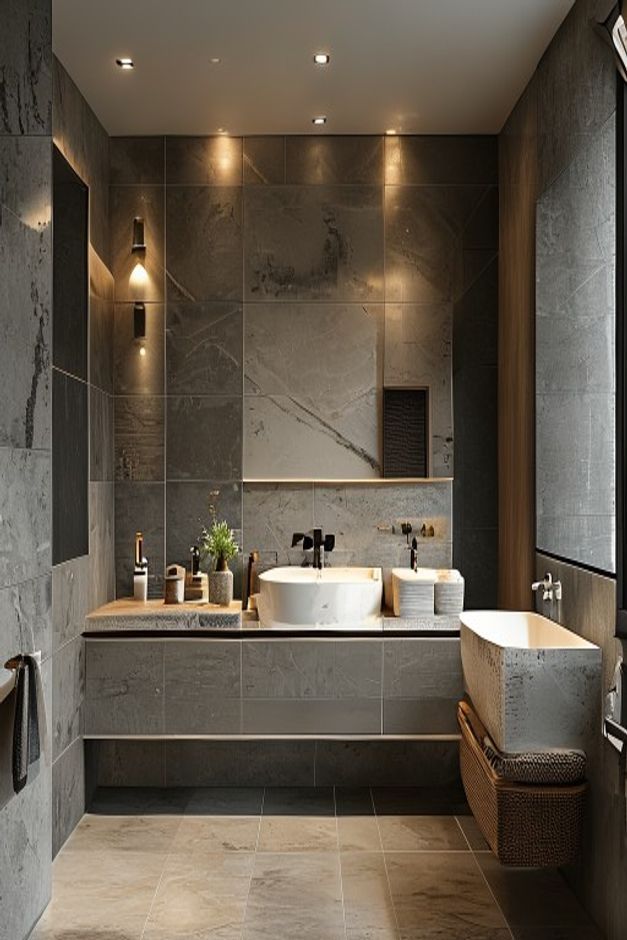

The vanity wall derives its impact from scale rather than many decorative objects. Large dark stone-like panels cover the rear and side surfaces, creating a continuous envelope with broad joints. A much paler veined slab occupies the center above the basin, giving the wall a controlled area of contrast instead of breaking it into unrelated finishes.
A floating gray cabinet runs beneath a white vessel basin and thin counter. A large dark mirror occupies the left wall, while small sconces and ceiling spots create warm highlights across the panels. The room feels moody but readable because light reveals surface variation and the pale central slab marks the working zone.
Large Panels Give the Narrow Room Visual Scale
The wall is divided into broad rectangles rather than a small tile grid. This reduces the number of joints and allows tonal marks within each panel to remain visible. In a narrow bathroom, larger modules can make the envelope feel calmer even when the color is dark.
Panel joints align across much of the rear wall, establishing a disciplined background for basin and cabinet. The exact material cannot be confirmed, so its effect is best described through dark stone-like appearance, scale, and visible veining.
The darkest panels occupy the perimeter, while the pale slab, basin, and counter concentrate brightness near standing height. This tonal distribution keeps attention on the useful center. It also gives the narrow room a clearer depth sequence from dark edge to light work zone.
A Pale Veined Slab Creates a Central Pause
A lighter rectangular panel sits above the vanity and extends higher than the basin area. Its diagonal veining contrasts with the regular wall grid, drawing attention toward the center. A narrow dark recess at the right adds depth without becoming a second major feature.
The pale slab also reflects more light than the surrounding panels. This keeps the sink wall usable and legible while allowing the outer surfaces to retain their deeper tone.
The Floating Vanity Releases the Floor
The cabinet runs horizontally across the rear wall but stops above the dark floor. A shadowed gap beneath makes the base appear lighter and lets floor tiles continue to the wall. Broad flat drawer fronts avoid adding small hardware detail to the already varied stone-like surfaces.
A published quiet luxury floating vanity uses suspension against a pale room. Here, the same open floor principle prevents a dark material envelope from feeling closed at the far end.
The vanity top projects only slightly beyond the broad drawer fronts, preserving a thin horizontal profile. That edge catches light and separates counter from cabinet. A thicker top would add another heavy band across the already substantial paneled wall.
The Vessel Basin Marks the Working Center
A white vessel basin sits near the center of the counter and provides the brightest compact object. Dark fittings rise behind it, creating a crisp silhouette against the pale slab. Small containers remain grouped at the outer edges, leaving space around the basin.
Mirror and Sconces Build Depth Along the Left Wall
A large dark rectangular mirror occupies much of the left side and reflects parts of the stone-like envelope. Two small vertical sconces create separate warm pools nearby. This side lighting makes the wall joints and surface relief visible without flattening the room into one even brightness.
Several recessed ceiling spots add further highlights along the rear wall. Exact output cannot be inferred, but the photograph clearly shows a layered pattern of local wall light and overhead points.
The mirror's black edge nearly disappears against the left wall, so reflected light and the adjacent sconces define it more than a decorative frame. This restrained treatment avoids adding another veined surface beside the already expressive panel composition.
The Right Edge Remains Visually Separate
A tall dark-framed opening or glazed edge runs along the right, beside a pale rectangular object and woven container. Their exact function is not clear enough to name, so they remain secondary visible forms. The vertical frame helps contain the vanity wall and reinforces the narrow room's depth.
The transferable lesson is to use one dark large-format envelope, introduce a single pale working panel, and release the floor beneath the vanity. Keep accessories compact and let localized light reveal material differences rather than attempting to brighten every surface equally.