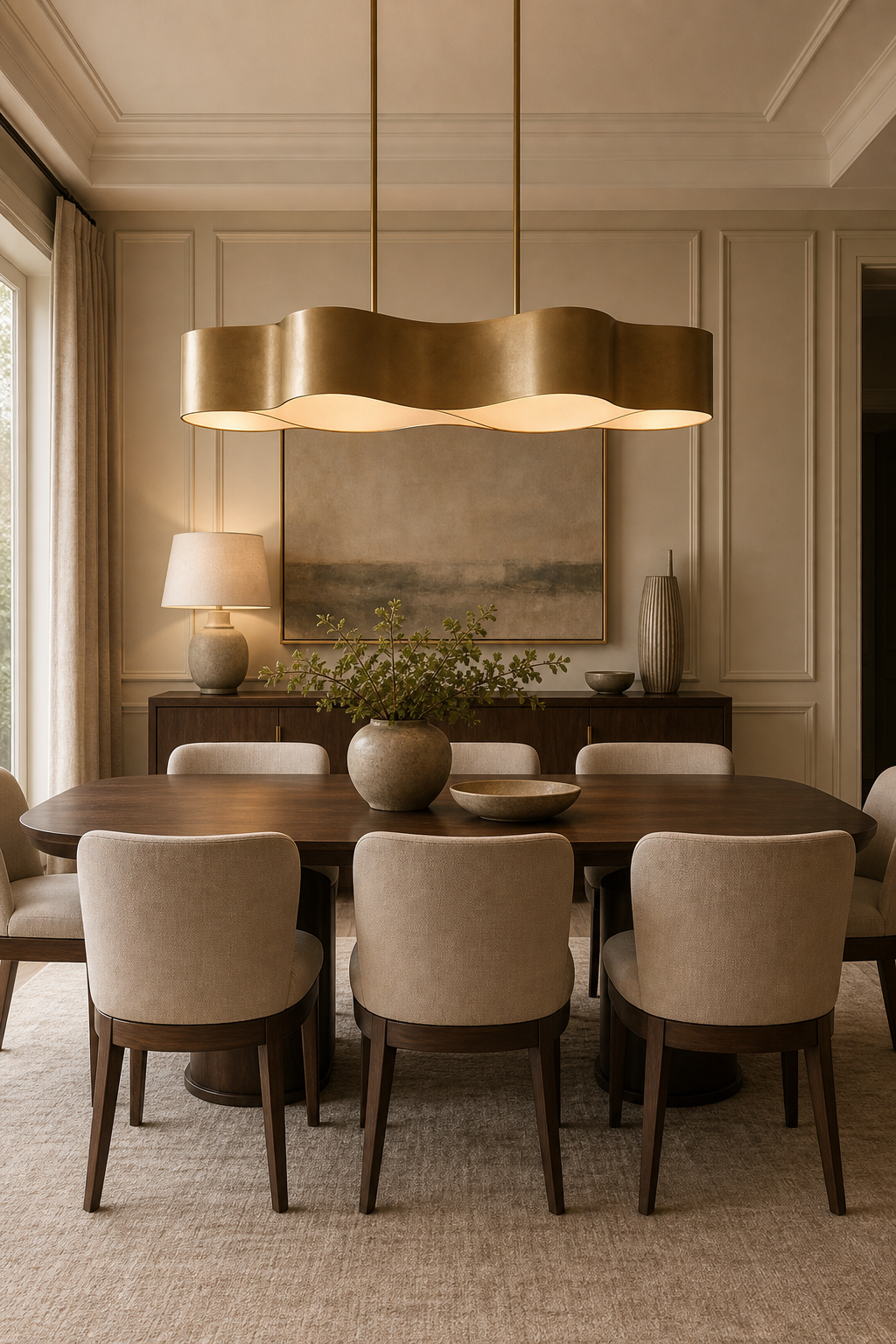

The pendant is the room's decisive gesture. Its broad metal-toned body undulates above the oval dining table, creating a strong silhouette without relying on crystals, multiple arms, or exposed bulbs. The fixture is expressive, yet its low horizontal span follows the furniture below closely enough that the composition still feels controlled.
Everything around it is quieter: pale paneled walls, cream upholstered chairs, a dark oval table, a long sideboard, restrained artwork, and full curtains at the left. This hierarchy is what makes the room read as luxury rather than display. One custom-looking form receives attention; the remaining elements supply proportion, comfort, and a calm architectural frame.
The Pendant Mirrors the Table's Long Oval
The fixture spans much of the tabletop and bends gently along its lower edge. That curvature relates to the rounded table ends and soft chair backs, connecting ceiling and furniture without literal matching. A compact central pendant would leave the table's outer seats visually detached from the lighting zone.
Its two fine suspension rods rise from separated points, reinforcing the width and keeping the body level. The mounting strategy reads as stable rather than delicate. Exact height cannot be measured from the image, but the fixture clearly remains above seated sightlines and below the upper wall molding.
A Warm Inner Glow Keeps the Metal Form from Feeling Heavy
Light emerges from the pendant's pale underside, while the darker outer band retains a sculptural edge. This contrast allows the fixture to appear substantial without becoming a dark block above the diners. Illumination is directed toward the table and softened across the curved lower surface.
A shaded lamp on the sideboard adds a second, lower source near the wall. Daylight enters from the left window. Those layers prevent the pendant from carrying every lighting task and let it remain the room's visual centerpiece rather than an over-bright utility fixture.
Upholstered Chairs Create a Soft Perimeter
Pale chairs surround the table with broad rounded backs and darker wood-toned legs. Their repeated upholstery forms a calm ring beneath the expressive pendant. Because the backs stop below the tabletop display and sideboard, the room maintains clear horizontal layers instead of stacking one continuous wall of furniture.
The chairs are numerous, but their close color keeps the group visually unified. Small gaps remain between them, preserving access around the oval edge. The plan feels formal while still acknowledging movement; no chair is wedged into a sharp table corner.
Wall Paneling Gives the Fixture a Disciplined Background
Rectangular molding frames the artwork and sideboard in broad, low-contrast panels. The lines provide order without challenging the pendant's curves. Crown detail at the ceiling adds another measured border and makes the suspension rods appear intentionally placed within an architectural bay.
The artwork is large enough to hold the wall behind the table but subdued in tone. Its horizon-like composition echoes the room's long furniture lines. A louder image would create a second dominant focal point directly below the pendant, weakening the clarity of the elevation.
The Sideboard Anchors the Rear Elevation
A dark, low sideboard runs beneath the artwork and carries a lamp, vessels, and a central leafy arrangement. Its depth gives the pale wall a firm base while keeping storage away from the dining circulation around the table. The visible doors are broad and minimally detailed.
The central branches rise into the artwork zone, but their open structure allows the frame to remain readable. Smaller objects sit toward the outer ends. This arrangement creates asymmetry within a strongly centered room and keeps the sideboard from resembling a line of evenly spaced accessories.
Filtered Daylight Preserves the Low-Contrast Palette
A tall left window and full curtain introduce soft side light across chair upholstery, tabletop, and rug. The light reveals subtle differences between warm wall paint, pale fabric, dark wood tones, and the pendant's metal-like surface. The palette depends on those tonal shifts rather than on strong color contrast.
The reusable principle is to select the table and overhead fixture as one proportional pair. Let one carry the expressive outline, then surround it with quieter chairs and a structured wall. Luxury emerges here from scale control and material restraint; adding more statement pieces would reduce, not increase, the room's authority.