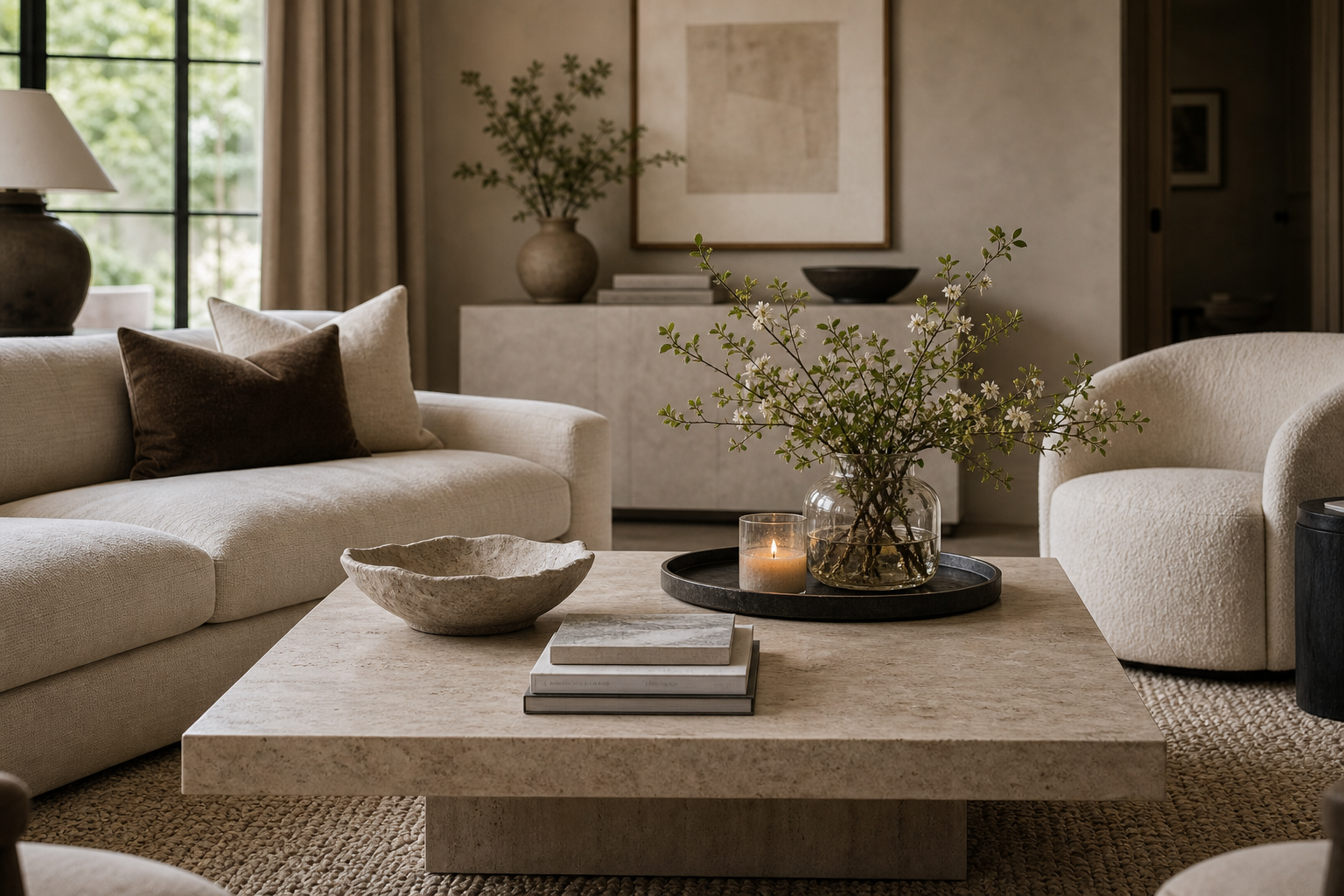

The coffee table succeeds because its styling respects the scale of the table itself. A thick light-toned top sits close to the floor on a broad central base, creating a strong horizontal plane between pale sofa and curved chairs. Objects are divided into three compact groups rather than spread evenly across every corner, so the table remains substantial and usable.
A dark round tray holds flowering branches and a candle near the rear-right quadrant. A textured pale bowl occupies the opposite side, while a short stack of large-format books stays near the front edge. Their different shapes create movement across an otherwise rectangular surface without introducing a busy palette or a tall opaque centerpiece.
The Table's Low Mass Sets the Styling Scale
The top is broad, square-edged, and visibly thick, with a central block base that leaves shadow around its perimeter. This monolithic silhouette has enough presence to support substantial objects, but its low height keeps the sightline open between seats. Small scattered accessories would look insubstantial on such a large plane.
The exact surface material cannot be confirmed from the photograph and should be described as a pale textured finish. Its warm variation relates to the plaster-like walls, console, and ceramic pieces. The table stands out through thickness and geometry rather than a glossy or strongly veined surface.
A Dark Tray Contains the Most Active Group
The shallow black tray gathers a clear glass vase, flowering branches, and a lit candle into one circular composition. Its dark rim gives the delicate stems a firm visual base and prevents the candle from appearing isolated. The tray also introduces a shape that contrasts with the table's straight edges.
Most branches rise and spread horizontally rather than forming a dense upright bouquet. Their open structure allows the rear console and artwork to remain visible through them. This transparency is crucial on a conversation table, where a solid arrangement at the same height would interrupt the relationship between seats.
The Sculptural Bowl Balances the Tray
A broad irregular bowl sits alone on the left half of the table. Its rough pale surface and asymmetric rim differ from the smooth dark tray, but its low profile keeps both groups within the same horizontal band. Empty space between them preserves each silhouette.
The bowl is not filled with decorative objects, allowing its form to carry the left side. That decision avoids matching the complexity of branches with another busy cluster. Quiet luxury is expressed here through editing: one tactile object can provide enough counterweight when the table and seating already have strong scale.
Books Create a Deliberate Foreground Layer
Three large books are stacked near the front center with their edges aligned loosely. A smaller pale volume rests on top, creating a slight step in height. The group remains lower than bowl, candle, and branch vase, so it forms a foreground layer rather than competing as another centerpiece.
Because the books sit close to the viewer, their rectangular shapes extend the table geometry toward the seating. No repeated ornaments are placed on top. This leaves the stack useful and prevents the front edge from becoming visually crowded.
Object Height Increases Toward the Rear
The lowest books occupy the front, the bowl and candle rise slightly behind, and the branching arrangement reaches highest near the far side. That gradual increase preserves a clear view of every object from the sofa. It also keeps the table's near edge open for temporary use.
A second branch vessel on the rear console echoes the table arrangement at a smaller apparent scale. The repetition is distant enough to create depth rather than duplication. Framed pale artwork above the console completes the background without adding another intense color.
Neutral Seating Frames the Table Without Competing
A pale sofa at the left and rounded textured chairs at the right and foreground create a soft perimeter around the table. Their upholstery varies subtly in texture while staying within cream and warm white. Dark brown cushions, a black side table, and black tray provide measured contrast.
To recreate this styling, begin with three zones: a contained living arrangement, one sculptural low object, and one short book stack. Vary height from front to rear and leave generous surface between groups. The room feels refined because the table composition responds to adjacent seats, background art, and sightlines rather than functioning as an isolated display.