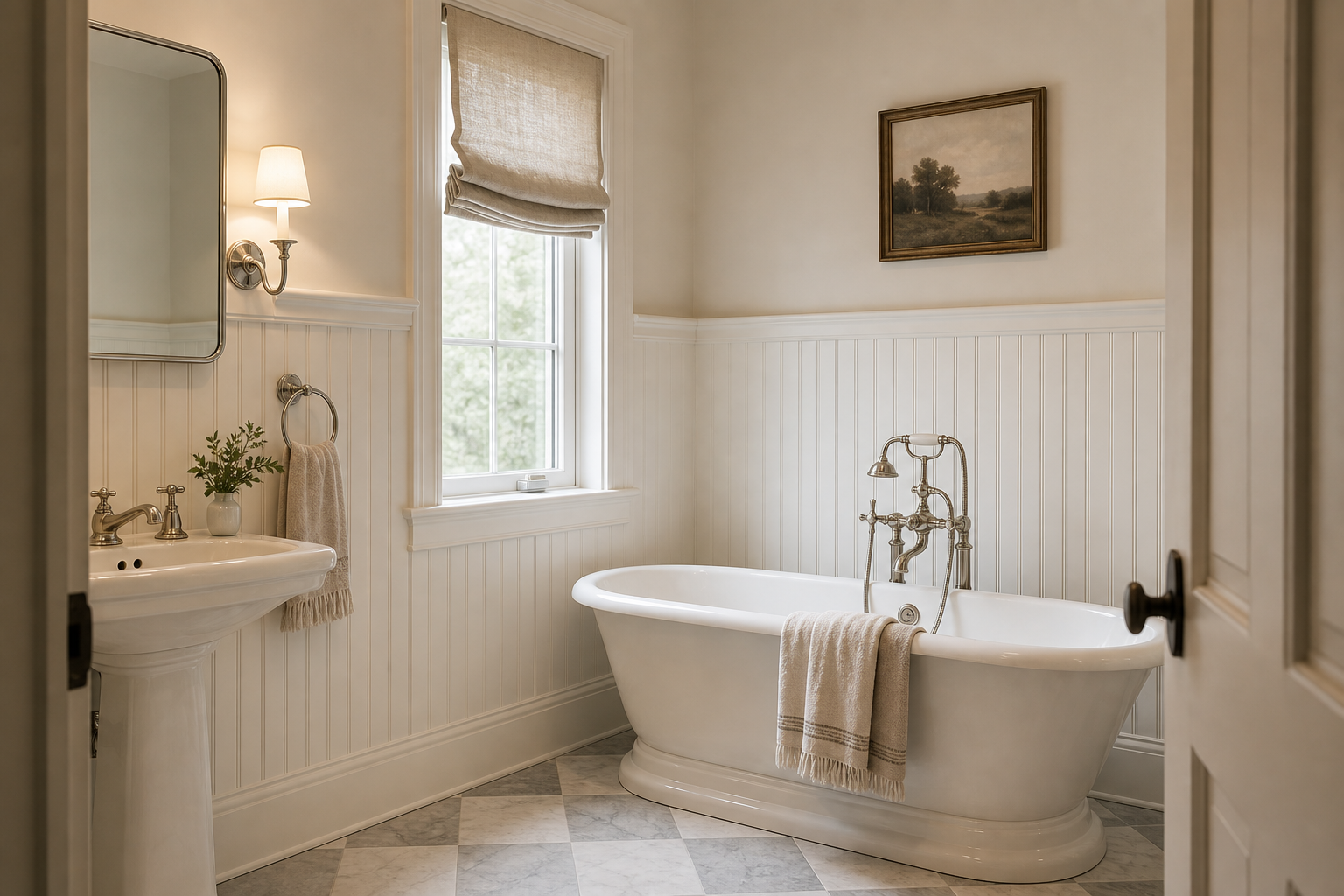

A continuous band of white vertical paneling does the organizational work in this compact bathroom. It passes behind the freestanding tub, beneath the window, and around the pedestal sink, binding fixtures of different shapes to one measured lower datum. Warm pale walls above prevent the room from splitting into harsh halves. A Roman shade, framed landscape, and small wall lights occupy the quieter upper field without interrupting the panel rhythm.
Half-Wall Paneling Establishes a Continuous Datum
The beadboard wraps the room at a consistent height, creating a clear lower wall zone. That repeated line is what makes the bathroom feel designed rather than assembled from separate fixtures. Because the paneling continues behind the sink, below the window and along the tub wall, the eye reads the space as one room instead of three unrelated moments.
The top rail runs at a consistent height through several corners, which is what makes the treatment architectural rather than decorative. Vertical grooves below create fine shadow, while the plain wall above gives those closely spaced lines enough visual rest.
The tub sits against the wainscoted wall, where the vertical grooves give the large white form a textured backdrop. Without that detail, the tub could feel too plain against a flat wall. The polished tub filler rises just above the rim, adding a traditional metal detail without overwhelming the soft wall treatment.
A Pedestal Sink Leaves the Wall Exposed
A pedestal sink is a smart choice here because it keeps the wall paneling visible. A bulky vanity would cover too much of the beadboard and reduce the room's architectural rhythm. The mirror, sconce and towel ring create a compact vertical composition above the sink while the wainscoting keeps the lower wall disciplined.
Open floor remains visible around the sink pedestal and below the bowl. This prevents the left side from becoming a solid cabinet block and lets the paneling continue as a readable surface behind the washing area.
The Window Trim Interrupts the Line Cleanly
The pale Roman shade softens the tall window without hiding the trim. Its relaxed fabric texture sits comfortably beside the painted beadboard and pale wall color. That combination matters in a traditional bathroom because hard surfaces dominate. A single fabric element near the window keeps the space from feeling too polished.
The panel top meets the window surround below the sill rather than cutting arbitrarily across the trim. That alignment gives the opening a clear boundary and lets the pale Roman shade soften daylight without hiding the original rectangular proportion.
Pale Floor Tiles Provide a Quiet Base
The pale tiled floor gives the bathroom a quiet base. Its checker-like variation adds movement, but the color stays close enough to the walls that it does not compete with the wainscoting. This is the right kind of contrast for a small traditional bathroom: enough pattern to ground the fixtures, not so much that the wall paneling loses importance.
Artwork Uses the Unpaneled Upper Field
The framed landscape sits on the plain upper wall, which keeps it separate from the textured lower beadboard. That spacing gives the artwork room to breathe. Its muted tones also echo the linen shade and pale floor, so the piece feels connected to the room rather than randomly hung.
Small Fittings Preserve the Room's Openness
Begin with the panel height. In a bathroom like this, the wainscoting should be high enough to protect and define the lower wall, but not so high that it crowds the mirror, window or art. Then keep the main fixtures visually light. A freestanding tub and pedestal sink allow the beadboard to remain visible, which is the point of the design.
Setting Wainscoting Height Around Existing Fixtures
I would not replace the pedestal sink with a large cabinet in this exact composition. The open base is part of why the paneling reads so clearly. I would also avoid high-contrast wall color above the beadboard. The warm cream upper wall lets the paneling provide texture without splitting the room in half.
The tiled wall in this Scandinavian bathroom surface study uses joints to order a wet zone. Here, painted grooves and a continuous rail provide the rhythm across the whole room instead.
The tub filler, towel ring, and wall lights are distributed around separate tasks and remain small relative to the paneled field. Their warm-metal accents create punctuation but never form a competing band. This restraint lets a modest bathroom gain character from wall proportion instead of from an accumulation of decorative fixtures.