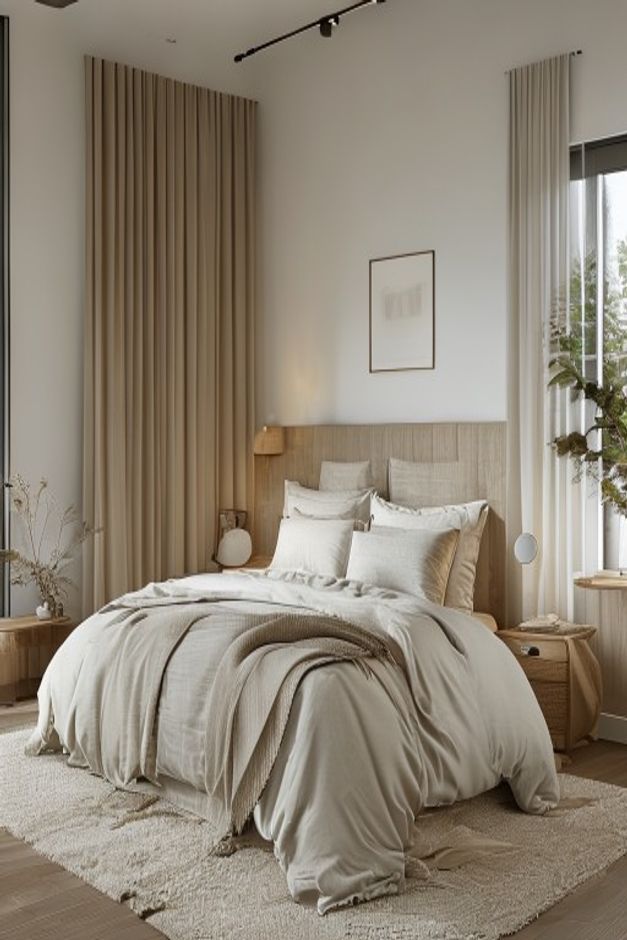

The room earns its calm through two large textile gestures rather than decorative abundance. A low, centered bed carries several pale layers with relaxed folds, while tall curtains descend at both sides of the composition. Together they soften the hard boundaries of wall, window, and floor without concealing the bedroom's simple geometry.
What makes the photograph useful is its control of scale. The bedding is generous but contained within the bed frame; the curtains rise far above it; and every bedside object remains deliberately small. That sequence lets softness feel architectural. Nothing needs to be perfectly smooth, yet the central axis and open foreground keep the informality from becoming disorder.
The Bed Holds the Center Without Looking Formal
The headboard and mattress sit on the room's middle line, with comparable breathing space visible at each side. Centering gives the layered textiles a stable base: their irregular edges can shift without making the whole scene feel off balance. A tiny artwork above reinforces the axis but does not widen it into a heavy feature wall.
Several pillows overlap at different depths, and the upper cover breaks into loose horizontal folds. The arrangement avoids a rigid hotel finish. Its discipline comes from the limited pale palette and the fact that the folds remain inside the bed's outline, not from aligning every edge or building an unnecessarily tall pillow stack.
Tall Curtains Turn the Window Edges into Soft Walls
The left curtain occupies a broad vertical band and pools only slightly near the floor; a second panel appears at the right. Their exact fiber cannot be confirmed, but the visible weight is substantial enough to frame the bed rather than flutter around it. Long uninterrupted drops also make the ceiling feel higher beside the low furniture.
Daylight filters from the right-hand opening and grazes the bedding instead of producing a flat frontal wash. The curtain moderates that contrast, leaving the headboard and wall readable. In a similar room, preserving fabric fullness at the sides matters more than adding another window treatment across the bright center.
A Low Bed Makes the Textile Layers Feel Generous
The bed frame stays close to the floor, so thick bedding does not become top-heavy. A pale rug extends beneath it and creates a quiet landing zone, while exposed wood-toned flooring remains visible around the perimeter. This stepped arrangement moves from solid floor to textured rug to soft covers without an abrupt change in visual weight.
The foot of the bed remains clear. That empty foreground is not wasted space; it lets the eye read the long edge of the cover and provides an unobstructed approach from the camera position. Adding a bench here would introduce another horizontal object where the bed already supplies enough mass.
Small Bedside Pieces Protect the Negative Space
Compact nightstands sit close to the mattress and carry only a few visible objects. Their narrow profiles preserve the pale wall on either side of the headboard. Larger chests would close those gaps, reduce the curtains' impact, and turn the balanced central composition into a continuous furniture wall.
Localized bedside lights remain modest in size, while a dark ceiling track crosses the upper plane. The track provides a fine graphic counterpoint to the soft textiles without becoming a chandelier-like centerpiece. Because fixture type and bulb temperature are not fully legible, the defensible observation is the layered height of the illumination, not a technical lighting specification.
Restraint Allows Imperfection to Read as Intentional
The palette moves through warm white, muted beige, light wood tones, and small dark accents. Those close values reveal seams, creases, and texture through shadow rather than through loud color contrast. The room therefore feels aged-in and tactile while still maintaining a clear order from curtains to bed to rug.
The practical lesson is to choose the two largest textile areas first and let them establish the atmosphere. Keep furniture outlines simple, leave visible wall between major pieces, and resist filling the foot of the bed merely because space is available. Wabi-sabi character is strongest here where use can leave a trace without disrupting proportion.
The small artwork is deliberately narrower than the pillow group below it, so it does not compete with the curtains for vertical emphasis. Its dark frame simply gives the pale central wall one precise mark and stops the bed axis from feeling visually unfinished.