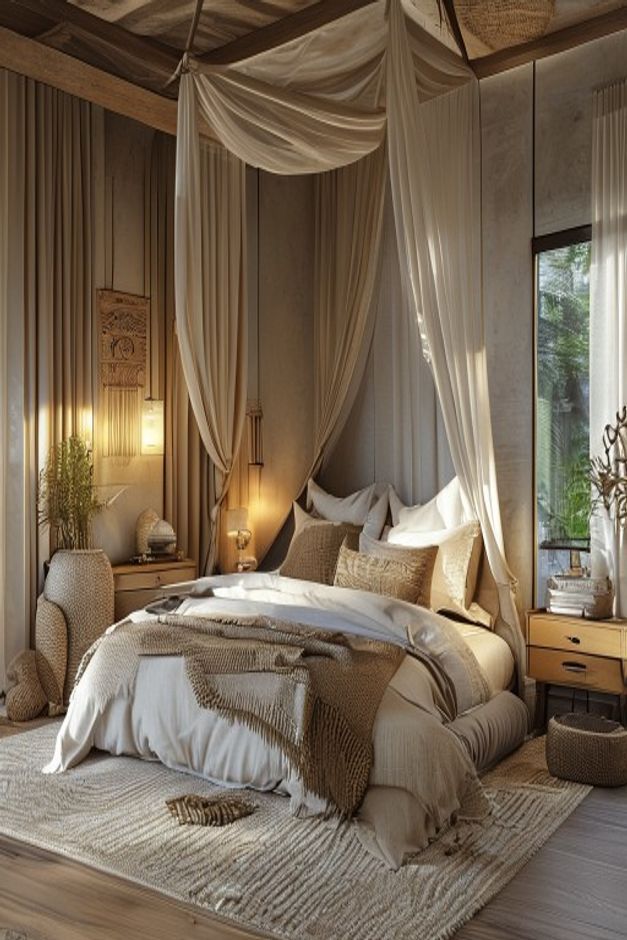
The defining move is overhead: lengths of pale fabric descend from exposed ceiling beams and gather around the bed, creating a canopy without a visible four-poster frame. That soft enclosure changes the perceived scale of the room. The bed feels intimate even though the ceiling is high and the glazing at the right extends nearly from floor to ceiling.
Bohemian interiors can become visually noisy when every textile carries a competing pattern. This room takes the opposite route. Drapery, bedding, pillows, rug, and woven accessories stay within ivory, sand, and brown, allowing their folds, fringes, and weaves to provide complexity. The result is abundant rather than cluttered because color remains tightly edited.
The Canopy Creates a Room Within the Bedroom
Fabric is suspended from several points along the timber ceiling structure, forming a loose crown above the mattress before falling in long vertical panels. The drape is intentionally uneven; one side gathers more deeply while another hangs almost straight. That irregularity gives the installation movement and prevents it from resembling a rigid hotel bed treatment.
The lowest folds stop outside the sleeping area instead of resting across pillows or blocking the bedside surfaces. This keeps the canopy visually immersive while preserving daily access. Anyone adapting the idea should resolve fabric clearance around lamps and walking routes first, because the photograph's romance depends on the practical edges remaining controlled.
The fabric's translucency changes across each fold: sections held against the light appear brighter, while gathered areas become dense and shadowed. This variation helps the canopy maintain depth even though it shares the bedding's pale color. The installation therefore depends on drape and illumination more than on pattern or contrast trim.
A Wide Bed Grounds the Vertical Drapery
The substantial upholstered bed provides a necessary horizontal counterweight to the tall fabric drops. Its rounded, softly padded base reads as one broad volume beneath layered white bedding. Without that visual mass, the canopy would appear disconnected from the furniture and the room would feel top-heavy.
Pillows step gradually from large white backs to smaller textured fronts, building depth toward the center. A brown throw crosses the lower bed in a loose diagonal, so the composition avoids excessive symmetry. The generous layers are contained by the limited palette and by leaving a clear strip of mattress edge visible at both sides.
Warm Wall Panels Give the Fabric a Darker Backdrop
Vertical wood-toned panels line the left wall and continue behind the hanging textiles. Their darker value sharpens the silhouette of the pale canopy and introduces a stable architectural rhythm. A narrow carved hanging and a few plants add detail, yet they remain subordinate to the repeated vertical joints.
At the right, the wall becomes lighter and meets tall glazing. This shift keeps the enclosure from becoming cave-like. The combination of a warm solid wall and a bright transparent edge is more effective than surrounding the canopy with equally heavy finishes on every side.
Low Light Keeps the Upper Volume Quiet
Small wall lights and bedside lamps create amber pools below eye level, while a woven pendant is visible near the upper right. Most of the brightness remains close to the bed, leaving the ceiling beams and canopy crown in gentle shadow. That distribution supports rest and makes the fabric folds appear deeper without requiring dramatic color.
Layered bedside illumination is also what makes the textile detail legible after sunset. A related quiet luxury bedroom in linen and wood uses fewer folds, but both rooms show how warm light can join pale cloth to a timber backdrop without flattening either material.
Woven Pieces Are Concentrated Around the Perimeter
The rug, round basket, upholstered chair, planters, and fringed throw occupy the room's lower and outer edges. Their rougher textures frame the smoother white bedding rather than covering it. This zoning gives the eye a calm central landing on the bed while still delivering the tactile variety expected from a bohemian scheme.
The room would lose clarity if more baskets, patterned cushions, or wall hangings were added simply to reinforce the style label. Its strongest lesson is selective abundance: one dramatic canopy, one deeply layered bed, and a supporting ring of natural-looking textures. The empty portions of the pale rug and curtain are as important as the decorative objects because they let the folds breathe.